I must create a system, or be enslaved by another man's. I will not reason and compare: my business is to create.

- William Blake

Wednesday, July 27, 2022

Minimalist B/X II - % skills [and nostalgia, and a rant]

In part I, I tried Target 20. Today I'm thinking of thief skills.

This is a bit of a rant. Normally I'm positive about old school D&D, but today I want to address a part I don't like.

I love old school D&D. Moldvay's Basic is one the best RPGs ever, at least in a similar page count.  

Still, I find it hard to accept that we should use the original typos 40 games after the game was published.


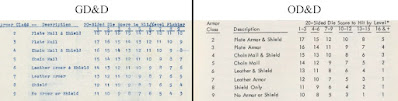
Maybe it is OCD talking... or maybe Cook/Marsh wrote "36" to mess with our heads. Similarly to the Cleric.

Nostalgia is fine. But some of us like old school games because they are great games, despite the year they were published. Or at least that is what we say.

Sometimes, I feel using old school D&D as written is almost as full of meaningless crunch as modern D&D. And I am not even talking about AD&D initiative or the weapon versus armor table (which I've seem people suggest we should keep as written despite its arithmetical errors to be "true to the original") - I'm talking about being obsessed with 1% (or even 10%) minutiae that does nothing to make the game better. Or using tables full of numbers that were adopted to fit a limited space in print.


Things that we do not because they make sense, but only because "this is how it was originally". It is not even preserving Chesterton's fence, it is refusing to even wonder if the fence needs repairs in order to serve its original purpose.

Sometimes I think that elegant games are so rare because the page count would suffer, making the books cheaper and the (depressively small) margins even smaller.

Of course, there are other ways to put more pages in a book without adding content. Maybe play with layout a bit, use big fonts and a creative design that allows you to fill pages with twenty words each, or create a slightly different table for a slightly different class. Well, I'm not great at that, and I while I love some good layout and beautiful art, content is even more important to me - so if I will not use 50 pages for something I can write in 20.

Anyway, rant over. 

Target 20 is great for thief skills, especially if you add Dex. 

With that said, there is nothing wrong with liking percentage skills, even if they are divided in 5% increases that could be replaced by a d20 roll. 

Here is an alternative to existing thief tables:

Thieves start with 30% chance in all their skills (except climbing and pick pockets). They are competent form the beginning. Add 5% per level, to a maximum of 99%. 

Climbing: start at 85% chance, +1% per thief level.

Hear noise: maximum 85% chance, if you want to keep things similar to the original, although I see no reason to do this.

For picking pockets, start at 50%, with no cap (maximum 120%), but subtract 5% per victim level (e.g., a level 2 victim causes a -10% penalty).

Saturday, July 23, 2022

OSR feats

My latest post was about OSR and customization. As I've said, Dark Fantasy Basic (currently on sale) tries to bridge that gap, giving more options to players but not as many as, say, third edition. 

DFB is a small game compared to the "big players" in the OSR scene - say, BFRPG, OSRIC, OSE, and so on. However, I think it has some elements that would interest people that play other OSR games. 

Alternate Magic was my first attempt of adapting ideas from DFB (flexible spells, random casting, blood magic, etc.) to other OSR games. I enjoyed writing it and got some great feedback. Now I'm considering doing the same for other parts of DFB, in a similar fashion. 


Here is an example of what I'm talking about:

Fighter feats

1.       Animal companion. You have an animal ally that follows you around, and will help you and fight for you (the player controls it) as long as you treat it well. It must be an ordinary animal (a wolf, horse, hound, hawk, etc.), although it is an extraordinary example of the species, and its HD is equal to your level divided by 2 (round down). If it dies, you can get a new one after spending 2d6 days in the wilderness.

2.       Armor master. When you wear armor, it is considered as being one step lighter (plate/chain/leather) for all purposes except AC, and you can move in light (leather) armor as if you were unarmored.

3.       Berserker. Whenever you wish, you can enter a state of rage for one turn, during which you get +3 to your damage and saves, and all damage against you is halved. After this, you take 1 HP of damage per level (save against paralysis/petrification for half damage).

4.       Favored enemy. Choose a type of nonhuman enemy – undead, demons, animals, giants, dragons, etc. You get a +3 bonus to your attacks, damage and saves against this type.

5.       Finesse. When you use light melee weapons (short sword plus anything lighter) or attack unarmed you can use your Dexterity bonus instead of Strength for your attack rolls. Damage rolls are still affected by Strength only.

6.       Fortitude. You get +2 bonus to saves against paralysis, petrification, and poison, but not death.

7.       Shield expert. While using a shield, you get an extra +1 AC, and also +2 to all saving throws if a shield could conceivably protect you (usually breath, wands and spells). You can extend these benefits to one ally within 5 feet of you.

8.       Unarmored defense. You get a +3 AC bonus when unarmored, +2 when wearing leather armor, and +1 when wearing chain.

9.       Wilderness explorer. While you are in the wilderness, you can hear noises and find/remove traps as a thief of the same level as you, and find tracks and hidden things with the same chances as find/remove traps. In addition, when foraging, hunting, or rolling to avoid losing direction, you have an additional 1-in-6 chance of success (e.g., 2-in-6 to forage).

10.   Wilderness skills. While you are in the wilderness, you can climb, hide and move silently as a thief of the same level as you.

11.   Warlord. Your followers gain +1 morale as long as they can see you. You can shout orders to attack (+1 to attack throws) or defend (+1 to AC and saving throws), affecting allies and followers within 60 feet that can hear you.

12.   Weapon master. You get +1 to attack, damage, and AC. Choose a type of weapon or a fighting style (blades, two-handed weapons, light weapons, missile weapons, dual wielding, sword and shield, grappling, etc.). When using this style, you get +2 to attack, damage, or AC (choose one when you pick this feat), instead of the usual +1.

I'm planning a 30ish page book, like Alt Magic, with about 60 feats, and small sections on how to replace races for feats, how to choose feats randomly, how many feats to give each class, how to give away feats in exchange for quest or XP, and so on.

I like to keep things simple... so probably no feat on level 1 and maybe about half a dozen feats for each PC at most. Since my last book was all about magic, this one will have more feats for fighters and thieves... they deserve the boost!

Does this sounds interesting?

---
UPDATEOld School Feats is now available! Check it out!

Monday, July 18, 2022

Worldbuilding, character builds, and old school D&D / OSR

Old school D&D is not great at "character builds". Meaning, you do not get many changes of customization unless you're a spellcaster (oh, well, maybe); other than that, maybe you have a magic item or two. The B/X fighter, for example, is remarkably simple: he gets a few bonuses (on HP, attacks and saves) but NO new features from level 1 to 9 (an no new feature after 9). OD&D and AD&D fighters are similar, but the Rules Cyclopedia and some other supplements at least gives them weapon proficiencies, etc.

Conversely, 5e D&D has LOTS of customization. Even the fighter has about half a dozen choices on level 1, leading to 10-20 variations; other classes may have more. A level 9 fighter can have at least 20 viable "builds", probably a hundred with all the supplements.

Another interesting thing is the level 9 change: from then own, your HP doesn't change much, nor do your individual capabilities (except for spellcasters), but your impact on the world is considerably augmented by your followers.

It is a matter of taste, mostly. For me, personally, 5e has too much customization, but B/X doesn't have enough (although I'd appreciate even less detail in some aspects), so I'm always playing with some hybrid version.

But there are some details that are present in old school D&D and not 5e. For example, level titles (e.g., calling a 5th level fighter a "Swashbuckler", and a "Lord" at level 9; a halfling will eventually be a "Sheriff", etc.). Also, class and level limits for nonhuman PCs (elves, dwarves, etc.). Most importantly, it shows you when and how PCs can become lords of their own armies and masters of their own castles, towers, villages, etc.


I think this shows a difference of focus between old school and contemporary D&D. 

The first is great for worldbuilding, because:

- Characters are easy to create. It's not hard to make a cast of hundreds, even including higher levels, and using the same rules as the PCs.
- Characters have a distinct place in the setting and the social order. The opposite is also true: if you have a village with a Halfling "sheriff", you can guess his stats.
- Nonhuman armies are easily comparable.

The second is great for character building, because:

- Characters are unique and detailed, you can create you "protagonist" any way you want.
- Characters can take the social role they desire, raising an army from level 1 if they can manage, or become a 15th-level lone wolf, etc. (you can do the same in OS D&D, but it encourages you to follow a certain path).

This is not only in characters, by the way. Monster statblocks follow the same logic. Likewise, alignment - once a tool to indicate you faction - is now almost entirely a matter of personal traits. Everything makes worldbuilding easier, while contemporary D&D prefers to focus on individuals.

I wrote about a similar topic a long while ago ("your character isn't special"). 

Notice that even HP reflects this: some old school games rule that PCs are dead at zero HP, and being knocked unconscious is barely in the rules. For beginning PCs, even wounds are uncommon: you die with one or two wounds. Likewise, critical hits etc., do not need to exist; they are fun in an individual fight, but they are unimportant in the grand scheme of mass battles, etc.

As I've said... Matter of taste, and I prefer an hybrid approach. However, after years of playing different versions of D&D, I find I'm more interested in worldbuilding (and, by extension, creating locations, monsters, adventures, etc.) than character builds, so my interest in modern D&D is dwindling. 

An hybrid approach can even enhance worldbuilding, as adding a few unique features to some characters and NPCs makes the setting cooler (and tweaking limitations allow unique settings, e.g., "all spellcasters are dwarves").

And, in short, the OSR is the place where I find this hybrid approach the most. Come to think of it, Dark Fantasy Basic reflects this kind of compromise, which is why I have a hard time replacing it for more strict retroclones. In addition, my players love customizing their characters a bit - but 5e becomes too cumbersome and thy often forget their own special powers before level 10 - so this method seems to be the best for my group.

If I make my next book (whichever it is) perfectly compatible to B/X, I'm very tempted to just create new PC classes that are a bit more complex than existing ones - requiring more XP, of course. So, the world would be full of "fighters", but PCs could pick a customizable "warrior" of sorts, and so on. This way, you could keep things simple for world-building (especially NPCs) while still giving some character builds to your players.

These are all Affiliate links - by using them, you're helping to support this blog!

UPDATE: this post  inspired me to write Old School Feats! Check it out!

Monday, July 11, 2022

Minimalist B/X (no tables!)

B/X is one of my favorite version of D&D. One thing I dislike are the tables. I prefer Delta's Target 20 mechanic - simpler, smoother and very accurate:
Every roll is d20 + level + modifiers, with a result of 20 or more indicating success.
Dark Fantasy Basic does something similar, with 1/2, 2/3 and 3/3 skills, including combat and spellcasting (Delta's blog was a big inspiration).

But if you want another minimalist version... here you go.

Every roll is still "target 20". Fighters, thieves, clerics and magic-users all get the SAME attack rolls. A 10th level MU attacks like a 10th level fighter (which doesn't really matter because he has 10d6 fireballs and can't use a sword, but...).

HOWEVER.

Fighters attack with 2d20, picking the best die (this is just to give B/X fighters a boost. They deserve it).
Thieves do the same for skills (if you want them to be better at climbing, they roll 2d20 and add the results), and also when backstabbing. This means other classes can attempt the same skills but fail about twice as often.
Dwarves and Halflings use the best of 2d20 when making a saving throw.
Elves get the same benefits as magic-users (see below).

There are no more spell slots. MUs can learn one spell per level (spell level no higher than half their level, round up), in addition to read magic. When they cast it, they try to "target 20", subtracting twice the spell level. If they fail, they spell is forgotten for the day. (I recently rembered this idea from JV WestDFB uses forgetfulness as one possible spell mishap).

Clerics start learning spells on level 2 and can learn a maximum of 12 spells. Turning undead uses Target 20 (subtracting target's HD) to destroy undead, but rolling 10 or more is enough to turn them. The cleric uses 2d20 and pick best if his level is higher than the target, pick worst if his level is lower (the distinction is not strictly necessary, it just keeps the numbers closer).

Every roll adds an ability modifier (from -3 to +3). Intelligence for spells, Dexterity for most skills, maybe Charisma to Turn Undead and the other five stats for saving throws (as suggested in the Rules Cyclopedia).

(Playing around with all these d20s is fun, of course... maybe a natural 1 causes a chance of magical mishap, or if the fighter would hit with both dice is a special maneuver or crit, etc.... but that is taking the idea further than the "minimal").

So, if you make a careful comparison of this idea with the actual B/X numbers using a excel spreadsheet, you will notice that the standard deviation is, approximately, "eh, close enough".

Just kidding. But I do think the result would be close enough, and probably I'd prefer that over using tables to find out skill percentages and saving throws. Well, we'd still need XP tables to keep the balance - but the character sheet would be a bit shorter, looking more or less like this (with fewer spells):


Well, this is admittedly a half-baked idea, but I like how it looks.

Is it superior to Delta's formula or DFB? Not really, just a different take - which includes turning undead and spellcasting in the formula, and also gives a bit more importance to ability scores, encouraging smart wizards, dexterous rogues, etc. It also has other collateral effects I enjoy - making early fighters stronger, spellcasting simpler and more random, and so on.

It also functions as an universal mechanic: a 12th level fighter might easily know, for example, something about the biology of a troll... even with low Int, she has more experience than a low-level MU... Just roll 1d20+12+Int, try to get 20, and you're done. 

Use 2d20, picking highest or lowest, if the task is particularly easy or hard.

Anyway, let me know what you think!

These are all Affiliate links - by using them, you're helping to support this blog!

Sunday, July 10, 2022

The Disoriented Ranger talks: D&D and the OSR

The second book in the series is out; here is my post about the first.

I've read this one cover to cover, as the subject interests me greatly. One of the main focuses is the Rules Cyclopedia (which might be my "one D&D book to take to a desert island"). If you enjoy the RC like me, you'll likely appreciate this one.

I never used the RC "RAW"; only as a source with inspiration with AD&D, B/X, etc., so I barely noticed the distinct ABSENCE of dungeon generating procedures in there. Jens talks about this and many other "oddities" in the RC - druids, race-as-class, damage to magic items, etc.

I also appreciated the section on "Changing rules without loosing compatibility to the source" (in the "R.A.W. vs. House Ruled" chapter). I think this deserves exploration and probably a post to explain my own opinion, but for now I'd just say I agree with Jens on this sentiment.

Again, only one dollar - click here to get it.


Here is the blurb:

What's this about?

Nothing is older than yesterday's blog ... or so they say. After 10 years of exploring "all things D&D and role-playing" on The Disoriented Ranger blog, most of it during the Golden Age of the so-called OSR (and some of it in the Silver Age, I presume), it is time to look back and see what I deem worthy of conserving.

I talked several subjects over the years, many of them about game design and gaming advice, but some of it was my continuing exploration of the D&D Rules Cyclopedia and, in that context, early D&D. What did those gamers back then actually conceive? What does it mean? How did it change? And: how good had those first attempts at "role-playing games" been?

I shared my takes about these and they make a good first anthology. So here they are: 18 posts on roughly 110 pages with thoughts and musings about The Rules Cyclopedia, as people would back then in the scene that would be the OSR for some time. All edited and prettied up for this pdf.

Also check out Part 1 about Gaming Culture here!

What's to come?

There are five more anthologies to follow in the next couple of months, so look out for:

  • Part 3: Musings about DMing
  • Part 4: Storytelling Advice
  • Part 5: DIY & Gamedesign
  • Part 6: Theories in Action

Parts 1 to 3 as well as Parts 4 to 6 will also be compiled for a PoD option!

This is not a trip down memory lane, the topics presented here are still as important as they had been when I addressed them. My sincere hope is that sharing them here will encourage and inspire new readers (or fans of the blog, but with fresh eyes) to see the wealth of potential our hobby has, as well as its pitfalls.

Other than that: I can just provide the map, and even I get lost ...

Cheers,

The Disoriented Ranger

----------

What qualifies me, you ask?

Just so you know: "You don't need to justify your love, you don't need to explain your love, you just need to practice your love. Practice creates the master." (Don Miguel Ruiz)


These are all Affiliate links - by using them, you're helping to support this blog!

Friday, June 24, 2022

Finding spells is better than choosing them

D&D is probably my favorite RPG nowadays - mostly in the OSR versions, but even 5e sometimes. But one of the things I dislike the most about it is picking spells: there is a HUGE number to choose from, and depending on the system you get to choose EVERY DAY which spells you'll prepare.

I have my own "fixes" to that - which I included in Alternate Magic.

But there is a "fix" I haven't tried much - is just forcing spellcasters to FIND their spells, in scrolls, grimoires, etc.

And it makes sense. Not only because it saves time, but because fighters must find their own magic, too - magic weapons, magic armor, and so on. Both modern and old school versions of D&D assume fighters will get those weapons, but not be able to CHOOSE a Flame Tongue or Vorpal Sword at level 10, for example.

Maybe you can BUY spells if other magic items are available for sale (although a functioning magical economy would encourage all casters to buy the "best" spells unless they are more expensive). Maybe you can ask a specific spell from your deity. Ideally, you'd go on a quest. I prefer to be agnostic about this. Maybe you can even choose a small number of spells. The important part is - do not assume you'll be able to choose new spell as you gain new levels.


This doesn't only make character creation and improvement infinitely faster and easier, but avoids any worry about "balancing" spells, and keeps magic mysterious and unpredictable. It will make wizards crave rare grimoires like fighters crave magic swords. Spellcasters are now shaped by their quests and experiences instead of an "optimal builds".

We probably should consider a roll for learning a spell (see AD&D 1e); some people are unable to learn some spells. I've seem it time and time again when playing D&D: the party defeats a wizard, and wants to learn his spells. It's great!

No two spellcasters are identical. Of course, casters will choose the best spells AVAILIABLE, but what is available will change from campaign to campaign.

(BTW, after you learn a spell, it should be HARD to forget it. Spells are living thingsDark Fantasy Basic has a system that will make spells invade your mind if you use scrolls too often).

Now you only need a spell list of generator. I like this one from Cairn if you want something free-form. There are generators for 5e. And if you're playing OSE, just roll a 1d6 to find spell level and 1d12 to choose a spell. Alternate Magic has 12 cleric spells and 12 magic-user spells, all of them very flexible; just roll 1d12 and flip a coin. And so on.

Sunday, June 19, 2022

D&D 5e fighting styles comparison: Tasha's Cauldron

This is a follow-up for my original post analyzing fighting styles from the PHB. I don't find much stuff in Tasha's Cauldron to interest me, but I like analyzing fighting styles, so here we go.

There is not much to say about these styles. They are mostly straightforward or open too many possibilities to analyze properly (for example, Blessed Warrior is good if you pick the right cantrips, but there are a lot of cantrips to choose from).

Some of them are "half feats" of some sort. For example, Blessed Warrior and Druidic Warrior are just weaker versions of Magic Initiate, and Superior Technique is a weaker Martial Adept. They allow you to change cantrips and techniques from time to time, which is nice.

This would be a good idea, IMO, if only to give more flexibility to "warrior" types - except that Tasha also introduces the Fighting Initiate feat, which only gives you one fighting style! This is baffling. And it is probably a horrible feat in most circumstances - except maybe for some Archery or Barbarian "build"

Oh well. Let's see what the new fighting styles are about.

Copyright WoTC.

Blessed Warrior (Paladin Only). Gives you a couple of cleric cantrips. This is a great choice if you have no cleric in your party, so you can get Guidance and Spare the Dying. Alternatively, you can get some ranged attack options (e.g. Toll the Dead from Xanathar's Guide to Everything).

A decent fighting style; I don't see why this must be limited to paladins, as I can easily imagine fighters, etc., being "blessed" without needing leveled spells - and having Guidance and Spare the Dying would be great for a "leader" archetype.

Blind Fighting. You have blindsight (10 feet), even when blinded etc., and can see invisible creatures unless they are hidden. Very flavorful, but very situational. Overall, I wouldn't recommended it.

Druidic Warrior (Ranger Only). Gives you a couple of druid cantrips. Exactly the same deal... Guidance still a good choice, maybe you can get Shillelagh or Magic Stone to get a magic weapon or ranged spell attack early on. But the Archery style is hard to beat.

Again, I can see a "green knight" or Paladin (Ancients) as a druidic warrior, so not sure why this would be restricted to rangers.

Interception. When a creature you can see hits a target that is within 5 feet of you with an attack, you can use your reaction to reduce the damage the target takes by 1d10 + your proficiency bonus (to a minimum of 0 damage). You must be wielding a shield or a simple or martial weapon to use this reaction.

This is comparable to the Protection fighting style. As I've said, "very flavorful, but has some heavy downsides".... "it uses your reaction - and at higher levels, monster damage is usually divided among several attacks, and this will only work against one. You also have to be within 5 feet of your ally - which limits its utility."

But this one has some nice scaling with proficiency, doesn't require a shield and you can (arguably) defend yourself with it.

Overall, not great, a bit better than protection IMO, but depends on who you're fighting. Disadvantage will usually cut your chances by half, so against strong enemies protection is better.

Superior Technique. You get a Battlemaster maneuver and a d6 superiority die. Well, this is good. Battlemaster maneuvers are nice and you can surely find something useful. A solid choice, even for Battlemasters - since their superiority die will arguably scale with level. Not that Battlemasters need the boost when compared to, say, champions or barbarians, but that's neither here nor there.

Thrown Weapon: Allows you to draw and throw a weapon as an attack, and thrown weapons deal +2 damage. This is a powerful style that makes "thrown weapons" builds viable. Get a few daggers or javelins and now you're deadly at a distance without needing Dex... Nice!

This is definitely a "cinematic" option - in real life, I'm willing to bet that a dagger held in hand is ten times more deadly than thrown dagger - but it fits the genre. You still need a decent number of weapons to avoid running out of ammo!

Notice that you can attack with a shortsword with one hand and throw a dagger with the other, for example, making it a viable way of "two weapon fighting".

Unarmed Fighting. Your unarmed strikes deal 1d6 + Str damage, or 1d8 if you don't have a shield  or weapon. And at start of your turn, you can deal 1d4 damage to a creature grappled by you. This is a great option, making unarmed attacks become a viable tactic, at least until magic weapons come into play. 

Notice that the 1d4 damage does not require a bonus action, making it useful even for monks, and folks that have the Tavern Brawler feat.

--- 
Overall...

Some solid options in there. Not is stronger than say, Archery, but they are all pretty strong except for Blind Fighting. The feat is a bad idea, but other than that these are some good fighting styles. Thrown Weapon and Unarmed Fighting are good for specific builds.

And it is nice that warriors get some love, since we already have approximately a bazillion spells.

I have considered writing a new Manual of Arms with new fighting styles - so far, I have about 20, which is not enough for a book. Maybe if I add a few stances and feats... 

Well, let me know if you like the idea.

---
Support this blog!


To support this blog, buy my books on DTRPG! Try my 5e Manual of Arms: Weapons, 5e Manual of Arms: Armor & Shields,or any of my books. Some titles are free!

Alternatively, click here or on the DriveThruRPG banner on the right. Any shopping you do through this link - even from other authors - helps us, without costing you a penny more!

In addition, there are many other ways to support this blog! Share and recommend it, leave comments, etc. 

Thank you all for your audience and support!