I must create a system, or be enslaved by another man's. I will not reason and compare: my business is to create.

- William Blake

Showing posts with label Alignment. Show all posts

Saturday, October 10, 2026

100 days of B/X (part III - B11 to B14) - alignment, costs, language

Continued from here.

B11 - Alignment.

Too much time has been spent on the subject. Here, the "cosmic forces" are not even mentioned, and alignment is just a measure of how trustworthy and altruistic you are. Law is explicitly similar to Good and Chaos explicitly similar to Evil. It doesn't work much better or worse than other versions of D&D. 

Because of that, alignment languages do not make sense here.

In addition, alignment is kept secret for Chaotics and Neutrals, but Neutrals have little reason to hide their alignment, and Alignment Language could be tested anyway...

B12 - Cost of Weapons and Equipment

The costs are very strange by medieval standards, but they make sense to make the game a bit more interesting and challenging, as PCs cannot carry much treasure at once.

One tip for remembering how much a coin is worth is The Parable of the Workers in the Vineyard (Matthew 20:1-16): one silver coin per day of work is a decent, standard wage for an ordinary laborer.

Armor is too cheap compared to other items, while garlic is ridiculously expensive, perhaps due to a typo. Plate armor costs about a dozen cloves of garlic, which I discussed before. These outliers have been fixed and simplified.

B13 - Language

This is purely setting-specific IMO. I don't think B/X (and D&D in general) is great in this aspect. Maybe a percentage of all intelligent creatures should speak Common anyway, to allow for more roleplaying and social interaction. I don't think it is an issue that needs to be changed or explored much in a minimalist game, anyway.

Not much to add to the player character creation example. It seems as always that the PC rolled a bit well for his stats, but not by much. Most of this has been covered in the last post.

B14 is the character sheet.

I'll stop here because B15 describes spellcasting and probably deserves a post of its own.

Anyway, here is my version.

---

Equipment


Most items are simplified because items are not the focus of the game. Weapons, armor and shields received more attention to make combat more diverse and interesting. Ordinary clothes are assumed and not counted.


Currency

The usual currency in this game is coins of various metals. For simplicity’s sake, assume all coins have similar weight, and each metal is ten times more valuable than the next in the list. 

1 platinum piece (pp) = 10 gold pieces (gp) = 100 silver pieces (sp) = 1,000 copper pieces (cp).

A gold coin is enough for hot meal, a cold beer or a night in a collective room. Copper pieces are rarely worth carrying for adventurers, but are common currency in hamlets etc. A common laborer will earn rough 1 gp per day and eat cheaper food.

100 coins weight one “item” (i.e., roughly 3 pounds).


Quick equipment selection (optional)

Instead of picking equipment, it is easier to give starting characters a predetermined selection. Each is worth about 105 gp. Feel free to add 10 gp to each character for saving everyone’s time if you want.


Fighter (96 gp equipment + 9 gp spare, 19 weight)

Light armor, light shield, large weapon, medium weapon, backpack, bedroll, camping gear, healing kit, rations × 3, rope, torches.


Thief (100 gp equipment + 5 gp spare, 16 weight)

Light armor, daggers × 2, sling, sling bullets, lock picks, backpack, bedroll, rations × 3, rope, grappling hook, torches.


Cleric (101 gp equipment + 4 gp spare, 16 weight)

Light armor, light shield, medium weapon, holy symbol, backpack, bedroll, rations × 3, healing kit, torches.


Mage (83 gp equipment + 22 gp spare, 16 weight)

Staff, daggers × 2, sling, sling bullets, grimoire, backpack, bedroll, rations × 3, rope, healing kit, hooded lantern, oil × 3, steel mirror, blank book, torches.


Miscellaneous equipment


Food (one day): Fresh (1 gp, weight 1), must be eaten within a week. Rations (2 gp, weight 1/3) last for one month. A hot meal or cold beer in a tavern costs 1 gp.


Common tools (5 gp, weight 1): backpack (holds 10 weight), bedrolls (winter bedrolls: 10 gp, weight 2), blank books, block and tackle (requires rope), board game, camping gear (flint, small blade and hammer), chain (per feet), climbing gear (for wood surfaces or similar; stone climbing gear is 10 gp, weight 2), clothes (winter clothing: 10 gp, weight 2), cooking tools, crowbars, fishing tools, grappling hook, hammers, healing kits (10 uses), hooded oil lantern, hunting traps, merchant's scale, musical instruments (small, like drums, horns, trumpets; larger and more complex instruments cost 10 gp or more), rope (silk, per 20 feet), shackles, steel mirror, winter blankets.


Heavy tools (5 gp, weight 3): caltrops (enough for 10 square feet), shovel, pick, iron spikes (30), tent (1 person).


Cheap tools (1 sp, weight 3): 15 torches, 10' pole, 20 candles (weight 1).


Expensive tools (25 gp, weight 1): holy symbol, lock picks, grimoire, and luxury versions of common items (that might be 10% better or give you a +1 bonus to a test).


Liquids: water for one day (usually free, weight 1; weight 2 in very hot weather), pint of oil (1 gp, weight 1/3 — can be lit and thrown 20' for 1d6 fire damage), holy water (25 gp, weight 1/3 — can be thrown 20' for 1d8 damage against undead, demons, etc.).


Skills & tools

Skills will often require tools such as a healing kit, climbing gear, lock picks, etc. Improvised tools will often cause disadvantages. Some tasks will be impossible without tools or made with a -10 penalty (GM's call).


Melee Weapons


In the case of melee weapons, the damage, price, and weight are determined by size. 


Size Damage Price (gp) Weight

Small (S) 1d4 3 1/3

Medium (M) 1d6 5 1

Large (L) 1d8 10 2

Great (G) 1d10 20 2


Small weapons can be used in the offhand and thrown (10 feet). E.g., dagger, dart, sap.

Medium weapons are used in the main hand and can likewise be thrown (10 feet). E.g., short sword, hand axe, light mace.

Large can be used in one or both hands (+1 damage when used with both). E.g., longsword, dane axe, heavy mace.

Great weapons must use two hands to attack. Two-handed sword (zweihänder, claymore), great axe, lucerne hammer, maul, most polearms, etc.


Ranged Weapons


All ranged weapons require ammunition and two hands to operate.


Weapon Damage Price (gp) Weight Range

Sling 1d4 2 1/3 40'

Short bow 1d6 20 1 60'

Long bow 1d6 30 2 70'

Crossbow 1d8 40 2 80'

Crossbows are slow. You must spend one round (or attack, if you have several) reloading between shots.


Ammunition costs:

• Arrows or bolts. 20 for $5, weight 1.

• Sling bullets. 30 for $1, weight 1.


Armor and shields


Armor comes in three types: light (+2 AC, 40 gp, weight 5), medium (+4 AC, 160 gp, weight 10), and heavy (+6 AC, 360 gp, weight 15). Unarmored characters have AC 10. The Dexterity modifier is always added to AC.


Shields

Shields may be light (AC +1, 10 gp, weight 2) or heavy (AC +2, 24 gp, weight 4; AC +4 against missile weapons). If used offensively, they deal 1d2 damage. Reinforced shields, made mostly of iron or heavy wood, add 50% to weight and cost; they are somewhat tougher but grant no extra bonuses to AC.


Languages

Every character begins to play knowing how to speak Common plus one additional language. Non-human characters have their extra language determined by their ancestry, while human characters may freely choose their extra language from the available list. Characters with positive modifiers in Intelligence, Wisdom, or Charisma may select further languages as described in the Modifiers chapter.

In most settings, characters begin the game illiterate. A character may learn to read and write by trading one of their available language slots for literacy rather than an additional spoken language.

The languages available to characters depend on the setting. Some common languages are Common, Elvish, Dwarvish, Halfling, Goblin, Draconic, Celestial, and Infernal. Common is the most widely spoken tongue across all peoples. Celestial and Infernal are the languages of angels and devils respectively, Draconic is used by dragons and sorcerers, and Goblin is used by goblins, hobgoblins, orcs, and similar peoples. Other languages may include Thieves' Cant (a secret, coded language used by criminals and rogues to communicate secretly in plain sight), trail signs and sign language. In some settings there might be dozens of languages (sometimes even in the same kingdom) and a few alphabets.


Trading Languages

After selecting Common and their first additional language, a character may trade every three further languages for one skill of their choice instead. Spellcasters may choose one extra spell in place of a skill. For example, a character with five extra languages from high ability scores could end up with Common, Elvish, Goblin, Literacy, and one skill.


Alignment Languages (Optional)

If the setting uses alignment languages, each character may select the language of their alignment (Lawful, Neutral, or Chaotic) for free, in addition to their other languages. The GM should confirm whether alignment languages are in use before character creation begins.


"Tragic Characters"

If you rolled your charters and the sum of all abilities is below 63, you can re-roll the smallest ability score once and take the best result. Repeat this until the result is 63 or greater. Alternatively, re-roll all abilities at once.


Skills & Checks


Skills

Certain characters gain skills through their ancestry, class, or talents. Skills allow characters to accomplish impressive feats that would be very difficult for the untrained.

A skill is calculated using the highest relevant ability score plus the character's level, minus 10. For example, a level 3 character trained in Alchemy with Intelligence 13 has a skill of 6 (i.e., 13 + 3 − 10). To test a skill, roll 1d20 and add your skill level; a result of 20 or more is a success. A natural 1 always forces a second roll; if that roll also fails, a mishap occurs at the GM's discretion.

Alchemy (Int/Wis). The character can identify potions, poisons, and similar substances. Mishap: the substance is misidentified or accidentally imbibed.

Athletics (Str/Dex). Covers climbing steep surfaces, jumping long distances, swimming in extreme currents, and other hard physical feats. Mishap: the character falls midway if climbing, falls prone and takes 1d6 damage if jumping, or risks drowning if swimming.

Awareness (Cha/Wis). The character's general alertness to their environment, such as noticing an ambush or suspicious behavior.

Decipher (Int/Wis). The character can attempt to decipher unfamiliar languages, codes, and scripts. Mishap: the text is misread.

Find (Int/Wis). The character can search for hidden doors, concealed objects, and things hidden in plain sight.

Healing (Int/Wis). The character can heal 1d4 HP per person immediately after combat, and 1 HP per person once per day just before sleep. Mishap: the patient loses 1 or 1d4 HP instead.

Hear (Wis). In a quiet environment, the character can listen at doors or detect approaching sounds.

Locks & Traps (Dex/Int). Covers picking locks and finding and removing traps. Picking locks requires thieves' tools and may only be attempted once per lock. Finding and removing a trap each require a separate roll and may only be attempted once per trap. Mishap: the lock and lockpick are broken, or the trap is triggered.

Lore (Int/Wis). Covers history, myths, legends, and arcane knowledge. Mishap: the character recalls confidently but incorrectly, and the GM provides false information.

Nature (Int/Wis). Covers tracking, hunting, foraging, and wilderness survival. Mishap: the character becomes lost, follows a false trail, blunders into a monster, or unknowingly gathers something poisonous.

Persuasion (Cha). Twice per encounter, the character may re-roll a reaction roll or morale check, taking the better result. Mishap: the attempt backfires; take the worse result instead.

Sleight of Hand (Dex). Covers picking pockets and similar feats of manual misdirection. Mishap: the attempt is noticed immediately and with certainty.

Stealth (Dex). Covers hiding in shadows and moving silently. Attacking or moving breaks concealment. Mishap: the character makes a conspicuous noise or is spotted in plain sight.


Unskilled Characters

The GM may decide that certain tasks are simply impossible for the untrained. Alternatively, an untrained character uses their raw ability score minus 10. A character with Intelligence 13 attempting an Alchemy roll would roll as if he had Alchemy 3 (i.e., 13 − 10). I prefer to err on the side of “there is always a chance”, noticing that unskilled attempts are often dangerous.


Ability Checks and Unskilled Tasks

If a task is easy and could be accomplished by an average person with some effort (e.g., breaking down a door or climbing a rope) it is rolled using the raw ability score alone, with no penalty. For example, 1d20 + 13 for a character with Strength 13. If the character has a relevant skill, they may add their level to this roll as well.


Alignment

The universe hangs in the balance of the cosmic struggle between Law, the infinite unifying principle of order and conformity, and Chaos, the unrelenting entropic force of freedom and change. It is up to you to pick a side or remain neutral.

You can choose to be Lawful, Chaotic, Neutral, or Unaligned, unless your class or other features require a specific alignment. Alignment is not a straitjacket for behavior, but a summary of your philosophy, worldview, and sympathies.

Lawful characters believe in heavenly order. There are divine laws, legitimate rulers, and faithful prophets, though also false idols and usurpers. Unholy magic is better left alone, the undead must be destroyed, and other aberrations with them. Some Lawful creatures are very dangerous, because the universe has mysterious rules the mortal mind cannot fully comprehend. To defy Law is to bring destruction upon the world.

Chaotic characters believe in freedom and chance. There are no legitimate kings or queens, no perfect doctrines, no reasonable taboos. The universe is ruled by randomness. The strong rule the weak with power and lies, as it always has been. People and magic are just tools for the clever. Even demons may cut good deals if you’re smart enough. 

Neutral characters believe in Balance. Both Law and Chaos are inimical to humankind, as each vision of paradise would turn this world into a living hell. The gods of Neutrality, if they exist at all, are bound by nature and want to preserve reality as it is. Life is more important than order or freedom.

Unaligned people and creatures are agnostic about this struggle, whether because they don't fully understand it, feel they cannot affect it, or simply don't care.

People don't always act in accordance with their alignment, and it is often hard to distinguish one from another. All alignments contain good and evil people. A Lawful character may wage war against other Lawful sects for religious or mundane reasons or choose justice over mercy without exception. Chaotic characters may cooperate with Neutral or Lawful ones to achieve a common goal. A Neutral character can pray to the Lawful gods against the hordes of Chaos in a moment of need.

Lawful and Neutral beliefs are more common amongst humankind, though Chaos is often worshiped simultaneously, or in secret.

Many nonhuman creatures identify as forces of Law, Chaos, or Neutrality. It is often hard to say if they're telling the truth. As a rule, Lawful creatures are somewhat more predictable, since they have rules to follow (though those rules often contradict each other).


Tuesday, November 04, 2025

On alignment, part III: the Dungeon Master and his emissary

One thing I found difficult in Part II was understanding why we even need “Law” in the first place. Why not just aim for the Good, if that’s the obvious goal?

I think the reason is that we cannot grasp the Good directly, so we need law to guide us. Until, like we discussed before, the law stops serving the Good and starts serving itself.

I’ve been reading about The Master and His Emissary by Iain McGilchrist (I haven’t read the book), and one of the main ideas seems to be the two ways the brain—divided into left and right hemispheres—sees the world. Basically (and please forgive me if I’m mangling this), the right side sees a diffuse “whole picture”, while the left has laser-like focus on one thing at a time.

[Or, as McGilchrist says in a Jordan Peterson interview, in many animals the right side is looking for predators while the left one is looking for prey].

One example (not sure if it’s from the book) is how we can be in a room full of people talking, and we’re completely unable to follow each conversation, but somehow we can hear our name get mentioned. This is the "right brain", perceiving nothing and everything at the same time.

So there’s an analogy here between Law and Good. Law gives us guidance: for example, “if someone commits adultery, stone them to death,” or “you cannot eat meat, shellfish,” etc. It’s simple, easy to understand, clear-cut—a job for the "left brain". But the Good transcends this: “he who hath no sin, cast the first stone,” “the Sabbath was made for man.” And this is not a binary “break the law” moment either—it transcends the mere yes/no. “I do not condemn you; go and sin no more.”

Another example—one I’ll mention just because of sheer coincidence*—comes from a TV show I was watching after pausing to write this very post. It was about a university student who missed his midterm exam by just a few minutes, and his teacher, principal, etc., insisted on enforcing the rule to show its importance. In the end, the student humbly asks the teacher to reconsider, showing that he’s learned his lesson but now needs just one person to say “F— it.” And the teacher does, giving the student another shot. I’m not saying this is right or wrong, but in that moment, the rules would have prevented the main goal—graduating an exceptional student—for no apparent gain.

[*BTW, these kinds of "coincidences" are the right brain's domain. I started reading about The Master and His Emissary because "coincidentally" two different courses I was watching pointed me to it somehow].


One final analogy came to mind while thinking about D&D. When going into dungeons, you can carry a torch—or, in later editions, even a "bullseye lantern". Now think of a modern small lantern: it’s much better than a torch, but it only points one way, while the torch lights all around you.

But, when walking in the dark (and we are all walking in the dark—from Plato to Scripture to Maya, etc.), you need a source of light to make all your surroundings clearer—lest you be jumped by monsters or fall down a hole you didn't see because you were looking straight ahead. Still, the lantern allows you to see farther ahead, and in greater detail.

One thing that bothers me about D&D torches is that, in real life, they’d be horrible to use in dungeons. Carrying fire near your eyes ruins your vision. You’d have to hold it behind you, or maybe mount a candle over your helmet. Looking directly into the light would blind you, not to mention the smoke.

That’s why we cannot look at the Good directly.

I like this metaphor because light is a symbol for the Good—but it can also be blinding. “For Satan himself is transformed into an angel of light.” So while Law, when twisted into Lawful Evil, can be defied by pure Good (which might resemble Chaotic Good), it can also be defied by Chaotic Evil—pure evil disguised as Chaotic Good.

I’m not sure how much of this applies in D&D, since deities like Bahamut are Lawful Good, period. I’m not sure how D&D handles the Euthyphro dilemma, or whether Bahamut could ever do evil. I think these things are more or less set in stone—although maybe there’s a module or novel somewhere about Lawful Evil cultists of a Lawful Good deity. 

If there is, I’d bet the adventure would play out in a way similar to what I’ve been describing: the Good  (or Chaotic Good) heroes having to break the letter of the law to uphold its spirit, while the true Chaotic Evil characters remain unseen, lingering at the edges of the zealots’ vision, because the zealots are using lanterns to search for motes in front of them and ignoring the Light above them, and the full picture all around them.

UPDATE: just found out there is a great video with the same name as this post, so here you go:

Tuesday, October 28, 2025

On alignment, part II: religion and philosophy

"The more laws and commands there are, The more thieves and robbers there will be." - Tao Te Ching.

I was reading about the history of philosophy and had a brief thought on alignment that I wanted to share.

As you know, in OD&D the "cosmic conflict" is framed as Law vs. Chaos, which is really about Good and Evil. 

AD&D makes things more complex by introducing nine alignments in two axis: Good-Evil and Law-Chaos (see below). 


Still, the "Good vs. Evil" axis seems more relevant than the Law vs. Chaos one; the difference between, say, Saintly and Beatific or between Devilish and Demonic (which would be nearly synonyms in some dictionaries...) is not as significant as the difference between Saintly and Devilish or Beatific and Demonic. 

In addition, rangers must always be good, and paladins not only must be Lawful Good but also cannot associate with non-Good people, although they can freely associate with non-lawful.

You could see Lawful Good as the "best" alignment, in the sense of "summum bonum", while Chaotic Evil are obviously the bad guys.

Orcs, for example, were portrayed as chaotic, lawful, neutral, and evil during the TSR era—but never good. notice that OD&D orcs are chaotic or neutral, but AD&D orcs are lawful evil, despite being the same creatures.

Another example I like is CE gnolls being led by LE flinds, which are very similar creatures.

But Lawful Good versus Chaotic Evil, or Heaven versus Hell, is a simplistic conflict; we can clearly see who is in the right. Maybe if we could see angels and demons, we wouldn’t need philosophy—we would just side with the angels.

Once you start looking into the history of philosophy (and religion—although this post is NOT a comment on real-world religions, but on D&D), you begin to notice a certain pattern.

We have a concept of "Good" and certain laws that are meant to help us achieve that good; this is Lawful Good. Over time, the laws—perhaps because they are simpler, easier, or more explicit than Good itself—start to become more important than Good. In other words, the letter of the law becomes more important than the spirit of the law. So Lawful Good begins to slide toward Lawful Neutral or even Lawful Evil.

Then a new doctrine or figure appears. In a way, it is Lawful Good because it offers a better path (a better law) to achieve Good. It denounces the current regime as Lawful Neutral or Evil, and is often considered Chaotic or Evil by the existing doctrine, as it appears to defy the letter of the law.

The current status quo is often denounced as a perversion of the old ideals, and the new doctrine is at times revolutionary and at times reactionary, going "back to the source", back to the TRUE Law, which is Good.

If the new doctrine succeeds, a new and improved Lawful Good becomes the norm—but it is always at risk of sliding back toward Neutral or Evil, as pure Good is elusive for mere mortals.

This seems especially evident in Taoism, Christianity (particularly in its critique of Phariseeism), Protestantism, and Buddhism, but it’s also present in other philosophies. For example, Confucianism is very heavy on obedience and ritual, but Confucius also emphasizes sincerity in performing such rituals.

I have a feeling that every revolution is also started like this: "the letter of law is now a tool of evil, it must be discarded entirely in favor of good, no matter the chaos we cause in the process".

This is not to say that the battle of Good versus Evil is uninteresting; but this cycle of LG becoming LE and then being corrected by an idea that looks CG until it becomes the new LG seems especially relevant in the history of philosophy and religion, and also in D&D.

In addition, the theme of “adherence to laws originally meant to protect good, but which have grown stale and now protect evil” is a common one in fiction as well; from Antigone to Les Miserables and Game of Thrones.

Of course, there are many other compelling alignment conflicts to explore in D&D: a Lawful Good society growing lax in its adherence to law and falling prey to evil and chaos; two LG factions clashing over fundamentally different interpretations of "good"; or a neutral or good-aligned character living in—or even ruling—a chaotic or evil society. But I’ll save those for another post.

Additional reading:

Saturday, June 10, 2023

AD&D DMG cover to cover - Part III, pages 23-37 (alignment, money, armor, hirelings, henchmen)

We are reading the original DMG - the ultimate DM book! - but from a B/X and OSR point-of-view.

Check the other parts of this series here.

In part III we will tackle:
ALIGNMENT 23
— ALIGNMENT LANGUAGE 24
— CHANGING ALIGNMENT 25
MONEY 25
— PLAYER CHARACTER STARTING MONEY 25
— PLAYER CHARACTER EXPENSES 25
— VALUE AND REPUTED PROPERTIES OF GEMS AND JEWELRY 25
— NOTE REGARDING THE MAGICAL PROPERTIES OF GEMS, HERBS, et al 27
ARMOR, ARMOR CLASS, & WEAPONS 27
— TYPES OF ARMOR AND ENCUMBRANCE 27
— DEXTERITY ARMOR CLASS BONUS 28
— WEAPON TYPES, “TO HIT” ADJUSTMENT NOTE 28
HIRELINGS 28
— STANDARD HIRELINGS 28
— EXPERT HIRELINGS 29
HENCHMEN 34
— LOYALTY OF HENCHMEN & HIRELINGS, OBEDIENCE, AND MORALE 36

ALIGNMENT

This part describes what the various alignments mean. It contains a simple explanation; law/chaos are groups vs. individuals, and good/evil is respect for human rights versus might makes right. Neutrality means balance. It doesn't really put an end to the discussion (I'm not even sure that this it's possible),  and it is not perfectly faithful to Anderson nor Moorcock, but it's a good start.

It adds a few notes on planes and their alignments, and stresses the importance of keeping tracks of PC's actions and change their  alignment accordingly. "It is of utmost importance to keep rigid control of alignment behavior with respect to such characters as serve deities who will accept only certain alignments".

Next, we have a section on alignment language that aims to avoid player abuse, once again, and one more section describing the penalties for changing alignment. 

Makes me wonder - if alignment is so prone to player abuse, maybe we should try some other approach?

I am not a big fan of alignment, nor do I think this solves most questions (such as nepotism, euthanizing evil creatures, unjust laws, individual rights against the group, etc.) - see " additional reading" for my take on alignments. 

This is still better and clearer than most modern takes.


MONEY

The section on money starts by saying "the amount of funds which each player begins with is kept low to prevent the game from becoming too easy". I think I'm seeing a trend here. Then, we have player character expenses ("not less than 100 gold pieces per level of experience per month") - possibly for the same reason. You must consider the maintenance of henchmen, strongholds, taxes and tithes. I'm not sure I'm particularly interested in running a game about accounting, and I certainly dislike dealing with taxes.

Next, we have a whole page on gems - their size, color, value, quality, and so on. It also describes their magical properties, and adds some fantastical examples ("Star Ruby: translucent ruby with white “star” center") that I didn't know (but they actually exist!). I find this extremely flavorful and interesting. It is by no means essential to your games, but very cool. This is top-tier "random table" stuff.

ARMOR, ARMOR CLASS & WEAPONS

A detailed account of various types of armor and shields, and some notes on Dexterity as it relates to AC. Can basically be used as written for B/X, if you care for this much detail. There's also an important note about a subject we've been discussing lately:
WEAPON TYPES, “TO HIT” ADJUSTMENT NOTE
If you allow weapon type adjustments in your campaign please be certain to remember that these adjustments are for weapons versus specific types of armor, not necessarily against actual armor class. In most cases, monsters not wearing armor will not have any weapon type adjustment allowed, as monster armor class in such cases pertains to the size, shape, agility, speed, and/or magical nature of the creature. Not excluded from this, for example, would be an iron golem. However, monsters with horny or bony armor might be classed as plate mail if you so decide, but do so on a case-by-case basis. Naturally, monsters wearing armor will be subject to weapon type “to hit” adjustment. 
HIRELINGS

The cost and description of various types of hirelings, including experts (alchemists, armorers, spies, and, of course, gem-cutters). The most interesting part here, in my opinion, is the list of troops and their organization. For example:
Captain: A captain is nothing more than a capable leader, a fighter of 5th, 6th, 7th, or 8th level (according to the d10 score, 1-4 = 5th, 5-7 = 6th, 8-9 =7th, 0 = 8th) but NOT capable of working upwards. A captain can command as many scores of troops as he or she has levels, i.e., 4th level enables command of 80 men, 5th level enables command of 100 men, etc. In addition, the level of the captain dictates the number of lieutenants which can be controlled. This is exclusive of serjeants and any auxiliary types such as servants, cooks, etc. The monthly cost of a captain is 100 gold pieces per level.
This makes high-level fighters a lot more interesting in mass combat - and they get a clearer place in society. Even tough these are not PC fighters ("NOT capable of working upwards"), they both indicate the potential capabilities of fighters and also sketch how an old school "warlord" class could look like (my version is a lot simpler, but not as focused on mass combat).

Likewise, the book contains a very detailed (two pages long!) description of another expert, the sage. Again, extremely interesting and could perfectly be a class of its own. It would be a fine addition to B/X and AD&D games. As most things you'll find is this book, it is unnecessarily complex, but full of inspiration.

HENCHMEN

Henchmen are individual adventurers, not merely laborers, employees or experts. They have PC classes, go to dungeons with the PCs and get a share of treasure, so they get more attention/detail. This section describes their classes, levels, races, costs, and hiring process. Their personality traits are described in other part of the book (PERSONAE OF NONPLAYER CHARACTERS). The organization is still strange, but at least we know where to look.

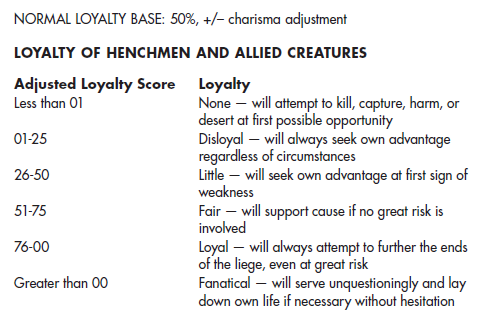
This section finishes with an entire page of modifiers to henchmen loyalty, obedience and morale. Each individual entry is interesting - I specially like the idea, for example, that while most creatures prefer to follow lieges of similar alignment, chaotic creatures make bad leaders and followers in general. However, keeping track of all these things looks like a nightmare. I prefer the much simpler 2d6 checks of B/X. Anyway, here is a good summary:


What have we learned today?
 
Once again - "lots of cool tables, but everything seems a bit unnecessarily complex, sometimes redundant". We have gems that we can use as written if you want that kind of detail, various troops for mass combat games, and two potential new classes waiting for a B/X adaptation: the commander and the sage.

Coming next... TIME! SPELLS! (prepare yourself: part IV is my favorite part of the DMG so far!)

Contains affiliate links. By purchasing stuff through affiliate links you're helping to support this blog.

Additional reading (on alignment):

Wednesday, September 28, 2022

Polyglot dwarves and elves - dungeon dialects

In B/X, ALL elves and dwarves speak six languages each. It is one language more than the smartest human wizard (well, unless you're using something like Old School Feats to become a linguist...).

Is EVERY dwarf a polyglot? This doesn't make sense... 

Unless...

What if these are similar dialects? Dwarves speak "Dwarvish, Gnomish, Goblin, Kobold". You can see dwarves and gnomes (their cousins) sharing a language, right? What if goblins and kobolds learned with them? This is the language of the (short) underground people.

What about elves? They speak "Elvish, Gnoll, Hobgoblin, Orcish". Sounds strange, since those are monsters in B/X terms. 

Orcs are "ugly, bad-tempered, animalistic humanoids who live underground and are active at night. Sadistic bullies who hate other living creatures and delight in killing." in the OSE SRD.

Hobgoblins are "Larger and nastier relatives of goblins. Dwell underground, but commonly seek prey above ground.".

And gnolls are "Lazy, humanoid hyenas of low intelligence that live by intimidation and theft. Legends say that gnolls were magically created by a wizard who crossbred gnomes and trolls."

Now, this doesn't make ANY sense... 

Unless short species have tighter social connection than taller species. Which sounds a bit ludicrous.

Or, we can rationalize it saying that gnolls, hobgoblins and orcs spent their waking hours outside... only sleeping in caves, etc. Or that orcs are warped elves (as in Tolkien). And trolls are related to elves somehow (as in Poul Anderson). And hobgloblins are... well, a mix of elves and goblins?

But it is all a bit unintuitive and forced.

And I didn't even mention alignment languages until now.


Languages in B/X is one of those idiosyncrasies - like immunity to ghoul paralysis - that works in Basic (there are few monsters, you can speak with some of them), barely works in Expert (now there are more than a hundred monsters) and break if you're expanding the game even further.

You can handwave it, use it as written, or ignore it altogether (as I've seem frequently). 

However, having coherent languages improves immensely on world-building... as everyone who read Tolkien knows.

Dark Fantasy Basic tries to make some sense of language - including alignment languages, "common" and dialects. You can read the whole thing here. It doesn't deal with demi-human languages, however.

Well, my next book is likely to be about demi-humans... And I'm wondering if it should include some ideas on languages. For now, I think I'd just say that elves and dwarves speak only three languages by default - and the last three languages on either list can only be picked by high-Intelligence characters.

And "cousin" languages can communicate, albeit with some difficulty: dwarf/gnome, goblin/hobgoblin, and maybe even elf/orc... depending on your setting.

Saturday, June 12, 2021

The individualism of modern D&D

I wrote a post about the origins of alignment a long time ago. It is one of my favorite posts in this blog. I thought I'd make it into a series, discussing alignment through all editions, etc., but nothing really occurred to me.

Now that D&D is trying to get rid of alignment (in the most recent books), I'd like to briefly go back to the topic. This post is not only about alignment, but it plays an important part.

In that post, I've mentioned that the move of alignments from "factions" to "individual behavior/philosophy" is part of a natural process as D&D moved from wargame (focused on armies) to RPG (focused on individual characters). 

Well, the move is nearly complete. Now even monsters aren't good or evil; tigers and demons must be judged on an individual basis.


But alignment is not the only change. If you compared early D&D to modern D&D, you'll see the "social" aspects were more important. You had hirelings, morale (i.e., if your team runs, you run), reaction rolls, and so on. Now, it is all about the single character. He might have a pet or sidekick, but he is always the star of the show (or ONE of they stars, like in the Avengers movies; although "solo play" becomes incresingly popular, and big tables more rare).

You can see it in monster statblocks too; in AD&D 2e, for example, you had information on diet, habitats, social organization; the number of monsters you'd find in an encounter or lair were also important. Now that is lost. The number encountered will be randomly determined, maybe level appropriate.

The "exploration" side of the game is also a bit weakened. Instead of, for example, finding a magic weapon by chance and carrying it around, you are specialized in certain weapons, so your character traits defines what weapons you'll carry.

Character complexity has grown exponentially. PCs now have feats, bonds, flaws; they are carefully built instead of randomly rolled. Deliberate character creation and development became an important part of the game.

Now we have have races, subraces, custom lineages, etc. (in addition to classes, subclasses, multiclasses). In some of the earlier versions, non-human PCs had level limits, since humans were the majority and they were the exception. Now, humans are only one - and maybe the most homogenous, since there is no "custom human" IIRC - of many different lineages.

(A recent example: Drizzt Do'Urden was once an outcast, a good-alingned rebel from an evil culture of "Dökkálfar", and now apparently part of a majority of good drow).

And, of course, the nonhumans become stranger and stranger - now you can play as a snake-man, undead, cyborg, and so on. The old limitations make no sense now - a dwarf can be a wizard, an elf can be a cleric, and so on.

 Like in 13th Age, each PC is unique.


It is not about humans exploring a strange world anymore - is about a group of strange people exploring, well... themselves? Or, most likely, they are exploring a world that has more internal coherence than the party. [For example, when playing Curse of Strahd, I've noticed that the PCs were some of the strangest being  around; the rest of the setting is what you'd expected from a "gothic horror valley".]

The importance of the party is also downplayed. To mention some games I enjoy, modern D&D is more like Skyrim or Dark Souls than Darkest Dungeon. While in DD only the fate of the party matters, in the other games you have to build a single character and try again and again until you succeed.

In the wargame period, characters would take one "hit" and they'd be dead, unless they were heroes or superheroes. I think it was Arneson who noticed people would get attached to their characters, and then hit point were made. I'm thinking that the next step is simply making PCs immortal - you can change your character when you get tired of it, and he/she only dies with the player's permission.

Well, is this good or bad?

The answer, obviously, is neither. It boils down to a matter of taste. You do not have to choose one way or another; you can play with these things. For example:
If you find alignment too restrictive, we could go the opposite way - adopt one or multiple "mien" from Troika* (e.g., Hungry, Confused,  Protective, Greedy, Conniving), one or multiple goals from Teratogenicon, or let behavior be described by any appropriate expression (chaotic, lawful, greedy, hungry, indifferent, territorial, aggressive, shy, etc.). Of course, each individual creature might be different - but having some way to start the process is useful.
The same goes for hit points and lethality. Do you want unique, carefully built PCs? Maybe you they shouldn't die in the first session. Do you prefer high lethality? Maybe players should be able to create new PCs quickly.

It is not about black and white, either. There are shades of gray. The extremes (for example, "nobody ever dies" and "at least one PC dies every session") are less popular than moderate versions.

I've played Ravnica campaigns in which I wanted the PCs to be strange; we had a great time. I certainly enjoy the weird creatures of Dark Sun and Tékumel. In Curse of Strahd, the strange PCs felt out of place, but I've found some alternatives). 

Now I'm starting a Shadow of the Demon Lord campaign (the sale is still on!). The game is fairly lethal, so I'm happy that character creation is really quick and starting PCs are really simple. I really like character customization to happen gradually, and Shadow of the Demon Lord is great at that (it has way more customization than some old school games, for example, but not as much in the beggining of the game like 5e).

Just try some different play-styles and see what suits you best!

*These are affiliate links - by using them, you're helping to support this blog!

Monday, July 27, 2020

Lucky Number Seth

There is an entire post to be written about how wasteful is to use a die with 20 sides to only get two or three meanings (hit, miss, or critical hit)... but I'm not writing that today.

Today is just one example.

So, here is Set (or Seth), an Egyptian god of many roles... some of them related to chaos or defeating chaos. Which is fitting.


If a player character becomes a follower of Set, roll a d20. This is now the number of Seth.

Say you've got a 12. Every time you roll a 12 with that PC, Set intervenes. He has his own goals in mid... but if you have been a faithful follower, he is very much inclined to help you out. Of course, he has his own, sometimes inscrutable, motives.

Extrapolate from this little mechanic. The possibilites are endless. For example:

- For clerics, the usefulness is obvious. Yes, you can sin against Set from time to time... but better not roll his number while doing it!
- The DM rolls in secret, and tells the PC when Set intervenes. Maybe he only does it once until you've got the time to pray again. But did Set really intervene? Or would that 12 have killed the monster anyway?
- You could form a pact with a deity, and use this help until you fulfill it.
- Maybe you can worship two deities? Well, roll a new die. Now you have two lucky nubmers! But whose goals are you following now? And you better not roll the same number twice - you soul might get ripped apart by jealous deities...
- Of course, it works differently for non-clerics. Maybe once a day, etc.

And so on.

Saturday, April 04, 2020

The absence of God

This setting idea was was partly inspired by reading Hell Is the Absence of God, although the result is nothing similar.

Lost Gods by Brom is a better source of inspiration for this. Yes, that Brom - did you know he is an impressive writer in addition to being an amazing artist? Check that one out, it has awesome depictions of the afterlife. I'll write a brief review later, I think.

Art by Brom - source.
Anyway, the idea reminds me of sword and sorcery settings... places with demons but no true gods in the modern sense. At least, that is what I feel when reading some stuff by Vance, Robert E. Howard and Clark A. Smith, for example, or settings like Tékumel and Dark Sun. Well, there are not many demons in Dark Sun IIRC, but they FEEL appropriate for some reason.

Here is how I summed it up in Dark Fantasy Settings:

---

The absence of gods


The rapture has come. The gods left, and with them the righteous. The rest of the universe was found wanting, and was abandoned. The problem is, nobody remembers it.

Humankind has a hole in their souls, but they don’t know why. There is no memory of the gods – the whole concept is alien. Altruism is almost unknown. Needless to say, there are no clerics or paladins, only different kinds of sorcerers. Temples are all fallen and desecrated – to most people, they look like ordinary ruins.

Demons are common throughout the land, but have no lower purpose other than gaining power, pleasure and gold. The word “demon” has lost its meaning. Humans treat them like a dangerous different people – the strong ones should be avoided (or worshipped, as they grant gifts), but some can be reasoned with, enslaved and even breed with humans. They also have no memory of the gods.

Bizarre monsters are also common. With no concept of natural order, there is also no separation between animal and monster. They are all bizarre beasts. No one cares to catalogue then, and everyone know you cannot predict what kind of creature you will find in your travels.

The most dangerous creature in these lands, however, are the Nephilim. Nobody knows that they are the angels that failed to save this world from judgement and damnation. These ancient, immensely powerful beings have a few clues and recollections on what happened before… However, none dare see the whole picture. Some gouged their own eyes out to avoid seeing how damned the lands have become. Other chained themselves for fear of destroying everything, or twisted their own limbs into tentacle aberrations. Many disfigure themselves to avoid the pain of remembering they were created in the image of perfection, while other carved their guilty into their own flesh. All became insane.

Maybe, if someone could put all the pieces back together, they could pray for one of the gods to look back on this damned world…

---


As I've said above, this is from my book Dark Fantasy Settings. It contains shorts essays and many tables to generate grim settings. You can find it by clicking on the link above. If you like this, you'll find more stuff like this on my Dark Fantasy line. 

It is also a great way to support this blog!

Hope you enjoy it! Thanks!

Friday, February 21, 2020

DARK FANTASY: SETTINGS, MAGIC ITEMS, and SALE!

So here are my two newest books: Dark Fantasy Magic Items and Dark Fantasy Settings.

They are on sale for US$ 0.95 and 50 cents for a limited time!


These are collection of tables and short essays to inspire the creation of dark fantasy settings and magic items. As always, the focus is on dark fantasy tropes: flawed heroes, terrible villains, corrupting magic, ominous ruins and damned wastelands.

Here are some examples from each book.

Settings:

d20
What is missing?
1
Gods. They died, left, became corrupted, etc. (see the “Dark Fantasy Religion” book for more ideas)
2
Water. In this deserted world, human life is cheap and water is expensive.
3
Food. Everyone are starving, and the number of cannibals is growing.
4
Sun. The sun is dying. It might have turned red already.
5
Light. It is always night, and torches are scarce.
6
Heat. This winter is harsh and lasts for decades. The whole world is covered in snow.
7
Civilization. Civilization has fallen, and barbarians live amongst the ruins.
8
Technology. The primitive humankind cannot tell the devices of the ancients from magic.
9
Sight. The whole world is surrounded by fog. Hard to see, easy to get lost.
10
Magic. The slow death of magic will bring doom upon the world.
11
Metals. Metals are scarce. Wood, bone and obsidian are used in its place.
12
Memory. Everyone seems to be forgetful, and the old ways are falling into oblivion.
13
Empathy. It is every man and woman for themselves now, and the devil take the hindmost.
14
Order. Nobody is in charge, and everything is permitted.
15
Transport. There might be peace somewhere, but no ways to get there.
16
Sanity. Everyone is crazy, but each in their own way.
17
Stability. Everything changes rapidly. Cities move around. Buildings grow and collapse like trees.
18
Souls. Most common people are born with no soul, although this isn’t always obvious.
19
Exit. No one can leave The Great City. Beyond the walls is hell, or worse.
20
Hope. Everything is going downhill, and nobody cares.

Magic items:

d20
Appearance
1
Deep and dark like the night sky. You cannot see the stars move, but they do.
2
Looks as if it was made of contained fire, without heat.
3
A sea of desperate faces float around with open mouths, making no sound.
4
Its parts seem to flow slightly within, like water.
5
Luminescent. It glows in the dark but provides no light for you.
6
It contains one or more eyes that occasionally seem to blink.
7
Made to resemble flowers and plants, with a sweet, slightly narcotic smell.
8
Reflective, like a perfect mirror.
9
Ultrablack – darker than your pupils, and makes the light around them a bit weaker.
10
Beautifully prismatic, like a cross between a rainbow and the aurora borealis.
11
Old bloodstains that can never be cleaned.
12
Incredibly fancy. Decorated with precious stones or metals.
13
Resembles (or contains the image of) an animal, demon, monster, child, etc.
14
Has small pulsating protuberances that resemble cists.
15
Made of living, flayed flesh, or human skin. Might bleed if damaged. / Made of bones.
16
Smooth, squishy and wet, resembling octopus’ skin. / Semi-transparent, like hardened glass or crystals.
17
Covered in scales of a dragon or great lizard. / Engraved with glowing runes.
18
Decorated with large feathers of extinct birds. / Perfectly polished metal.
19
Rubbery and flexible, but still very resistant. / Radiant, like a beam of light or “laser sword”.
20
Covered in the strangely colored fur of an unknown beast. / All bent and twisted.

I think the series is now complete! I'm really happy on how things turned out. And I still have other stuff up my sleeve...  Stay tuned!