I must create a system, or be enslaved by another man's. I will not reason and compare: my business is to create.

- William Blake

Showing posts with label Magic the Gathering. Show all posts

Thursday, July 28, 2016

The Lost Mines of Ravnica, III - Phandelver Remade

Read Part I here and Part II here. The first two parts were about ideas and techniques for adapting LMoP to Ravnica or some other setting. This third and final part is a straight-up conversion, or a description of what I did to LMoP without any criticism or analysis of the original module.

It will probably only be useful if you actually want to run LMoP in Ravnica, but who knows. I still plan to run this campaign again to people that are new both to Ravnica AND LMoP, one day.

Here you go - you need to be familiar with LMoP, but not necessarily Ravnica, to make this work. In fact, I altered some bits of Ravnica lore to fit my tastes, and I encourage you to do the same.

---

Introduction to Ravnica

(There is an astonishing amount of lore in the MTG salvation wiki; the challenge is reducing it to avoid overwhelming first-time visitors).

The city of Ravnica is a sprawling gigalopolis that covers most of the surface of the planet. It looks like a high-tech world with magic in place of technology, insanely tall spires and towers, and multiple underground levels.


There are innumerable creatures in Ravnica, but most intelligent humanoids are humans, goblins, minotaurs, elves, centaurs, dryads, ogres, trolls, giants, Vedalken (think of blue-skinned, bald Vulkans), Viashino (lizard-people), Loxodon (elephant men), demons, mutants and the undead. Other races in the PHB such as orcs, dwarves, haflings and dragonborn should be re-skinned, although in such a cosmopolitan setting almost everything is possible.

In ancient times, innumerable factions were in constant war against each other (and, as legend goes, against gigantic alien monsters, but that is probably exaggerated...), until the ten most powerful ones made a magical contract - the Guildpact - that would keep the planet peaceful. The lesser factions were disbanded or destroyed.

999 years later, the guilds are still at relative peace - even if they disliked each other, the Guildpact stops any serious attempts of war. One of the guilds has been destroyed and forgotten. The other nine guilds control a separate aspect of civilization each - law, religion, food, mining, recycling, and so on.

There is no government "per se"; the guild often negotiate with each other and the Guildpact prevents things from derailing. The exact terms of the Guildpact are known to few, and understood by fewer, but basically it is a set of magically enforced laws that cannot be broken, lest the whole order be destroyed,

Most of the populace is Guildless, though, and they must offer services to the guilds in order to be admitted - or just to survive. Many resent the guilds and some even long for the days before the Guildpact, but without the guilds the world would go back to chaos.


Your guild is The Boros Legion, and your mission is to keep the peace and bring troublemakers to judgment. You were probably invited to join after showing martial progress at a young age. You are still being tested before being made a permanent member.

Most of the legion is comprised of humans, goblins, viashino (lizard-people) and minotaurs, but others can join too. The leaders of your guild are avenging angels with fiery blades; you hardly see them, but they inspire you with ideals of justice and vengeance.

In theory, you have to follow the byzantine laws of Ravnica, but in practice you can do harm with relative impunity as long as you follow your orders and don't disrupt official guild business (either Boros or otherwise).


[It is possible that people from other guilds will accompany a Boros band for various reasons, such as providing healing or technology, but I'm assuming most of the PCs to be Boros. Most classes will do just fine, with a few exceptions such as bards and druids. Alternatively, you can let the PCs start without a guild and acquire one during play. Also, I do not expected players that are not familiar with Ravnica to memorize all the guilds at first; three guilds, plus the knowledge of a missing one, will be enough for LMoP].

Background

In Ravnica, mining is the job of the sadistic Cult of Rakdos, one of the most dangerous guilds around. In their underground domains, they do as they wish, but they give plenty of gold to the other guilds in return. Still, there are plenty of ancient mines that the cult haven't found yet - the Wave Echo Cave is one of them. In theory, any mines should be given to the Rakdos, but in practice there are plenty of greedy, foolhardy opportunists that would try to take the gold for themselves.

This is what happened here. An ancient mine was found in Phandalin by Rockseeker, a goblin explorer. Soon enough, all criminal gangs in the area started being suspicious and started looking for a way to get their cut.

The thing is, Phandalin is basically a gigantic slum, filled with ruins and partly covered by overgrown forests. Worse, the Gruul clans are very active in the area. The Gruul clans were once responsible for the forest, but singe the growth or Ravnica has destroyed most great forest in the planets, the Gruul are now homeless, marginalized and angry. Swindled out of their share in the Guildpact, now the Gruul threaten civilization from within. Even then, their numbers never seem to dwindle, maybe because any guildless can potentially join the Gruul, although the weak are brutalized by the strong.


Chaotic, angry and prepared for war, the Gruul are in many ways the savage counterpart to the Boros. Like the Boros, they have humans, goblins, viashino and minotaur in their ranks, but also trolls, ogres, centaurs, elves and other creatures that are either martial or aligned with nature.

There is no strict hierarchy among the Gruul; many criminal gangs fancy themselves part of the guild, but they fight each other almost as often as they cooperate.

Let the players know that they can arrest any Gruul that comis a crime and can destroy them in self-defense, but merely being a Gruul is no crime, although many Boros hate them. Some Grull might be informants, friends or even family to the PCs.

Part 1 - Goblin arrows

The players are charged with investigating the disappearance of Sildar Hallwinter, a Boros officer that was investigating a supposed criminal gang in Phandalin (in my campaign, Sildar was involved with the hiding of the mine). They have an informant in Phandalin that could help. As they meet this informant, he will say he must meet the PCs in a more private place. If the players are smart or suspicious enough, they will realize that this is an ambush; the informant has been compromised.

Part 2 - Phandalin

Phandalin causes mixed reactions to the Boros; they might be appalled by the poverty and lawlessness of the people, but the simple fact that the place is so filled with natural life could cause some admiration. While interacting with people in the city, it will soon become obvious that not not all guildless are alike, and even among the Gruul there are very different people.

The factions of Phandalin are mostly substituted by guilds in my version, but you can certainly have smaller groups that are not directly tied to any of the major guilds. If your PCs are Boros, they will probably not pledge allegiance to any competing faction, but they can - and should - cooperate with other guilds to advance the goals of the Boros or their own - make clear that this is part of normal life in Ravnica.

Part 3 - The Spider's Web

Not much to add here. The green dragon is a giant worm (or "Wurm") in Ravnica instead; a creature worshiped by some of the Gruul as a symbol of primal power and chaos unleashed upon civilization. The owl-bear might be a symbol of corrupted nature gone wild, too - like a giant boar out of Princess Mononoke. Or say it is a giant bear - and that the PCs had never seen a bear before. It adds to the strangeness of the setting.


Part 4 - Wave Echo Cave

The story behind WEC is that is was sealed a thousand years ago because it was overrun by the undead and many other foul creatures - specially one particular being (the spectator) that is an envoy from the dangerous, forgotten gods from before the Guildpact. The Black Spider is interested not only in the gold, but in the ghost-stones that kept the undead active for all this time. He wants to study them and use them to help building his own undead army.

The wraith and the spectator have a pact of their own, so they can't destroy each other. They will try to enlist the PCs for their cause, promising many rewards. The spectator will claim to be a herald of ancient gods that were hidden from the people of Ravnica by the corrupted guilds.

The Black Spider, in reality, is the psychic vampire Szadek, head of the secret tenth guild. In the original Guildpact, the tenth guild was charged with secretly challenging the power of the other guilds, a fact that only the ones who signed the pact know. The other guilds are forbidden to let the secret out.

He will not fight to the death; instead, he tries to run away (even before the fight ends) or surrender (promptly reminding the PCs they shouldn't attack a surrendered foe).


What comes next?

Giving the mines to the despised Rakdos will be an issue in itself - many Boros might agree with Sildar and try to take some of the gold for themselves. If the PCs arrest Szadek, the Boros will have a problem on their hands, since his existence being known would break the Guildpact. He might find a way to escape (in which case the Boros will eventually give the PCs job of assassinating him), or maybe he will be quietly executed.

Even if Szadek dies, there are still plenty of things to do in Ravnica, based on MtG lore, novels, etc. 


Here are some ideas:

- The PCs are assigned to look for one of the Ten Most Wanted of Ravnica, or maybe they are just looking for the reward.
- The angels that rule the Boros disappear, leaving a power vacuum.
- The ghost-stones will be used by other guild as a weapon to try and exterminate the Gruul, creating a ghost-town in Phandalin.
- A creature created by the Simic combine escapes and hides within Golgari territory.
- A power struggle within a guild makes conspirators search for allies in other guilds.
- Two guilds associate in order to gain supreme power.
- The guildless revolt against the guilds. Some Boros want to massacre them, some understand the anger, some want to leave the legion.
- The Guildpact is eventually broken. This opens Ravnica up to visitor form other planes.
- The ancient gods, no longer held back by the Guildpact, attack Ravnica. They look like something out of a Lovecraft story.
- The last dragon, Niv-Mizzet, finds a megadungeon under the Senate: the Implicit Maze. It contains the power to re-establishing the Guildpact, but all guilds must cooperate (even though not all members are willing).

(all art belongs to Wizards of the Coast)

Wednesday, July 20, 2016

The Lost Mines of Ravnica, II - Phandelver Resolved

Read part 1 first.

Let us continue to fix what we can from LMoP, by setting it into Ravnica or doing something else.

I won't stick too closely to Gus' article this time, but instead I'll try to describe my own campaign and some of the solutions that I've adopted, which is probably more useful to the reader.

Problem #2 - The silly names (and problem #1 continued)

I have to agree with Gus on this one, the names are very bad. There is little I can add to his post; in my adventure I indeed shortened some of the names, and my PCs couldn't remember "Sildar", let alone "Sildar Hallwinter".

One interesting thing is that I actually used "The Black Spider" (TBS) instead of "Nezznar the Black Spider", because his name was meaningful in-universe; in my version of LMoP, TBS was really the psychic vampire Szadek in disguise (whose guild symbol is a black/blue spider). Yes, in theory a guy as secretive as Szadek shouldn't go by "The Black Spider", but the goal here is to put an image in the PCs head, and use the lack of a proper name as a source of mystery. This was a happy coincidence; of course you could call him "Red Wolf" or something in a different setting.

The tenth guild is only a legend...
In short: give some meanings to the names, or make them shorter and easier. Also, take this idea further: give meanings to everything else. We'll get there by the end of the post.

Problem #3 - Goblins (also, ogres, bugbears, humans, and other monsters)

A goblin ambush, goblin canon fodder, goblins that attack on sight... It has always been done before. The way LMoP treats goblins seems to encourage treating them as little monsters or obstacles, not humanoids.

I don't have a problem with goblins "per se", so I kept them in the game. I don't even have a problem with goblins as canon fodder, but it seems like a poor use for them, specially because LMoP gives you some opportunities for negotiation.

My solution? More goblins.

Canon fodder? More like canon makers!
Goblins are a part of the PCs guild. Goblins are some of the best engineers in the setting. They are not only the aggressors, but often victims of bigger creatures such as humans and minotaurs (unfortunately, the MtG website for Ravnica describes goblins as "test subjects" instead of engineers, etc; that is not how I interpret the cards and novels). Also, since there are no dwarves in Ravnica, they are all goblins now. Hopefully, when the PCs sees a goblin, "kill that pest before it attacks us" is not the first thing that comes to mind.

(Incidentally, the party had a kobold in it; I couldn't convince the player to use a re-skinned goblin instead, and I put player choice over setting details most of the times, but I think this fact made it easier for them to deal with goblins).

As for the goblin ambush, there is no caravan and no road. Instead, the ambush is a social one; someone tries to lure the PCs into the the ambush, but they can avoid it if they are smart enough to be suspicious of what is going on.

Which also makes the first encounter of the module less likely to result in a total party kill.

Also, later on the adventure the PCs had to collaborate with a goblin to find what was wrong with their own guild. Some of the PCs superiors were quick to tell them that they were the true heroes and everyone else was canon foder, but these were the bad guys, and the PCs could only find this out by talking to some goblins.

I applied the same reasoning for most of the monsters in the module, and in the end most of the humanoid enemies (minotaurs, ogres) were either present in the PCs guild or often victims of the some guild's power.

These are the good guys... or are they?
For some of the other monsters, I re-skinned them to Ravnica too. The green dragon became a great worm worshiped by the Gruul, which conveniently exist in Ravnica. Owlbears are replaced by tentacled Simic aberrations gone wild. The Beholder-like creature became a thrall to the Lovecraftian Eldrazi that might end up destroying Ravnica.

I kept some monsters as they are, but told the players their charachters had never seem something like that before. This worked well for the doppelganger, but not quite for the zombies.

Problem #4 - Phandalin, factions and the lack of forests

The town of Phandalin offers various factions, storylines and side-quests. As Gus notices, some of them are quite boring. Ravnica automatically solves this problem with the guilds: they have plenty of conflicting objetives an many shades of grey, so that any player could conceivably make deals with any guilds for various reasons.

One problem of using Ravnica for LMoP is that there are not many wilderness areas in Ravnica, since it is supposed to be one single mega-city. Still, I figured, there must be plenty of uninhabited ruins, slums, big parks, etc.

Everything that looked like wilderness, thus, became Gruul (the wild, barbarian guild) territory.

Conveniently, that made the wilderness not only a source of danger, but also a source of ambiguity: it reminded the players that civilization had destroyed most of the forest and the "chaotic" Gruul clan were one of the few guilds that actually cared about that.


Entering Gruul territory...
Problem #5 - Not enough fantasy

In the end, the lack of "weird" fantasy in the model can be solved by adding weirdness to everything that feels too cliched for you. Some of it is re-skinning, some of it is turning all assumptions on their heads.

Let each encounter tell something about how your setting is different from generic fantasy, by giving every question about it a slightly unexpected answer. The monsters above are one example, but there are many others. The mine has to be kept secret not only because of the gold, but because otherwise the Rakdos (the demon guild) would have the right to claim it, as they are responsible for the underground. The mine are not valuable because of its gold, but because it is filled with radioactive rocks that keeps ghost imprisoned (also a thing in Ravnica). And so on.

Why bother?

At this point, you might be asking yourself why I went through all this trouble instead of just getting an adventure best suited to my tastes.

There are a couple of answers for that. First, I enjoy writing adventures, but I don't care much for creating maps and statblocks. The "plot", if you can call it that, is what entices me. Also, there are no published Ravnica adventures.

But, also, because LMoP is a great adventure. Yes, vanilla is not my favorite flavor, but I like everything else about this adventure. The encounters work well, the traps are fun, there are great opportunities for creative problem solving, and, all in all, it is  a great introduction to 5e, which was exactly what I was looking for at the time.

So, it is worth playing, and it is certainly worth saving if it is not exactly suited to your tastes.

Next: enough with this problems, let us give some solutions already.

(all art belongs to Wizards of the Coast)

Sunday, July 17, 2016

Plane Shift: Innistrad review - Re-skinning classic horror

WotC has release the second iteration of the "Plane Shift" series this week. You can get it here. Their first effort was Zendikar - you can see my review here.

I found Plane Shift: Innistrad to be way more interesting than Zendikar. Zendikar, as I wrote earlier, had a very lackluster presentation of a potentially awesome setting. Innistrad, in many ways, is the opposite: it looks like a very traditional gothic setting in the outside, but the PDF does a great job of highlighting what is special about it, and giving you things you can use in your game.

Most of all, it is a lesson in the noble art of re-skinning, which is probably my favorite aspect of it. From cover to cover, the PDF gives you tips and hints on converting classes, races, settings and adventures ("Curse of Strahd") from your classic D&D to Innistrad.


This is a great way of showing people that you can basically get any adventure or campaign and insert it into the type of setting that you prefer, avoiding "vanilla" fantasy if you want it, or even dialing things back from the weirder aspects of fantasy if that is not your thing. Take a look of my re-skinning of Lost Mines of Phandelver to the MtG world of Ravnica and you'll see what I'm talking about.

Another awesome aspect of Innsitrad is the monster variations. This is an underused idea in D&D that make monsters infinitely more interesting. 5e's Monster Manual has a few interesting ideas, and even LMoP does this to some extent. My own bestiary (if I ever write it) is created around this idea. The gist of it is that you get a familiar creature and add a twist to it, completely changing the encounters. For example, werewolves are all the same in the MM, but if you add one of Innistrad's traits to it, the fight will look completely different:


The fact that you can use traits such as this to reflect some aspect of the setting ("Vildin werewolves are particularly bloodthirsty", etc) or to investigate aspects of the setting to plan for combat makes things even better.

There is lots of useful "game" stuff in this PDF. A few new creatures and creatures traits, a flavorful new background (inquisitor), some flavorless human variants (oh, well...), new rules for madness and corruption, etc.

The art is great as always.


Since most of the setting details can be found online, as the PDF itself points out, all this re-skinning seems to be a good use for Plane Shift books. The alternative - using this short PDFs as summaries of the MtG settings - seems to be a bad idea, specially for Innistrad, since most of it is homage to classic horror, with some cool variations but little that is really unique.

There is little to be said about the setting; basically, it has werewolves, vampires, angels, demons, etc. Mostly Ravenloft, some MtG lore, some Diablo, some Lovecraft, all Gothic fantasy. It doesn't describe many interesting factions or NPCs, Good and Evil are clearly present but the shades of gray come from the fact Evil has affect pretty much everyone.

Innistrad has at least one interesting twist on Gothic horror, and although it might sound that adding Lovecraft to Ravenloft (or to anything, these days) is not the most innovative thing in the world, I really like how Innistrad implements it; basically, you got your Ravenloft / Hammer horror world with vampires, werewolves and all, where the church and peasants with pitchforks fight the evil powers... until Emrakul (basically Cthulhu and the like) invades the world and starts driving everyone, including the angels, crazy.

This seems like a perfect fit for Curse of Strahd, which takes characters to level 10 - after they are finished with the campaign, add Emrakul to the mix for some high-level threat to Ravenloft's very existence.


In short, Plane Shift: Innistrad is a great resource for D&D horror. It is not my favorite MtG setting, nor is it "weird" enough for some peoples' tastes, but is is a great improvement over the Zendikar PDF and, basically, almost the best I would expect from a 40-page conversion of a MtG setting to D&D.

WotC seems to have found its way with Plane Shift, and I'm looking forward for the next ones.

All art and text copyright by Wizards of the Coast LLC, used under fair use doctrine, for purposes of criticism only.

Wednesday, April 27, 2016

A Magic: The Gathering setting comes to D&D... now oficially

Like many of you, I have been waiting for years for an official Magic: The Gathering setting book for D&D (or any RPG, really). I'm a fan of these settings, specially Ravnica, and I use them in my D&D campaigns often.

Well, the day is finally here. Plane Shift: Zendikar is one of the most recent MtG settings, adapted for D&D. You can download it for free in this link.


The PDF looks stunning - as MtG art often does. The text is... well... a bit underwhelming.

You see, one of the reasons I like Ravnica is because it seems so alien to traditional fantasy. Sprawling cities, no feudalism, strange technology, one single dragon, no orcs or dwarves, and so on. 

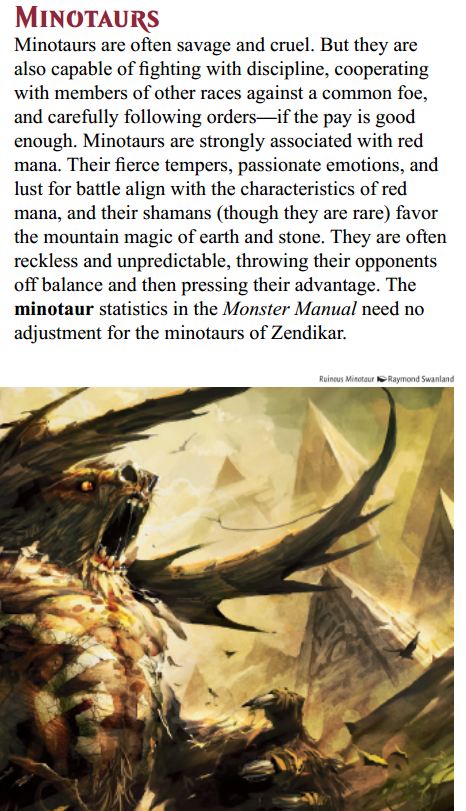
Zendikar, at least as portrayed by this PDF, seems to be the opposite. They have chaotic dragons, nice angels and evil demons, vampires scantly dressed in leather and silk, and... well, look at the Minotaurs:


Do you think such paragraph belongs in a 38 page PDF? "There are Minotaurs in Zendikar" would be enough to me, and would save some time and space (although the art is still awesome). And don't get me started on humans...

Well, the cliches seem to be intentional. It says right on the introduction that Zendikar is meant to be a "traditional D&D" world. Which makes it ideal if you want something more "generic" and easily suited, but is not the most useful setting for my tastes.

Now, there seem to be some awesome stuff in Zendikar: Lovecraftian deities, wild magic, flying island everywhere, etc. Goblins, merfolk and elves get some interesting traits (somewhat), and to be fair vampires also wear chitin carapaces in addition to leather. And the art certainly indicates there is plenty of space for creative stuff. 


The problem, them, is focus: Plane Shift: Zendikar spends little time the things I consider essential for a good setting

Factions are mentioned briefly, and other conflicts seem to be very black-and-white. The metaplot is seems to be central to the setting; I have a hard time understanding why one would be looking for gold and gems if they know Cthulhu has awakened (although I can't blame Zendikar for some of its choices, as my own Days of the Damned revolves around the awakening of Ttians, and is inspired by classic D&D settings, as well as Berserk and Dark Souls). 

NPCs and locations are also not detailed; "Emeria, the Sky Ruin" and "the monstrous demon Planeswalker Ob Nixilis" sound cool, but get nothing but a mention. Hedrons, essential to the setting, are also not fully explained.

Now, I didn't intend to be so critical to a thing I waited for so long (and also not a finished product). Nor do I want to write a long review of a free product that is 38 pages long; go read it for yourself. 

But for now, your best bet when immersing in MtG lore is still the internet: check the MtG wiki., where you can find about the story of Ob Nixilis, the origin of hedrons and, more importantly, what is so cool about Zendikar. You might also or one of these two sites by WotC.

Or maybe you should buy The Art of Magic: The Gathering: Zendikar... which might be the whole point. 

To be honest, even the cards are more flavorful than some of the text in this product. It is hard to see how they managed to make such a vanilla PDF from this material


All in all, I'm happy WotC finally decided to give us D&D players a taste of MtGs settings. I wish they focus on some of the weirder settings, such as Ravnica and Mirrodin, or at least focus on the weirdest parts of each setting. Reading that "humans are the most numerous, diverse, and adaptable folks" is the last thing I need.

BTW, you can let WotC hear your thoughts here. I, for one, would certainly buy a "Hardback; 160-320 pages" in the vein of "The World of Ice and fire", if they do it right.

And I'd also like to hear you in the comments section!

All art and text copyright by Wizards of the Coast LLC, used under fair use doctrine, for purposes of criticism only.