I must create a system, or be enslaved by another man's. I will not reason and compare: my business is to create.

- William Blake

Showing posts with label Old School Ramblings. Show all posts

Saturday, February 26, 2022

My favorite D&D (and OSR) likes and dislikes - what are yours?

If I were to choose a "pound for pound champion" of D&D, it would be Moldvay's Basic* -  the best ratio of great content per page. On the other hand, my "single book" champion  would be the Rules Cyclopedia* - greatest amount of cool stuff in one single book.

Both books are remarkable because of that, IMO; other D&D books would get more extensive with time. Redundant stuff was added and some important content was nearly lost with time (reactions, morale, hirelings, etc.). 

However, when I started writing my list of likes and dislikes I realized how extensive the latter is. And these are not details - they are fundamental things about my favorite games. I am still a bit unsure about how to explain this - maybe my "likes" have a bigger weight than my dislikes here. Or maybe "dislikes" are just easier to list - if I were to list my 5e dislikes, for examples, I'd include "too many skills, too many spells, too much repetition and redundancy", but when I write about old school positives I just say "simplicity".

The funny thing is that all my "dislikes" have been fixed in 3e, 4e, and 5e, but I still find that B/X and the RC are better (although early 5e is almost there IMO). Maybe it is just because I find adding half a dozen things to a game is easier than subtracting dozens of things between hundreds.

Pound for pound champion!

Anyway, here we go. I'll use B/X as an example because it is my favorite.

Likes:
- Simplicity, usability, conciseness, lack of clutter.
- Focus on reaction, morale, hirelings.
- Easy to house-rule.
- Monsters are easy to run.

Dislikes:
- Race-as-class.
- Different XP tables for each class (including different XP limits), which makes XP useless for some characters for  a big chunk of the game (unless multi-classing etc.)
- Byzantine XP math, including ability bonuses and dividing the XP by your level or something.
- Attacks and saving throws tables.
- Thief skills using d6 and d100 (also, d100 in increments of 5% instead of d20)

Neutral:
- Domain building - I like it as long as you actually use it, which I haven't seem in my games.
- Descending AC.
- Vancian magic.
- Lack of "streamlined mechanics".
- Lack of generalized skills for non-thieves.

My preferences have not been changed even after playing multiple versions of D&D. I even wrote my own take on B/X (Dark Fantasy Basic), changing everything I dislike.

I do realize this is a matter of taste. However, most of the I've mentioned as "dislikes", I also find to be:

- Arbitrary (see the cleric post for an example).
- Justifiable if we don't use them ("sure, Halflings stop at 120,000 XP, but we never play high-level campaigns anyway") or use optional rules.
- Only make sense in the wargaming context (if you had a "XP budget" to build your troops, for example).
- Relics of Arneson/Gygax's original campaigns that do not make sense in 99% of our campaigns.

If you'd like to discuss this, I am curious to hear your opinion about:

- What are your likes/dislikes and, if different from mine, why do you like/dislike this.
- Are there any important likes/dislikes that I'm missing?

* Affiliate links - by using this, you're helping to support this blog!

Saturday, June 26, 2021

Fantasy "races" - stereotypes vs. cosplay

A quick thought (maybe continued form here; maybe only vaguely related).

Fantasy "races" are usually different creatures: elves, dwarves, dragon-people, cyborgs, mantis-men, etc. You can have half-elves, etc., but these cases are in the minority. So "races" is not the most adequate term.

Anyway.

On one extreme, you can treat these creatures as stereotypes: all dwarves have big personalities, carry axes, speak with a Scottish accent, etc. At best, you treat them as archetypes instead (the gold-loving dwarf representing human greed, ec.). At worst, you fall into fantasy clichés.

On the other extreme, every dwarf is an unique individual with no distinguishing traits. You don't even get a Constitution bonus, because your dwarf PC might be frail, smart and really fast. This is basically cosplay; different species are like different hairstyles, clothes, or tattoos. 

Most people prefer something between the extremes, of course.

Mechanically speaking, I prefer the modern "any one can be anything" over "you choose a race OR a class" of my beloved B/X, or the "certain combinations not allowed" of older D&D. The B/X version, however, has the advantage of quick character creation (see Shadow of the Demon Lord for another interesting take).

However...

I still like different creatures having different habits and mindsets, in some settings. They still have their own physiology. They are different from humans - a different species.

When dealing with different creatures, some stereotypes would be justifiable. "See those guys with horns, big claws, and sharp teeth? Yeah, they tend to be aggressive". Sure, if a player really wants to play a vegetarian shark-woman, I don't see a problem; she is just different to most creatures of the same kind. But the "kind" means something.

(I can also see some settings where elves are agnostic and cannot be clerics; or maybe the Goddes of Healing is bigoted against them.)

Do not judge a book by its cover. He is a really nice guy.

It all depends on the setting - but even is cosmopolitan Ravnica, creatures have certain tendencies. And there is something interesting about a character fighting his own natural (or cultural) tendency towards evil - think of Hellboy or Drizzt (or, better yet, Elric). 

Of course, this can be reminiscent of real world problems. In the first Ravnica novel, IIRC, the protagonist attacks a minotaur for no reason; in the first Elric novel, human pirates feel justified in killing and pillaging Melniboné since melniboneans are so evil. if you want to AVOID this kind of stuff, treating humanoid species as cosplay is a good idea.

Should entire species (or cultures) of intelligent creatures be evil? In certain settings, this would make sense. Think of fallen angels, cloned storm troopers, or orcs that were magically created to serve a great evil. In Volo's Guide, for example, some creature are evil because they were created by evil deities, or worship evil deities. In any case, there will certainly be exceptions.

My book Teratogenicon discusses this "group x individual" question in some length. Here is a small bit for fun: 
Nevertheless, the idea of “savage, entirely evil races” is seem as ridiculous propaganda by many humanoids. The Laestrygonian philosophers, for example, laugh at the notion that a black widow spider is “evil” for consuming its mate or that a wolf is “immoral” when it kills an innocent child. The fact that the Laestrygonian themselves enjoy eating both spiders and children should not influence our perception of their philosophy, which is based on purely logical grounds.
Anyway, this is all theory. My friends LIKE playing odd-looking PCs as cosplay, so I'm okay with that for most settings. Allegiances and hostility between creatures is like rooting for the same (or opposing) football teams. Unless some player want to play a character with relevant ties to its group - which I also find interesting.

Anyway, in the best literature, different creatures (or peoples - Cimmerians, Melniboneans, etc.) are neither stereotypes nor merely cosmetic. Like Elric, Conan, Frodo and Fafhrd, they are both individuals and part of a distinguishable group - which is reflect on their actions and stories.

Tuesday, March 09, 2021

Players don't need the rules (Old School Ramblings)

I haven't written an "old school rambling" in a while. Well, with the latest from D&D 5e (especially Tasha's) I think this is a question worth addressing.

As you know, I play mostly 5e and OSR stuff. Here is an important difference between the two: in the OSR, the GM needs to know the rules, while the players can play with learning much. In modern D&D, there is a tendency of requiring the players to know a lot about the rules (3e is probably the main offender here; 4e is a bit better, and 5e a lot better in this regard).

I am not saying this is true of all OSR games (or modern D&D, for that matter); only that this seems to be the expectation.


This distinction comes from RPG pre-history; it is the main difference between Kriegsspiel and "Free Kriegsspiel" (if you ever heard about the FKR or "Free Kriegsspiel Revolution", this is where it comes from, BTW), like you can see in the Wikipedia article (emphasis mine):
Lieutenant Wilhelm Jacob Meckel published a treatise in 1873[d] and another in 1875[e] in which he expressed four complaints about the overcomplicated rules of Kriegsspiel: 1) the rules constrain the umpire, preventing him from applying his expertise; 2) the rules are too rigid to realistically model all possible outcomes in a battle, because the real world is complex and ever-changing; 3) the computations for casualties slow down the game and have a minor impact on a player's decisions anyway; 4) few officers are willing to make the effort to learn the rules.[13] The fourth issue was the most serious, as the Prussian military struggled to meet the growing demand for umpires.[14] Meckel proposed dispensing with some of the rules and giving the umpire more discretion to arbitrate events as he saw fit. The only things he kept were the dice and the losses tables for assessing casualties.[15] 
In 1876, General Julius von Verdy du Vernois proposed dispensing with all the rules and tools completely and allowing the umpire to arbitrate the game entirely as he saw fit.[f] This form of Kriegsspiel came to be known as free Kriegsspiel (counterpart to Reisswitz's rigid Kriegsspiel) and was well-received by the officer corps because it was easier to learn and allowed umpires to apply their own expertise.[16][17] 
As you can see, in "Free Kriegsspiel" the umpire (GM) is supposed to know more about the rules than the players. In fact, he can completely disregard the rules in favor of "ad hoc" rulings that better suit the the complexities of the real world (or the even greater complexities of fictional world, I'd guess).

That hasn't been my experience with 5e - or modern D&D in general. The fact there is a lot of discussion online about good "builds" and "character optimization" shows me that the players are supposed to know the rules in some detail.

On the other hand, the amount of existing material makes nearly impossible for a GM to know all there is to know about players characters (more and more with every new splatbook, of course).

In practice, in the 5e tables I have participated, each player was responsible for knowing the rules that applied to their own characters. They choose their own races, feats, classes and subclasses, and the GM doesn't need to pay attention to the character sheets.

That is fair enough for me - the GM already has a lot on his plate.

However, like in "rigid" Kriegsspiel, having complex player-facing rules discourages them from learning the game in the first place.

On the other hand, I play the game with experienced players... who also play GURPS, Savage Worlds, and many other games. They are fairly smart guys, but there is no way they can memorize all the rules of all those games, and that's not our focus anyway. When playing 5e, I've realized they forgot half their features by level 10. I can only imagine how level 20 playes, since we didn't get there.

Of course, memorizing and using many features forces you to focus on the character sheet - but the moments we enjoy the most in our games are focused on the fictional world. 

(I've just realized there is a lot of overlap between this post and the character sheet one... oh well).

And in combat, my players like grappling, dropping heavy objects on opponents, pushing them from high places... things that are not necessarily encouraged in the existing rules.

So, anyway - this is the reason I'm writing a minimalist D&D. I seems like a good options for both new players and experienced players that play a lot of games or don't care to memorize lots of rules. The exception are the players that like system mastery. 

It is certainly a matter of taste - and I'd certainly be happy to run a game for hardcore 5e optimizers, as long as they take care of their own sheets and let me run the game as I see fit.

I guess I prefer Free Kriegsspiel over rigid Kriegsspiel, after all.

Saturday, November 28, 2020

Tasha (and D&D 5e?) is for experts... and beginners. Is 5e OSRish anymore?

Tasha's Cauldron of Everything is the latest D&D 5e book.

I'm probably skipping this one. And maybe a few more. Here is why.

Hint: it is not the reprinting of material I already own (like the Artificer class, which I kinda like).

By the way, this is a bit of a rant. 

You've been warned...


Tasha's is mostly a book of players options, from what I've seen. And some new DM toys - magic items, group patrons, etc.

Well, certainly. WotC is selling well, and 5e is popular. 

But does anyone NEED more character options?

How? 

There are more than 30 subclasses in the PHB, more than a dozen races and subraces*, and other customization options (feats, spells, items, fighting styles, backgrounds, etc.). My players haven't tried nearly half of that, nor are they willing to change class and race at every game. Books like Xanathar's and Volo's expanded their options significantly, and, to be honest, I let them use whatever race they find on the internet with some adaptations.

(* If you're not familiar with 5e, it is worth mentioning that decent class/race combinations are a lot more numerable nowadays - which I like).

In fact, I have the opposite problem - the amount of choice feels overwhelming for me as a DM, and the players get lost.

Well, more choice is always good. But to require more choice at this point you'd have to be some kind of expert 5e player, haven played dozens of campaigns so far, to at have at least TRIED some of these options for half a dozen levels. None of my players have... nor have I.

The alternative would be someone deep into character optimization and theory-crafting... People who have fun creating mechanically cool characters. 

And that's is fine, but not our cup of tea. 

It is also not role-playing. Role-playing begins when the game starts.

On the other hand... Tasha contains some REALLY basic-level stuff

Things like "what is session zero", "you can actually TALK to monsters before killing them", or "you know, if your elf character was raised by dwarves, you could give him proficiency with battleaxes instead of longswords (two nearly identical weapons, BTW)". 

I'm paraphrasing here, of course.

Do you notice something strange?

How can people play through dozens of campaigns without knowing what a "session zero" is... or realizing they can make their own rules and create their own stuff

It is in the DMG, after all!

When 5e was released, I thought it had a decent amount of crunch... too much for my taste, but not enough to overwhelm me. I got excited with the idea of having an "OSR inspired" D&D being the most popular RPG around!

But mainstream D&D seems to be going in a strange direction... where people are familiar with dozens of "official" builds but are shy to change the rules.

 Where everyone knows who Volo is, but the idea of a pointcrawl is a complete mystery, hexcrawls are misunderstood, and lots of railroading is acceptable. 

Where beholders are common but the ideas on spells are still catching up to DCC RPG.

I'm not sure how to put that... but 5e has become too "official". It feels like it is written for people who only know and play D&D 5e and nothing else. Something very specialized... maybe comparable to a cofee-afficionado that loves Strabucks but tries nothing else. Or a good boxer calling himself a MMA fighter with no grappling training. Bear in mind that the boxer could beat some actual MMA fighters. But I'm getting lost in the analogy...

There is enough 5e homebrew stuff online for me to know 5e players can be very creative, BTW. Maybe it is a matter of focus. Should we focus on creating new spells, or making magic more interesting? 

And so on.

And I know this sounds like a criticism of 5e, but it is not. D&D 5e is one of my favorite RPGs EVER. Certainly in the top 10. 

Maybe it is just this book that is not for me.

Or maybe it is me - I like lighter systems, rulings over rules, "minimalism", etc. Perhaps I'm a minority among 5e players. I... I have more books than time by this point. Maybe that's just my age speaking.

On the other hand... maybe I should have seen this coming, as many people might have noticed before me.

Anyway, I'm not giving up on 5e yet.

I would buy a new campaign (maybe Icewind Dale...), but please, make it easier to run and less railroad-y. I am tired of having to go to The Alexandrian or to the DM's Guild to fix things.

By the way, that's is WHY I still play a lot of 5e: I know that if I find something I disliked, it is very easy to find someone who "fixed" it online, usually for free. It is just the amount of information I have to deal with that is overwhelming.

Oh, and apparently they fixed the beastmaster ranger. Yay!

Post scriptum (29/11/2020). Someone reminded me that "player's options" books are not that common in 5e, and this is the first one we have since Xanathar's in 2017. Fair enough. If you like creating new characters, I'm happy for you. Maybe it's just my playstyle that is different. 

I'm just saying - if you haven't read Moldvay's Basic, Rules Cyclopedia, DCC, Shadow of the Demon Lord, Pendragon, Call of Cthulhu... you don't know what you're missing. These are some of the best RPGs ever, and if you like RPGs chances are you'll have a great time.

Sunday, November 08, 2020

10 OSR Lessons from Darkest Dungeon (part II)

Here is part I.

Here are a few more OSR lessons I learned (or at least remembered) from playing Darkest Dungeon.


1 - Frail characters, strong archetypes. In old school games, there is a tendency to have slightly weaker characters. Character death is a little more common and resurrection, a little rarer. It is not a good idea to get too attached to your character. In Darkest Dungeon, the game is automatically saved, so when you lose a character (or even the entire group) there is no way to save them. You simply recruit new heroes and return to the dungeon.

Although the characters are fragile, their classes (warrior, sorcerer, cleric, etc.) represent strong archetypes. The classes establish not only the powers but also the roles of the characters in the game (protecting allies, destroying enemies from a distance, healing wounds, etc.).

2 - Simplicity. Since you change characters from time to time, generating new characters should be simple. Unlike modern games, a new character has few "powers" and is often generated randomly.

In Darkest Dungeon, you simply recruit the character that is available, without choosing anything about him. In old school games, you can (sometimes) make a few choices, but it is common for characters to be randomly generated, or to be found and hired as retainers or hirelings before becoming player characters.

In D&D 5th edition, on the contrary, creating a new character takes some time and several choices. In addition, a first level character already starts with three or more "special powers".

3 - Teamwork (and positioning). With fragile, simple and somewhat limited characters, teamwork becomes even more important. No character is capable of doing everything on its own. The strength of the group is not a simple sum of its parts, but relies on the synergy induced by the appropriate combination of skills.

In Old School games, it is useful for each player to understand their role within the group - although the roles are not entirely rigid.

Another interesting characteristic of DD is that physical positioning is important: some classes fight on the front line, others on the rear or even on the second row. In Old School games, this is a little more emphasized - in some old school games, spears, for example, could attack from the second row, and bows were useless in hand-to-hand combat.


4 - You are what you do. As we have seen, the characters are, at first, simple archetypes. Your past matters little. Even your personality is not yet fully defined when the game starts. Only through the game does the character gain more characteristics and nuance.

This is a lesson that old school games taught me some time ago: developing characters through play is often more fun than creating complex backgrounds that almsot no one will read.

5 - A living, enticing world. In Darkest Dungeon, like in OS RPGs, the internal story of each character is not as relevant as the setting itself. Although characters will grow and create their own narratives, the main goal (or at least one of them) is to explore the world they inhabit. A world that "grows" with the characters, and that will be there even after they are gone.

The idea is that the characters leave their mark on the setting, and from this interaction the "story" emerges.

How do I apply this to my games?

I am currently running a Tomb of Annihilation campaign. It is a very lethal 5e campaign (with a "meat grinder mode"). To stay true to this premise, I am using my "minimalist D&D" rules to give the game an old school style - something I have been trying to do for some time.

In this system I'm using, the characters are generated with few scrolls (something like Dark Fantasy Characters), start without powers and almost without backstories. Each player controls two characters and, when necessary, can replace one of them. In addition, each attempt to explore Chult is an expedition that requires some planning about encumbrance, rations, etc. There are always several expeditions available for players to choose from - in a structure very similar to DD.

It is working quite well. Let's see how far this goes. In the meantime, I keep devising new ways to bring these DD (and other old school games) lessons to D&D 5th edition.

Monday, November 02, 2020

10 OSR Lessons from Darkest Dungeon (part I)

Darkest Dungeon is a fun and addictive PC (and video-) game. It seems strongly inspired by OSR-style RPGs (or at least has similar influences). Playing Darkest Dungeon (DD) reminded me of several interesting principles for my own OSR games. 

Of course, the interesting thing about this game is not only the mechanics, but the Gothic atmosphere and the amazing visuals, which go very well with the "dark fantasy" motif. If you want that "feel" in your games, you can try my "Dark Fantasy" line

Anyway, here are some "lessons" that occurred to me when playing DD.


1 - Expeditions. Many modern RPGs are organized through sessions, adventures, campaigns, "milestones", etc. Some even use terms such as scene, episode and season, or divide events into minutes, hours and days. Darkest Dungeon, like some old school modules, is divided into expeditions.

The structure of the expedition is as follows. You start at your "headquarter", the village - a somewhat safe place, where you can buy weapons and supplies, recruit helpers, rest, etc. Then you set out to explore a "dungeon" - a dangerous place, where the possibilities for resting or obtaining useful resources are limited. Finally, IF you survive, you return to the city with some treasures and perhaps a few missing members in your group.

Most 5e D&D campaigns do not make this structure very explicit, but the two I played most recently could certainly benefit from this perspective. Try applying this "expedition" mechanic to Curse of Strahd and Tomb of Annihilation, and you will see some interesting results. 

2 - Resource management and encumbrance. Managing the resources that will be carried into the expedition becomes a essential part of the game. Your carrying capacity is limited, you need to bring torches to avoid being surprised by monsters in the dark, enough food to keep you from starving, etc.. In addition, you need to bring shovels, antidotes, bandages and other useful tools. But carrying too many things limits your ability to carry treasure (and, in old school games, also slows you down). 

This aspect of the game is all but lost in modern games like D&D 5e, in which encumbrance is too generous and gold is too light.


3 - Time limits. Gary Gygax famously said that "YOU CAN NOT HAVE A MEANINGFUL CAMPAIGN IF STRICT TIME RECORDS ARE NOT KEPT" in page 37 of the original Dungeon Master’s Guide

A similar idea applies here. Although there is no explicit "ticking clock", the longer you stay in the "dungeon", the more stress you accumulate and the more food and torches you spend - increasing your chances of dying alone in the dark or going crazy. That means: time, along with torches and food, is a scarce resource that must be managed.

In fact, the stress meter from DD is an EXTREMLEY useful and versatile tool. Although this is not common in old school RPGs, it fits this "limited time" concept very well. I think it deserves a post of its own (on how to integrate this into your RPG games). Stay tuned!

BTW, the problem with stress in DD that it causes some significant amount of stress in real life, lol. Not an easy game!


4 - Mundane items. As you can see, mundane items (torches, rations, shovels) are very important. It is not about accumulating powerful magic items, but managing ordinary objects. 

In "old school" games, which have much broader possibilities than video games, ordinary items (such as a rope, shovel or 10-foot pole) can always be used in many creative ways to overcome obstacles, although consumable items (torches and rations) lose some of their importance when the characters reach the highest levels

5 - Underground Nightmares x Gygaxian Naturalism

Since the beginning of RPGs, dungeons have been built in two different (and somewhat antagonistic) structures. 

In the first, the dungeon is a dreamlike and almost inexplicable place, containing dragons bigger than the tunnels would allow and creatures that have no obvious ways to feed themselves - as if they came from a nightmare. In the second structure, the dungeon was created for a reason, and the creatures that live there are part of a (somewhat) coherent ecosystem ("Gygaxian naturalism").

In DD, the dungeons fit into the first model, but the game makes some concessions to the second, with aquatic creatures in the most flooded environments and mushroom-men living in the caverns. 

The lesson here is that even in the unexplainable environments of a nightmare, having some thread of rationality is useful in giving players some chance to prepare themselves adequately to face the challenges that lie ahead. If there was no predictability, a huge part of the "preparation of resources" phase would be lost, since there is no way to choose the best tools if there is no clue as to what is to come.

Well, I think this is enough for today. I'll have the second part soon - explaining some characteristics of the characters in DD and OSR games.

Friday, August 31, 2018

O5R in actual play: playing 5e the old school way

As I've mentioned a few times before, OSR has different definitions for many people. You won't find any of them in this post: just a small anecdote from this week's game, that I've shared over G+. It may be relevant to the old school versus new school... but then again, it's just one session.

I was starting a new campaign and had to choose between 5e and Dark Fantasy Basic (DFB), my BX clone.

I had one new player in my group, to whom I had never GMed to, and everybody was more familiar with "official" D&D. Another player wanted to make a gnoll PC, which unfortunately isn't a thing that exists in DFB (yet). So I thought 5e would be a better fit for everybody.

In practice...

We spent most of the session choosing features and spells for the new characters (the warlock was a hassle). Having options is nice, but going though a dozen classes and more than a dozen races (had Volo's on the table... sigh) didn't improve the enjoyment of the game.

Luckily we rolled stats randomly (with 5e quick characters) skipped feats, flaws, etc. In the end, we manage to play a bit less than two hours (we had four to begin with).


During the game, I went full "YES, you can" and "NO,  we don't need to check the rules" on the players.

Player: Which weapons can my warlock use?
GM: You have 10 Dex and 10 Str... Just pick any weapon you want.

Player: Can my 1st level spell identify if this plant is poisonous?"
GM: I don't remember... but you're a druid spending a spell slot, of course it can.

Player: Can my barbarian pick the snake-demon and thrown it across the room in one turn? How does grappling work in 5e again?
GM: Just make an athletics check and we'll see.

I do not pull punches against the PCs when running adventures, but it seems I cannot be bothered to check the books during play anymore, and I err on the side of "of course you can". Like I've said in the latest post, the NPCs play by the same rules (or lack of thereof)!

I also (half-jokingly) went through the whole "the dice do nothing" exchange during the game:

Player: Can I roll Arcana?
GM: Sure.
Player: 17. 
GM: Good for you. Now, describe what you're trying to do instead.

BTW, the fact that the character was a gnoll didn't come up even once in the session. Nor did any of the other races (aasimar and tiefling... yeah). Except for the goliath, who had disadvantage fighting witg a greataxe in a narrow corridor... which was fun, but I'm pretty sure is not in the actual rules of the game.

In short, WotC D&D has many different options, but that doesn't necessarily means more enjoyment - even though I REALLY LIKE having options.

And RAW has almost no place at my table nowadays. Which is fine.

It was an awesome session nonetheless, once we started playing. Didn't finish the module (Frozen in Time, for DCC) but seemed like a good adventure (although it requires PCs to be a bit foolhardy at times).

In the end, I had something very positive to say about 5e: I ignored spells, some combat rules, and weapon proficiencies while running a DCC adventure for 5e with no previous adaptation... and it went very smoothly. After we started playing the game, everyone had a blast.

In conclusion, 5e might be a bit fiddly for my tastes, but it is a solid game and works well under this kind of OSR pressure!

Saturday, August 11, 2018

D&D, OSR and "anticlericarism"

Although I understand the reasons to have a certain "anti-cleric" feel (i.e., the intent of removing the cleric class from the game or making it less important somehow - as seen on Delta-s blog, as mentioned below, or Seven Voyages of Zylarthen) in D&D, I feel that some of the criticism is unwarranted.

At a first glance, the cleric can look like an "odd duck"* in D&D. You have fighters/mages/thieves that can use combat/spell/skills to defeat their enemies. Thieves are somewhere between fighters and magic-users, with access to some combat capabilities and some spell-casting.

(*BTW, we will disregard the fact that fighters/mages/clerics were the original classes, that the elf is the original fighter/mage, or that the thief class is as old as the paladin - we are looking at this from a mechanical, not historical, perspective, which is also why we're calling the magi-users "mages" etc)


However, the cleric fits perfectly among the other three. Let's see:

- The fighter has the BEST access to weapon, armor, BAB, and HP, and the WORST access to spells.
- The mage has the WORST access to weapon, armor, BAB, and HP, and the BEST access to spells.

These two classes, by themselves, would be enough to play the game. People who like the fighter/mage/thief combination often see the thieves as middle ground... But see, they have VERY LIMITED access to armor, spells. and HP. Of course, they thieves have their own abilities, which make them good attackers (sneak, back-stab) and explorers (climb, find traps, etc).

The cleric, then, fulfills a different role: with more access to armor and HP, and also lots of spells, but mostly focused on DEFENSE rather than offense.

Then you'd have:

- The fighter has the BEST access to combat offense AND defense, and the WORST access to spells.
- The mage has the WORST  access to combat offense AND defense, and the BEST access to spells.
- The thief has BAD access to combat defense and spells, but GOOD access to combat offense.
- The cleric has GOOD access to combat defense and spells, but BAD access to combat offense.

Of course, you can also say that the mage is more focused on offense than the fighter (great firepower, less protection), then you have something like this:


Quite elegant IMO!

This is why my retroclone, Dark Fantasy Basic, uses the four "classic" classes rather than OD&D's original three, or fighter/mage/thief.

You can also turn the dials to create infinite combinations - good offense and magic for the elf, great defense and magic resistance for dwarves, etc. Or you can mess with range (clerics have fewer ranged options since they cannot use bows, for example), alignment (clerics tend towards Lawful), XP, etc. In all instances, there seems to be a place for the cleric.

Of course, there are DIFFERENT reasons to dislike the cleric. Delta's D&D Hotspot makes a great case against the class... This is a particular strong point:

As I've said on numerous occasions, it is the cleric class which makes the least overall sense in the context of pulp fantasy, and is the most fundamentally troubling class to be included in Original D&D. Among other multifarious reasons, the armored, adventuring, miraculous man-of-Catholic-faith is simply not a type you see very much in the roots of the genre, if at all. The inclusion really sticks out like a sore thumb in OD&D.

I agree - thematically, the cleric makes little sense.

However, there seems to be a mechanical space for the "defender" type, maybe some type of knight, paladin or war leader, focused on protection/support and strong defenses. Someone like King Arthur, Aragorn, etc. Not exactly "pulp" but within what I expects D&D to be nowadays.

Wednesday, June 01, 2016

Old School Ramblings #4 - Stop looking at the character sheet

One popular distinction of old school RPGs is that it focuses on "Player Skill, not Character Abilities", as Matt Finch famously puts it:

Original D&D and Swords & Wizardry are games of skill in a few areas where modern
games just rely on the character sheet. You don’t have a “spot” check to let you notice
hidden traps and levers, you don’t have a “bluff” check to let you automatically fool a
suspicious city guardsman, and you don’t have a “sense motive” check to tell you when
someone’s lying to your character. You have to tell the referee where you’re looking for
traps and what buttons you’re pushing. You have to tell the referee whatever tall tale
you’re trying to get the city guardsman to believe. You have to decide for yourself if
someone’s lying to your character or telling the truth. In a 0e game, you are always
asking questions, telling the referee exactly what your character is looking at, and
experimenting with things. Die rolls are much less frequent than in modern games.

The explanation is clear and very useful (as the rest of the book), but the term "Player skill" is equivocal and a bit misleading. Most of my frustration with 3e and 4e D&D is that it requires a significant amount of player skills that I'm not interested in improving or acquiring.

In 4e, for example, it seemed that most of our choices were about what power to use, and at what time. A skilled 4e player would be able to use the right power at the right time, and there were lots of powers, specially at high levels (yes, I see a similar problem with old-school MUs, IF they get to choose their spells, which isn't necessarily the case).

3e, on the other hand, requires quite an effort in character building: there where too many options and combinations, some of them way better than the others. I never had the skill or the interest in building the perfect character, nor do I appreciate "player skill" being able to build an overpowered character (or the lack of it causing characters to be useless).

Now, I love choices. They might be my favorite thing about role-playing. But the choices I like are similar to "do we let the goblin go or imprison him", not "should I use a Burst 3 or Blast 2 spell"; “do we tell the king what happened or lie”, not “which feat is better”.

I don't like looking at these things for too long.
My favorite definition of this aspect of old school play come from Randall Stukey (here):

"System mastery is not required. Players do not need to know the rules to play (and play well). They can simply describe what their character is doing in plain language (not gamespeak) and the GM will tell them the results of their action or what they need to roll. [...] The system mechanics are not purposely designed to be interesting for players to manipulate but to get out of the way so the stuff going on in the campaign is the center of attention. It's not about what mechanical features a character gets as the campaign progresses but about what the character does in the campaign."

(Read this too; Randall has great insights about old school play and RPGs in general).

There is a lot of important knowledge on those lines.

The bit about system mastery is specially. As time goes by, I realized I'm into this "natural" or "spontaneous" form of role-playing, that seems to be instinctive to children or people who never played an RPG before. See the cases of Toby and Max, for example.

This has little to do with "player skill" or even "role-playing versus role playing"; instead, what interests me is the time we spend looking at the character sheet. Or engaging with dice, tokens, mechanics, etc.; this is not how I want to spend most of my session.

Okay, you can look at this one, it looks amazing (from Doomslakers).
Of course, a group of players that are very familiarized with the system and their characters can make things run smoothly even with "rules-heavy" games. But it seems obvious that games that can be easily and quickly  grasped by children or beginners have the upper hand on this matter.

In fact, this has little to do with rules-heavy or rules-light games. Fate RPG, for example, is quite simple, but you have to constantly engage with game mechanics in the form of tokens that are supposed to be passed around frequently. AD&D, on the other hand, is TOO complex for my tastes, and still considered "old school" by many people (maybe because so much of the complexity is in the GM's side).

The important bit, as Randall says, is that the mechanics are not purposely designed to be interesting for players to manipulate. They should be fast and get out of the way. It is a matter of FOCUS, like most things. When you have a challenge in the game, you don't focus on the character sheet. Instead, think of the situation being described.

This is why I avoid talking about "player skill" or "rules light" when explaining why I like this style of play; "I don't like spending too much time dealing with game mechanics" makes things clearer in my opinion.

Or, if I’m the GM, I will just advise players to stop looking at the character sheet.

Tuesday, November 24, 2015

Old School Ramblings #3 - But what about Conan?; or: Appendix N characters are uninteresting

After my latest post on this series, I have received a few comments to the effect of: "But what about Conan? He is certainly special!". The same can be said of many appendix N characters such as Elric, the Gray Mouser, and so on. In fact, some are more than "special" - they are nigh-invincible superheroes, or at least have very sturdy plot-armor. Since this is a fair objection, I'll address it here.

First of all, I'd like to avoid any explanation that effectively dismisses the importance of the appendix N for now. Yes, I am aware that many people see the appendix N as nothing but a list of Gary's favorite books, that was written long after D&D, and surely there are gaming reasons for creating a game based on Howard's works without having Conan as the protagonist. Also, RPG are played in groups with many characters, and having one, or all of them, to be that special would detract from the experience, as well as making dangerous encounters almost impossible. This are all valid explanations for the reason why D&D characters don't look like some appendix N characters but, other than this paragraph, this isn't the point of this post. Instead, I'll start with the assumption that the appendix N is an important part of old school D&D.

Now, the Appendix N is quite extensive, and includes different types of books. There are few things one can say that will include every work in the list, and I must admit I haven't read all of it. So I'm going to focus on a few works, while recognizing that the rest might be different. Keep in mind that Gygax says that "the most immediate influences upon AD&D were probably de Camp & Pratt, R. E. Howard, Fritz Leiber, Jack Vance, H. P. Lovecraft, and A. Merritt".

If you analyse the main characters in the Appendix N, you'll see that many of them can be inserted into one or more of the following types:

The quintessential Hamlet: no relation to Conan at all.
Type A characters are true protagonists, or "alphas". They are the center of attention (or ate least a significant part of it) in their own stories; they have conflicting motives, a rich inner world, they experience growth and development, perdition and redemption, etc. Characters such as Boromir, Frodo, and some others from the Lord of The Rings are in this category, as well as Elric (Moorcock) and some characters from Roger Zelazny (or so I'm told...). Popular examples outside of the appendix N would be Hamlet, Othello and other Shakespearean protagonists, or modern characters such as Tony Soprano and Walter White. Compare those to Conan and you'll see that the barbarian is quite shallow, relatively, although he has his moments.

Type B characters are badass; they are stronger, smarter and just above ordinary men in almost all circumstances. Conan and Elric are the main examples, but most of other works that feature men from Earth going to a different time or place make them very powerful and nigh-invincible too (John Carter and other characters from Edgar Rice Burroughs, pulp-era heroes, etc). Other figures are incredibly powerful wizards and mythical beings, such as Rhialto (Jack Vance) and Jack of Shadows (Roger Zelazny).

By Frank Frazetta. Of course.
Type C characters are "picaresque" (or Cugel-like, for lack of a better C-word). This Wikipedia snip is extremely relevant (emphasis mine):

According to the traditional view of Thrall and Hibbard (first published in 1936), seven qualities distinguish the picaresque novel or narrative form, all or some of which may be employed for effect by the author. (1) A picaresque narrative is usually written in first person as an autobiographical account. (2) The main character is often of low character or social class. He or she gets by with wit and rarely deigns to hold a job. (3) There is no plot. The story is told in a series of loosely connected adventures or episodes. (4) There is little if any character development in the main character. Once a picaro, always a picaro. His or her circumstances may change but they rarely result in a change of heart. (5) The picaro's story is told with a plainness of language or realism. (6) Satire might sometimes be a prominent element. (7) The behavior of a picaresque hero or heroine stops just short of criminality. Carefree or immoral rascality positions the picaresque hero as a sympathetic outsider, untouched by the false rules of society.[1] 

Sounds familiar? For many people, this describes most characters they have ever had in any RPGs; the popular "murder hobos". It also describes Cugel, Fafhrd, the Gray Mouser, and Conan to some extent.

For further Reading, see what James Maliszewski and Zak S have to say about the subject. They said it first, they probably said it better, and you should read it if you haven't yet.

Type D characters are disposable, or replaceable, as in "not recurring" or "not that important"; they appear once in a short story, and they're gone. Sometimes, they have no special characteristics at all - they are portrayed as the "homo medius", the average, reasonable, American (or English), middle aged man. Often. they are adventures, scientists, scholars and explorers, and the stories focuses on their exploits and findings, not on their inner selves. They might be in longer stories, but they are not the focus of it. The works of Merrit, Lord Dunsany, and H.P. Lovecraft usually fall into this category. These characters are often not special by themselves, but because of the strange or bizarre circumstances that they face. They have no "character arcs" or anything similar.

By Sidney Sime, the original old school artist, illustrating a story by Dunsany.
Compare, for example, E. A. Poe to H. P. Lovecraft; even with numerous exceptions, we can say that many of Poe's characters put themselves in hideous circumstances for personal reasons (of madness, revenge, etc) while Lovecraft's characters are threatened by supernatural forces that are greater than they can comprehend, by accident, ignorance or through no fault of their own.

Now, look at the appendix N again and I think you'll agree with me: most of the main characters in the Appendix N (and specially in the "most influential" list) are often uninteresting when compared to their surroundings. In fact, Type A, "Shakespearean" characters are the exception and not the rule. Badass characters are common, but often shallow and "picaresque" in most aspects. "Disposable" characters are obviously not special by themselves.

Yes, many of these characters are awesome, but we don't care much about their inner thoughts and feelings, or even about their backgrounds (what they did before their adventures), that are often reduced to a few sentences or paragraphs. How much did Howard write about Conan's issues with their parents, for example?

Instead, we want to see the strange lands these characters explore and the bizarre monsters they encounter. Even when Fafhrd (a barbarian somewhat reminiscent of Conan) becomes an ascetic and gives up drinking and women, there is little character development, and he ends up quite unchanged. Elric has a few great moments, I'll admit, and even Conan has to face some philosophical dilemmas ("The Phoenix on the Sword"), but the focus is still on their surroundings most of the times - or at least this is what Gygax used when building D&D.

Old school games are not ideal to portray characters with deep inner struggles; try reading some Robin Laws ("Hamlet's Hit Points") or some modern game instead. My own RPG, Days of the Damned, is quite focused on character development, including extensive treatment of damnation, redemption and sacrifice, things that are not often seem in most old school games I have played. 

Elric, by Rick Troula.
I'm not opposed to character development, even in old school games; I think it is one of those things that will happen naturally to some players and some characters, but you shouldn't try to force it through elaborate backgrounds or dedicated mechanics. Charachter development is part of "story", and forcing it might detract from the actual experience.

There might be some points to be made about "special" characters not being ideal to playing in groups, as they are lone wolves or get all "character spotlight" to themselves; and that playing characters with deep, conflicting motivations not being to everyone's tastes (and probably difficult to beginners); and "badass" characters existing just because death would put a halt to their explorations; and being badass because of what they DO, not because of who they ARE (no prophecy saying Conan will save the world from darkness, his stories are told in retrospective, etc); but this post is already too long as it is. 

In short, I still think that there is enough stuff in the Appendix N to justify saying that D&D characters shouldn't be special, at least when they start adventuring, but I must admit that the Appendix N is ultimately a list of Gygax's favorites, and whatever game style you choose will also be dependent on your own preferences.

Once more, this is one of the things you should experience to see if you like or not. Keep an open mind about your starting character; see where Fate will take her, and don't be afraid to take matters into your own hands, but remember what happens to the best laid plans of mice and men...

One of the proposed motes for old school gaming is "we explore dungeons, not characters" (I'm not sure about the source). I'm not that enamored to dungeons, so I would use "worlds" instead, but the focus on outer exploration feels right. Maybe add a word or two to make clear that the we do this stuff with others, as a group, not focusing on the inner struggles of each single characters.

So, maybe:

Old school gaming: Together, we explore worlds.

Not my finest idea, but I guess that will have to do until I find a better catchphrase.

Thursday, November 19, 2015

Old School Ramblings #2 - Your character isn't special

Read part I to see where I'm coming from, and some sources. Also, see this post  by James Maliszewski, and Matt Finch's Primer. In any case, keep in mind that "old school gaming" is hard to define, and a lot of it is in in the eye of the (metaphorical) beholder.

Behold! The old school beholder.
This week, I'm discussing another trait of (what I see as) old school D&D: your character isn't special. At least at the start.

Take the original D&D (1974), for example. Starting characters are very frail in OD&D. They have little HP and can be easily killed in one minute of fighting, no matter the weapons being used. Falling from a height of 10 feet can be a death sentence. In fact, even a house cat is a worthy adversary in some versions (although this is probably unintended). 1st level characters, sometimes, look more like victims or paws than heroes.

As far as abilities are concerned, characters are average people; their stats are defined by rolling 3d6 in order, which seems to be what you would expect from a random “commoner”, and they don't get any better with level. Fighters, specially, are sometimes defined as “normal men” (see this post from Delta). By switching this system by “4d6 pick highest”, for example, you make the characters inherently better than average, specially if abilities have greater bonuses than they do in OD&D.

Characters are mechanically similar to others in the same class, with differences depending on equipment and tactics more than personal characteristics. A fighter is almost identical to another fighter of the same level, all thieves share the same skill progression, and so on. Characters can be almost interchangeable, with hirelings taking the place of a slain PC. A common complaint against old school games is the lack of customization, but that is very in line with the rest of the rules.

Character's motivations are somewhat simplistic to non-existent. Everybody seems to be trying to make a buck, and alignment is simply a choice of faction, not a behavioral guide. They don't need ideals, bonds or personality traits, or, some would say, even a name at first. “Male Elf”, an anagram of your name, or some random pun will do.

It's easy to see how this characteristics play well with one another. For many people, losing a character can be very frustrating in any circumstances, but losing a character that you have spent a few hours creating is ten times worse, so is better to make character creation a quick affair.

One could even argue that by taking lots of options you're already investing too much in the character while you should be playing with it, instead, which is why random character generation might work better for such games (and sometimes char-gen is a mini-game unto itslef, with death being on the table - like in some editions of Traveller. This seem a bit extreme for me, but it would be cool for generating random stories of families, groups, etc).

By Jim Holloway, from the DCC RPG
Likewise, is hard to lose a character you played for a while. In fact, this seems to be the whole point of hit points (pardon the pun), as Dave Arneson explained:

" Combat in Chainmail is simply rolling two six-sided dice, and you either defeated the monster and killed it … or it killed you. It didn't take too long for players to get attached to their characters, and they wanted something detailed which Chainmail didn't have.
[...]
I adopted the rules I'd done earlier for a Civil War game called Ironclads that had hit points and armor class. It meant that players had a chance to live longer and do more. They didn't care that they had hit points to keep track of because they were just keeping track of little detailed records for their character and not trying to do it for an entire army. They didn't care if they could kill a monster in one blow, but they didn't want the monster to kill them in one blow."

Of course, this is quite cleverly implemented in D&D, since the more attached you get to the character the less chance she has of dying quickly or without warning.

That's why characters are harder to kill at higher levels, and resurrecting them becomes more viable. Surviving makes the characters stronger.

Background and advancement are one and the same.

Characters can BECOME special by the things they DO during the game. They certainly don't START special or have any RIGHTS to grandeur.

This is, in fact, one possible goal of the game (from the character perspective), according to Gygax:

"The ultimate aim of the game is to gain sufficient esteem as a good player to retire your character--he becomes a kind of mythical, historical figure, someone for others to look up to and admire."

A popular catchphrase among old school enthusiasts is that "character background is what happens in the first 3 levels" (I couldn't find the original source). Or as Mike Mornard puts it:

"The cool thing about your character was what you did in the game"

As you can see, this is obviously connect to the idea of "Story Later" I mentioned in the first post of this series. Starting the game with an elaborate background encourages you to see the game in terms of "stories" and "character arcs".

This kind of old school gaming where starting characters can die like flies is quite rare even in D&D. The desire to customize characters and make them though heroes from the beginning became common early on, and was fully adopted in most editions. Gygax himself allegedly used quite a few house rules that would make the game less lethal for starting characters.

Ultimately, the idea of fragile characters isn't too popular out of the "old school gaming" circles, and even in D&D it fell out of favor. WotC-era D&D characters have lots of HP, powers, details and options, from the very start.

These look like heroes...
Fourth edition, for example, has powerful characters, with lots of HP, from the very begging - they won't be dying in a single round anytime soon, and many people thought 4e combat was meant more as a balanced sport than a messy and bloody affair. Fifth edition, being somewhat of a compromise edition, takes a step back, but not really: death saving throws still make a character with 0 HP a bit more likely to wake up than to die.

Some games inspired by D&D make the distinction even more clearly. To mention just a few games I like:

13th Age: all characters start with “One Unique Thing”. They are very special from the very beginning. They also have relations with the Icons of the setting (creatures like Tiamat, Elminster or Bahamut) or attitudes towards them, and start with about 20 or more HP. Their skills are defined by customized, flavorful backgrounds, often invented by the players themselves.

Dungeon World: in this game, even character classes are special.  If you're a fighter, you're THE fighter, and there are no other fighters in the group (or the world, for that matter). As you create your character, you choose bonds and alignment (which is an unique “moral outlook”). Again, abilities are higher than average and you start with a fair amount of HP. You don't get much more powerful as the game progresses.

Dungeon Crawl Classics: DCC, unlike 13th Age and Dungeon World, goes through great lengths to maintain (or even improve) this old school style. It's right there in the blurb of the game (“You’re no hero”), but also in the rules: 3d6 in order, 1d4 HP, characters start at level 0, traits are selected by chance, etc. More famously, the game starts with a “character funnel”, in which each player controls various characters, most of whom will die early on. You're not supposed to get attached.

...these don't (art by Stefan Poag - DCC RPG).
No style is better or worse, of course, and there is subjectivity involved in the classification. Some games are in the middle of the road, and a game can conceivably do both at different stages, as every edition of D&D does to some extent.

Personally, I like both, and sometimes enjoy a middle ground. My own "new school" game, Days of the Damned, gives some "unique" stuff to every character, but keeps character generation somewhat simple, since it can be quite deadly. I played a few "old school" adventures with B/X inspired games, and had a GREAT time, but most of my current group seems to be more comfortable with more character customization and less random death.

The cool thing about old school lethality is that it sometimes feel like playing in hardcore mode, like some Nintendo game or Dark Souls - you might even have multiple lives in the form of new characters, but challenges seem more significant when the PCS lives are on the line, and great stories can be told - after the fact, remember - about their random misfortunes and demises.

The downside is that it may get a little addictive. Nowadays, I must confess that I don't enjoy playing a game as much if I see that the game master is focusing on some story rather than play, and I find non-lethal combat somewhat boring (although you can always have something else at stake).

As long as you're having fun, any style you do, but if you have never tried old school gaming, I would strongly recommend that you do. Even if you don't stick with it, it might make you see D&D (and RPGs in general) in a whole new way.

Friday, November 13, 2015

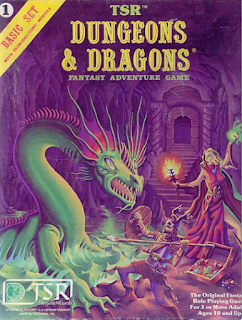
Old School Ramblings #1 - Play Now, Story Later

NOTE: This series of articles are about what old school means to me and what I like about old school games. As you can see, my understanding of Old School isn't strictly chronological, and might be a bit unorthodox and opinionated. You're welcome to comment, disagree, and add your own opinions in the comments section.

The definition of "old school gaming" is a contested one. There are many interesting opinions out there, including the ones here. I would like to share some of those and some of my own. Eventually, I will discuss the ones described by Matt Finch in his Primer, which carries a great importance in the definition of OS. Although I might differ in some points, it is a very enjoyable read that I would recommend for anyone interested in OS gaming.

One aspect I really enjoy and identify with old school gaming is what I call "Story Later". This is a way to distinguish OS games from more modern RPGs that are focused in creating a narrative with beginning, middle, end, climaxes, cliffhangers, etc.

(Yes, the term is inspired by this article by Ron Edwards; I think my conclusions are quite different, thought. Instead of writing careful counter-arguments for a twelve-year-old article that has been discussed more times than I can count, I think it will be more interesting to talk about my own experiences. Since I don't fully subscribe to the theory, I see no need to adopt the jargon as well).

Some RPGs have mechanics to enforce a story "flow"; Robin Laws, one of my favorite designers, has created great games based on the idea that a session should be managed with "ups and downs" similar to the ones you can see in a play or a movie, for example. Other examples are Fate RPG and Lady Blackbird, games where the management of meta-game currencies (dice pools, fate points) makes you more likely to succeed after you fail many times and vice-versa. D&D 5e has something similar, to a limited extent, in the Inspiration mechanic.

By Robin Laws - source.

Although those mechanics may sound new, the idea of focusing on stories in RPGs isn't a new one. James Maliszewski, who affirms that Dragonlance "ruined everything", puts it this way (emphasis mine):

"No longer were adventures "modules," implying they could be swapped in and out of campaigns with minimal impact. Now, they had to tell a coherent narrative that was dramatically satisfying."

James points similar approaches in the Desert of Desolation and Ravenloft modules, for example. His stance is a critical one, although he recognizes the success of that approach at the time.

There is an important distinction to be made here, so you don't take this the wrong way. This early "story" modules are described as "railroad-y", meaning the players had little input in the story. Railroading has become some kind of offense nowadays, even though that are still people that don't mind it - although even of those people would probably be appalled by the idea of a PC dying by GM fiat. Now, I don't like railroading, but I will not tell others how they should play their games.

The important thing to keep in mind for the folks that eschew "story" is that railroading is not the only path to story creation. The "modern" games I mentioned above are great example on how to encourage story "flow" without resorting to railroads (some would say that they are incompatible, as there is no story creation if the story is already written). I would even say that this methods are better than the ones originally used by Dragonlance, at least for my tastes. The downside is that the "climaxes", resolutions", etc, aren't guaranteed without previous planning, but clever mechanics may enhance the probability that they should happen at the right time.

I think one way to explain the success of the "story" is that "a coherent narrative that is dramatically satisfying" is not a bad thing. In fact, it is often the way our brain works. We naturally expect such things, and I would dare to say that they can make our games a lot more fun - whether old school or new school.

Here is how Nassim Nicholas Taleb defines the narrative fallacy in The Black Swan:

The narrative fallacy addresses our limited ability to look at sequences of facts without weaving an explanation into them, or, equivalently, forcing a logical link, an arrow of relationship upon them. Explanations bind facts together. They make them all the more easily remembered; they help them make more sense. Where this propensity can go wrong is when it increases our impression of understanding.

The thing is, because our brains work that way, you don't actually need to pursue a narrative in order to create one. As far as my own experience goes, there is a natural pull towards "story" even among people that eschew the idea.

This is a point where I disagree with Edwards, as I think that story WILL, in fact, "consistently emerge from play that does not prioritize it". You see, story will even consistently emerge from our lives, because this is how our brain works. Our lives aren't stories, but simple sequences of events; still, when we think about the past, we cannot help but creating stories.

Whats more, we are creating stories during the events. I am having a change in my job next year, and I have thought a millions times about "how it will end". But it will not "end"; some things will happen, some things will be different, but most things will just continue, No true "resolution" other than the one I create in my head.


I believe this happens during old school games as well. Even if you character doesn't have a name, or dies in the first "scene", you will usually be thinking about what happens next, and will inevitably create a narrative to suit the events.

The difference, then, is one of focus. Old school players, the way I see it, aren't focused on creating a story during play, but they subconsciously create a narrative during the story anyway.

The question that arises is: are there any guarantees that the story will be "coherent" and "dramatically satisfying" enough? For me, the answer is NO, not necessarily - specially if viewed from the outside. In fact, games focused on creating stories might, well, create better stories (and that is a whole different thing, one I can enjoy too).

Think of it this way: I'm a regular guy. If I tell you some stories about my life, it might bore you to tears. Still, these stories are interesting to me because they happened to me. I didn't find a soul-mate, got a job, traveled around, etc, to create stories, but, ultimately, to be a part of something. If I were focused on creating a narrative during the events, I think it might detract from the whole experience; but the stories I can tell about such things are usually easier to remember than most stuff I have read from C.A Smith, R.E Howard and others.

Old school gaming, for me, is like that: it creates interesting stories not because they follow a three-act structures or use effective plot devices, but because we are focused on participating as they as they happen.

We have fun now, and tell stories later.