I must create a system, or be enslaved by another man's. I will not reason and compare: my business is to create.

- William Blake

Showing posts with label Teratogenicon. Show all posts

Saturday, May 31, 2025

Undead types and NPCs

I recently remembered the similarities between death knights and skeleton warriors. Both are powerful undead creatures, clad in decayed flesh and ruined armor, big swords, with ominous red dots for eyes.

[Wraiths also have red dots for eyes in their descriptions. And decaying flesh. Wights are similar].

One major distinction is that skeleton warriors are typically enslaved by a wizard, compelled to serve without autonomy. Death knights retain their will and intelligence—although, theoretically, they could be bound by a powerful spellcaster, like ANY undead could.

[I'm remined of "The Empire of the Necromancers" by Clark Ashton Smit. Go read it, it is awesome. Some undead retain some memories by accident, not because a wizard decided to create a specific "type" of undead].


So they look similar and serve similar purposes. It is unlikely that PCs would be able to tell them apart.

This speaks to a broader Dungeons & Dragons trend: the proliferation of nearly identical monsters.

Personally, I’d prefer a “powerful undead” template with variations instead of dozens of creatures that mostly feel the same. Imagine, for example, a system where magical users become liches, warriors evolve into death knights, and thieves fade into shadows or something similar.

Maybe they can keep (some of) their levels, so you'd have undead of all levels of power. These can be individuals, not simply monster types. Whether they are enslaved or not, or if they lead other undead, or if they wear armor or carry a sword, depends on their circumstances.

Not all liches must be super powerful! Some minor wizards could take a chance and botch the process a bit. Same goes for other types of undead.


In my book, Teratogenicon, I describe three fundamental types of undead:
  • Mindless – Purely animated bodies, like zombies and skeletons. These do not need personalities or many details.
  • Bodyless – Entities of mind and soul, but no physical form (ghosts, wraiths). Some will have interesting personalities and traits.
  • Soulless – Powerful creatures like vampires, liches, and death knights. While they retain their physical and mental abilities, they are somehow estranged from their souls. Maybe it is stored somewhere safe, maybe it is lost, or maybe just forgotten and they could be redeemed (but that'd probably cause their physical/mental demise). "Soulless" is a more poetic than practical description. They definitely deserve some history, personality an and traits!
This categorization offers a simple and effective way classify undead though a body/mind/soul divide. Undeath creates a fissure—some beings lose their autonomy, some exist only in spirit, and some are something else entirely.

Of course, there could still be liminal undead: creatures that keep some of their mental faculties, like ghouls, or protoplasmic shapes that are just echoes of souls and no actual souls, poltergeists that can affect the physical world up to a point, or dead bodies inhabited by spirits that belong somewhere else.

As you can see, I have nothing against undead types; in fact, I wrote a PDF with one hundred of them and ideas on how to create even more ("glowing red eyes" are there, but there are more than 100 traits to choose from!) . 

But I think some types of undead, specially the most powerful ones, should be seen as individuals (NPCs) rather than monster types.

Thursday, January 23, 2025

AD&D DMG cover to cover - Part XI, p. 174-215 (Appendices C, D, E - Random monsters)

We've been reading the original DMG - the ultimate DM book! - but from a B/X and OSR point-of-view.

Check the other parts of this series here.

Today we discuss random monsters!


APPENDIX C: RANDOM MONSTER ENCOUNTERS

This includes extensive tables for random monsters. These are bigger, more detailed, and overall a bit better than the weird B/X / OD&D tables. Whales are not encountered in any kind of "water", but only in "deep water", etc.
"the only monsters which are included are those in MONSTER MANUAL. Two notable exceptions to this are those the mezzodaemon and nycadaemon which are found in the AD&D module D3, VAULT OF THE DROW (TSR Games, Inc.). If you do not have this module, simply ignore results calling for these monsters and roll again." 
A weird choice, but okay; the author found these two creatures important enough to be part of the core.

This section includes encounters in dungeons, outdoors, water, underwater, airborne, astral, ethereal, and also psionic encounters, whatever these are.

I'll admit this looks like it is too much for me. Underwater adventures are maybe 100 times less common than forests, at least in my campaigns.

First, there are random dungeon encounters. I do not think this is a great idea but the tables are detailed enough that they may help you create your own dungeon, with a proper theme and hopefully some coherence. 

There is a big focus on balance here; in theory, players can only find the strongest dangers if they travel deep enough (alike wilderness encounters, where they can suddenly face a couple of dragons). This has indeed some "mythic underworld" vibe, with little regard for naturalism/realism/etc: the deeper you go, the bigger and more numerable the monsters become. You can find a dozen bandits on level 1, but there is 120 of them if you find them on level 10.

You can also find adventurer NPCs, each extremely detailed, including random magic items. It is not clear how - and why - are these tables different from the ones in the appendix P.

The book recommends you prepare several parties/NPCs in advance. Looks like a lot of work, but fortunately we might have some tools like this one to make it automatic.

Underwater encounters are simple enough, but detailed - they are "are divided into those which occur in fresh water and those in salt water (seas and oceans). Each division is further broken down by depth - shallow and deep water encounters". Not much to comment here, and not much use for me as noticed above.

ASTRAL & ETHEREAL ENCOUNTERS are next. These are completely baffling to me. The explanation might be elsewhere; I might have read and forgot about them, or skipped it (probably they are the result of some spell?). The glossary indicates there is an explanation in the PHB, so its my fault for not reading it first. 

After some research, it seems these pertain to a certain spell, so maybe they should be include in that context. Like underwater encounters, I feel these won't be used often.

In any case, these are evocative and very interesting. It makes astral/ethereal travel feel dangerous and exciting.

PSIONIC ENCOUNTERS may happen if PCs are using psionic powers - these apparently can attract demons and other entities, which is sinister. These seem to manifest out of thin air (since the yellow mold doesn't move IIRC), so I'm not sure why the book suggests "Roll until an appropriate encounter occurs, ignoring inappropriate results" for this particular table only.

OUTDOOR RANDOM MONSTER ENCOUNTERS is the meat of the chapter. It has tables and subtables for Inhabited areas, Uninhabited areas, Castles, multiple types of terrain in various climates (artic, subartic, temperate, etc.), plus some setting conditions like "faerie", "Pleistocene" and "Prehistoric".

Well, Pleistocene is part of "Prehistoric", but here it means "Age of Dinosaurs", as indicated by the table. The book adds: "Feel free to devise your own encounter matrix for Jurassic, Triassic, or other period with non-aberrant creatures.". 

Why are there no mountains, hills river or seas in the age of dinosaurs? No idea. Probably it is the other way around: in D&D-land, you'll only find dinosaurs in these places.

Pleistocene conditions are somewhat to Sub-Arctic Conditions, without fantasy creatures such as trolls, etc.

I can IMAGINE the Pleistocene/prehistoric tables could be combined for a pulp/S&S campaign, but then you'd also need a river/sea table without nixies, hobgoblins and such. as written, maybe they are meant to apply to certain "lost world" parts of your settings - despite dinosaurs and mammoths being found in the regular tables too.

Putting everything together looks like a bit of a headache, but hopefully this too can be automated (I am sure there is an online roller somewhere, please let me know in the comments!). This one is based on 2e.

AIRBORNE RANDOM MONSTER ENCOUNTERS is short and sweet: "simply use the appropriate
OUTDOOR RANDOM MONSTER ENCOUNTERS table [...] but an encounter occurs only if the creature indicated is able to fly or is actually flying."

CITY/TOWN ENCOUNTERS are meant for unexplored cities, basically. They seem to happen incredibly often ("every three turns"), probably because you meet people all the time in a city, but many will simply ignore the party. 

Checking that often must be a bit of a hassle in practice; maybe we could just check a few times a day for "memorable" encounters that are likely to approach the party.

Also worth noticing that ordinary people seem to be a small percentage of encounters. I'd assume there are more, but unlikely to make memorable encounters. As written, these tables make cities extremely  dangerous, full of demons, undead, and bandits, maybe even more than the cities of S&S like Lankhmar.

BTW, this is where you can find the infamous "harlot table" that describes encounters with "brazen strumpets or haughty courtesans".

We also get ANOTHER table to generate magic items for NPCs, for reasons I cannot fathom.

APPENDIX D: RANDOM GENERATION OF CREATURES FROM THE LOWER PLANES

This is, basically, a generator of random demons, devils, etc.

I LOVE this chapter. This is a precursor to Teratogenicon and all similar books.

Basically, it makes each creature weird and unique, from head to toe, including stats. Here is one example created by this generator:

Demon #1
---------------------------------------------
Frequency: Uncommon
No. Appearing: 3
Armor Class: 0
Move: 15"
Hit Dice: 9
No. of Attacks: 3
Damage: 3-9 (Mouth), 2-12 (Each Arm), 
Special Attacks: Summon/Gate, Spell-like Abilities, 
Special Defenses: Acid Immunity, Weapon Immunity, Cold Immunity, 
Other Abilities: None
Magic Resistance: 45%
Intelligence: High
Size: L
Psionic Ability: Nil
Strength and To Hit/Damage Bonuses: 18 (00) (+3/+6)
---------------------------------------------
Appearance:
Head: Human-like  / Knobs
Overall Visage: Wrinkled - Seamed
Ears: None
Eye Color: Metallic
Eyes: Huge, Flat; Two-Eyed
Nose (If Necessary): Slits Only
Mouth: Tusked; Tiny
Bipedel Torso: Ape-like
General Characteristics: Short and Broad
Tail: None
Body Odor: Urine
Skin: Leathery/Leprous
Skin Color: Reddish
Back: Normal
Arms: 2Hands: Taloned
Legs and Feet (As Applicable): Suctioned
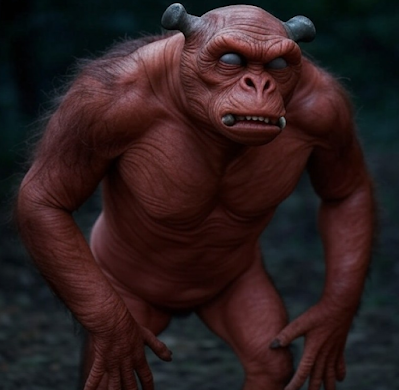
Pictured by Grok using data above.

This technique is great to keep things fresh and keep players guessing, although all fiends share some traits (e.g., magic resistance).

Teratogenicon extends this reasoning to other creature types: undead, aberrations, monstrosities, etc.

APPENDIX E: ALPHABETICAL MONSTER LISTING

A list of monsters and their stats. Probably based on the Monster Manual. No stats for the mezzodaemon, but more than 20 lines for hydras with varying number of heads.

Overall, these appendixes are good, despite some redundancies, weird choices, and mixing things of dissimilar importance without clear distinction, which seems to be a common trend in the DMG.

NOTE: there is a California Wildfire Relief Bundle on DTRPG. It has lots of Savage Worlds (including Savage Worlds Adventure Edition) and a couple of OSR games. "By This Axe I Hack!" and "There and Hack Again" are the most interesting to me.

Contains affiliate links. By purchasing stuff through affiliate links you're helping to support this blog.

Monday, October 23, 2023

Teratogenicon is the DEAL OF THE DAY - 50% off!

Dear friends,

Teratogenicon, our most impressive book, is the DEAL OF THE DAY on DTRPG. - 50% off!

The books is a collection of tables and essays on how to create your own monsters.

It contains one chapter for each of the fourteen most famous monster types (aberrations, beasts, celestials, constructs, and so on). Each chapter examines specific habits, appearance, goals, traits, powers, origins, and many other topics.

In addition, the appendixes will help you to create stats (for both old school and contemporary games), to roleplay monsters, and to include all monster types into a coherent whole, among other things.

If you haven't got it yet, this is your chance. It is compatible both with OSR and modern RPGs. 

If you buy it - or if you already got it - you can also buy my "everything bundle" for a discounted price, after you buy Teratogenicon.

Just check the previews to see if it piques your interest!

And please share, like, upvote and retweet if you can!


Tuesday, June 14, 2022

Teratogenicon: print costs and a discount coupon

A quick post on the subject before DTRPG updates printing costs. If you have the book already, you might skip this post - I will repeat myself...

The Teratogenicon is the most beautiful book I ever produced. Because of this, is the only book we've created with a print version in mind. I really like how it turned out, both in Standard and Premium color.

Now, print versions are not easy to make - I needed a professional artist for that (Rick Troula). And the margins are very small compared to PDFs, of course. I might do a post explaining that further for the people that ask for print versions of my books (I appreciate the interest, BTW).

But this is a book I think it is worth having in print.

Well, now, because of various reasons, DTRPG's printer, Lightning Source, will be increase the print prices. The change will happen on July 13.

And you can STILL get the PDF for a couple of bucks if you buy the print version. 

If you want to get the PDF only, here is a discount coupon. It is good until July 13.

So, if you don't have the book yet, consider getting it before July 13!

Both versions look awesome in print. The premium version looks sharper, brighter, with vivid shades of gray (see below). The paper feels glossier. The standard color is darker - both art and text - but the quality and resolution are mostly maintained.


We've decided to reject the B&W version, as the price difference is too small to justify a (slightly) lower quality (and some text/art visible through the back of the pages) for such a beautiful book. We've also decided that the book is too thin for hardcover, which would also make it more expensive.

As always, you can buy bundles of our digital products for a great price. 

Sunday, January 09, 2022

AI-generated monsters

As you might know, Teratogenicon, my biggest book so far, is about generating random monsters. I'm really pleased with the results - I tried creating a few monsters and it worked out really well . And the book looks amazing - just check the previews!

I'd like to make the process automatic someday. It is probably not hard to do, and I already have all the tables, but I know next to nothing about programming. Well, anyway, here is someone who does:

User Deep-Fold just posted some AI-generated monsters on Reddit. They look vaguely familiar (they are based on official monster art), but very weird, sometimes in ways that a human mind would have a hard time reaching... Truly alien stuff. Makes me wonder if one day we'll write monsters inspired by AI-generated images... 

Here is some of my favorites. 

Flayed beholder:


Burning cockroach demon:


A couple of folks who would fit in Dark Souls:


Lard golem:


Flying orifice:


Whatever the heck these things are:


Unfortunately, there is no better resolution available.


Thursday, November 18, 2021

Teratogenicon - print version now available!


TERATOGENICON - our most impressive book so far - is a collection of tables and essays on how to create your own monsters.

It contains one chapter for each of the fourteen most famous monster types (aberrations, beasts, celestials, constructs, and so on). Each chapter examines specific habits, appearance, goals, traits, powers, origins, and many other topics. In addition, the appendixes will help you to create stats (for both old school and contemporary games), to roleplay monsters, and to include all monster types into a coherent whole, among other things.

The book is beautifully illustrated by Rick Troula (of The Displaced fame). Take a look at the previews to see for yourself!

After analyzing all the POD (print on demand) options, we've chosen to make the book available in softcover, in two versions: Premium Color Book and Standard Color. 

Both look awesome in print! The premium version looks sharper, brighter, with vivid shades of gray (see below). The paper feels glossier. The standard color is darker - both art and text - but the quality and resolution are mostly maintained.


We've decided to reject the B&W version, as the price difference is too small to justify a (slightly) lower quality (and some text/art visible through the back of the pages) for such a beautiful book. We've also decided that the book is too thin for hardcover, which would also make it more expensive. In both cases, if you have a different opinion, let us know!

As promised, we've sent previous costumers a discount coupon today. If you haven't bought the PDF before, you can buy both the PDF and the print version at the same time at a discounted price (we will keep this price for a week, at least). As always, you can buy bundles of our digital products for a great price. 

Thursday, October 07, 2021

Small Press Spotlight Sale - huge discounts

DTRPG is having a Small Press Spotlight Sale. This includes more than fifty thousand titles (all of my books are on sale).

I went looking for " titles has been marked down by up to 60%". I haven't found many books with 60% discount... except for my own! Dark Fantasy Basic is only 2 bucks right now. Probably one of the best prices I ever had.

Teratogenicon is also heavily discounted. The print version is (hopefully) coming soon, and I'll send customers of the PDF version an e-mail with a discount when ti comes out.


Other than that, here are some books that might be of interest:

Low Fantasy Gaming Deluxe Edition is a great take on sword and sorcery OSR. I review an earlier version here.

Astonishing Swordsmen & Sorcerers of Hyperborea is also a great AD&D sword & sorcery clone - this is the second edition, there is a third edition on the way.

Into the Unknown is one of my favorite "minimalist 5e" out there. Completely compatible with 5e.

Mythras is a d100 game (adjacent to Runequest) with cool combat mechanics, analyzed here.

The Chapel on the Cliffs is one of the best 3rd-party 5e adventures I've ever played. If you're looking for a 5e Halloween adventure, this is it. Recommended.

Warlock! and Troika! are "British OSR" games, inspired by Advanced Fighting Fantasy. Both look fantastic in different ways, but I haven't played them yet.

Did you find other good deals? Let me know in the comments!

*These are all Affiliate links - by using them, you're helping to support this blog!

Tuesday, July 06, 2021

A Groats-worth of Grotesques - a baroque OSR bestiary

I've got a review copy of A Groats-worth of Grotesques* from G. Edward Patterson III, one of the alpha readers for my Teratogenicon book. He gave me valuable advice on my book, and I'm not sure I am completely unbiased (so this is not exactly a review), but this book looks very interesting.

In short, this is an OSR bestiary, or a "baroque bestiary" as the author call it. 


Here is the blurb:

Being a SYSTEM-AGNOSTIC Role Playing supplemental treatise ON MONSTERS; which is to say a BESTIARY for your Tabletop Games of Fantasy. Styled in the manner of the Baroque Period; a Curiosity Cabinet of Creatures for enlivening the table!

The over 100 entries were gathered out of sundy authors, philosophers, physicians, and poets; sacred and profane. The illustrations are collages of diverse prints and emblems. From the lowly ant to the earth shattering Behemoth, the mundane dog to the alien Ch M G, this collection is a rollicking gambol through history and myth. 
This style of language in used throughout the book. It reads like an "in universe" (or diegetic) bestiary, with no separation between "ordinary" and magical beasts; it has ants (who makes friends and enemies out of other insects), crocodiles (that impale people on their thorny backs), dragons, golems, aliens, and even a haunted umbrella (pictured in the cover) listed by alphabetical order. 

I really like this idea; there is no reason why ants in Elfland should be identical to earthly ones, and "in universe" writing is always good for inspiration.

It also has entries for fighters, magi, clerics, etc., with various orders, philosophies and so on.

It doesn't include many "typical" D&D creatures like elves and ogres. Instead, it focuses on the bizarre.

Here is a typical page:


The art is old public domain stuff of the same quality you see above. Every monster is illustrated. The sidebars are full of small details and ideas about the monsters. The book contains a fully hyperlinked Table of Contents. It also contain a rules appendix with many ideas on large monsters, swarms, grappling, etc.

I think this would make a good bestiary for "genuine" medieval campaigns, inspired by Arthurian legend and medieval myth rather than Tolkien and Vance (it reminds me of Ars Magica*, for example) or to add some new, strange creatures to your D&D/OSR games. 

Check the previews on DTRPG* to see for yourself!

*By purchasing stuff through affiliate links you're helping to support this blog.

Friday, March 26, 2021

Did you miss the sale? No problem!

Teratogenicon, our most impressive book yet, was the DEAL OF THE DAY on DTRPG... and now the day is over!

But don't worry - I'm here to help you out! I created a discount coupon, good until Easter (April 4).


If you haven't got it yet, this is your chance. It is compatible both with OSR and modern RPGs.

And it has AMAZING art by Rick Troula - just check the previews!

(This is the first time I do this. Let's see how it works. I was worried that people might miss the deal because I didn't advertise enough in advance... but I'm not sure this is a great strategy for me. After this is finished the price will probably increase to make the whole viable. BTW, I'm planning a physical version soon, in addition to some new books! Anyway, I hope you enjoy it.).

Thursday, March 25, 2021

Teratogenicon is the DEAL OF THE DAY!

Teratogenicon, our most impressive book yet, is the DEAL OF THE DAY on DTRPG.

If you haven't got it yet, this is your chance. It is compatible both with OSR and modern RPGs. 

And it has AMAZING art by Rick Troula - just check the previews!

Saturday, August 01, 2020

Dark Fantasy Basic - and Characters - ELECTRUM SALE!

If you already know my stuff, skip this post! Otherwise...

Dark Fantasy Basic is an electrum product in DTRPG. This means that it is somewhere around the top 10% (maybe 15% to 5%) best-sellers in the entire site!

And now Dark Fantasy Characters is also electrum!

I am very happy to see that!

I have about a dozen books in DTRPG. Some short, some long, some free, some PWYW, etc. Of course, I'd like to see them ALL with lots of readers. But there is one in particular that I think deserves more attention: the Teratogenicon.

If you know any of my books, the writing style might be similar. However, the ART and LAYOUT in Teratogenicon is something else, as you can see in the FREE preview, and in the page below. Teratogenicon is already a "best cooper seller"!

Let's reach for gold And beyond!

Anyway, I've put them all on sale for a short while (ate least until the end of August). Enjoy!


Click on the labels  below to se more posts about these subjects!

Thursday, May 07, 2020

Owlbear-like generator

The TERATOGENICON is coming!

Roll 3d6.

Head.
1. Owl.
2. Hawk.
3. Parrot.
4. Komodo dragon.
5. Alligator.
6. Snapping turtle.

Body.
1. Bear.
2. Sloth.
3. Gorilla.
4. Monkey.
5. Giant Armadillo.
6. Wolverine.


Cool power.
1. Limited flight or swim.
2. Stealth.
3. Tough armor.
4. Burrowing.
5. Climbing.
6. Tail club.

Stay tuned!

UPDATE: the TERATOGENICON has arrived!

Saturday, November 03, 2018

Celestial Creation

From an early draft of Teratogenicon:

Celestials are creatures native to the Upper Planes. Many of them are the servants of deities, employed as messengers or agents in the mortal realm and throughout the planes. Celestials are good by nature, so the exceptional celestial who strays from a good alignment is a horrifying rarity. Celestials include angels, couatls, and pegasi.
A typical celestial has the following traits:
Size: any.
Alignment: Lawful Good.
Abilities: varies.
Common resistances/immunities: charm, fear, nonmagical attacks.
Senses: Darkvision.
Languages: Common, Celestial, and many other languages.
Challenge: 2d6.

Habits, diet and habitat

Celestials live in different planes to humankind and often come with a specific mission. Angels and their kind can live anywhere and do not need to eat, drink or sleep. Animal-shaped celestials, such as unicorn and pegasi, are usually more mundane in this aspect.


Appearance & Powers

A celestial’s heavenly nature manifests in their appearance, as auras of gold, shining armor, and feathered wings. When they take humanoid form, they are healthy, strong, and thin specimens. Some celestial are somewhat more mysterious and less human, as if to indicate they are somewhat superior or different from mundane beings (the last eight entries are darker than the rest; use 1d12 if you want a more traditional look).
Attacks. Celestials often carry big magic weapons with impressive special properties. Even when unarmed, their attacks are usually considered to be equivalent to magical weapons.
Some celestials can project attack with beams of radiant damage, auras of fire, and so on (spheres of energy originate on the celestial but do not affect it). Celestials without ranged attacks will often have strong defensive powers (teleportation, invisibility, etc.).
Energy. This table applies to the celestial’s attack and possibility to their features as well – fire halos, radiant wings, lighting auras, and so on.
Animals. Some celestials look like animals - examples are winged lions, golden stags, unicorns, etc. Some were actually animals once, now ascended by the contact with higher powers (in this case, their attacks will probably be unarmed – although some animals may carry weapons in their mouths or possess intelligent weapons that fight by themselves on command). Other celestials have animal features, animal motifs in their clothing, animal companions, or the ability to transform into animals. The list below contains the animals most commonly associated with celestials.
Color/metal. These colors and metals are commonly applied to celestial features – clothes, eyes, wings, hair, skin, etc.


Origins and goals

Celestials are usually created by deities, but there are other possibilities. Their goals are usually benevolent, but not always. Notice that some deities have draconic laws against insignificant sins (wearing the wrong color in a temple, eating forbidden food, etc.).

Tables


All art: copyright Peter Mohrbacher.
---


If you enjoyed this post, you'll certainly enjoy the final version: Teratogenicon, the ultimate monster builder! It is full of random tables like the ones above and it has amazing art by Rick Troula. Chek the previews to see what I mean!

Saturday, October 20, 2018

ABERRATION GENERATION!!! (5e)

From an early draft of Teratogenicon:

Aberrations are utterly alien beings. Many of them have innate magical abilities drawn from the creature’s alien mind rather than the mystical forces of the world. [from the SRD]

Aberrations are the strangest and most variable type of monster. A giant with two heads or blue skin is still a giant; a giant with a head on its stomach, a serpent for a tongue and half a dozen slimy tentacles where the legs should be is probably an aberration.
Some aberrations are very intelligent while others are dumber than farm animals, but most of them are utterly unpredictable. Their alien, deranged minds are capable of feats unknown to most of humankind – innate magic, telepathy, baffling schemes and calculations – but can also make them erratic and self-destructive. Few aberrations have humanlike capacities – most are either incredibly gifted or incredibly stupid, although some appear to be both.

Habits, diet and habitat

Aberrations are alien enough to defy comprehension. They are mostly inscrutable, although many behave like common predators, killing for food and sport. Most aberrations need food and water to survive, although some seem to subside on psychic energies, ether, or other mystical energies. They often live in forgotten dungeons, temples and caves, away from human eyes, since none in their right mind would suffer them to exist.

Traits

A typical aberration has the following traits:
Size: any.
Alignment: Chaotic Evil.
Abilities: good Strength, Constitution; bad Charisma, Intelligence.
Senses: darkvision 60 ft.
Languages: Few aberrations can comprehend languages and even fewer can speak. If they do, it is likely Deep Speech, Common, or Undercommon.
Challenge: 2d6.
Attacks: upper limbs (see below) and others.
Appearance. The first five tables describe an aberration’s appearance – skin, upper and lower limbs, body and special features. There is no entry for heads – the head, if any, will be appropriate to the body most of the times (amoebas will rarely have heads, octopuses have heads and no bodies, etc.). However, you can roll twice on the body table to produce a different head.
A monster with no upper limbs must attack with the lower limbs or other body parts (bite, slam, etc.). A monster with no lower limbs may use pseudopods, some form levitation, move with the upper limbs, or just roll around.


Special Powers

1. Genius: The monster has genius-level Intelligence (18 or more), knows a few languages and mental skills, and gains one additional special attack appropriate for an intelligent creature (psionic blast, ray gun, spellcasting, etc.).

2. Telepathy: The monster can magically transmit simple messages and images to any creature within 120 feet of it that can understand a language, and detect the overall intentions of their foes from the same distance.

3. False Appearance: While the monster remains motionless, it is indistinguishable from a common object, animal or terrain feature (rug, tree, cow, humanoid in robes, stalagmite, bundle of ropes, etc.).

4. Teleporting: As an action, the monster can teleport, along with any equipment it is wearing or carrying, up to 120 feet to an unoccupied space it can see.

5. Aberrant Ground: The ground in a 10-foot radius around the monster is difficult terrain (doughlike, frozen, slippery, filled with tentacles, etc.). Each creature that starts its turn in that area must succeed on a Strength saving throw or have its speed reduced to 0 until the start of its next turn.

6. Regeneration: The monster regains (2xCR) hit points at the start of its turn. If the monster takes one specific kind of damage (choose one from fire, acid, radiant, etc.), this trait doesn’t function at the start of the monster’s next turn. The monster dies only if it starts its turn with 0 hit points and doesn’t regenerate.

7. Carapace: the monster has a thick carapace that adds +2 bonus to AC and all Dexterity saving throws.

8. Fog: the monster is constantly surrounded by a thick fog (or illusion, cloud of darkness, etc.) that makes it invisible to all creatures that are not within 15 feet of the monster.

9. Four-dimensional: the monster lives in four dimensions and occasionally shifts out of existence. As a bonus action, the monster can roll 1d4. On a 1 or 2, nothing happens. On a 3, it shifts partially out of the three known dimensions, becoming heavily obscured. On 4, it enters a fourth dimension, where it is still visible yet it cannot affect or be affected by anything on the material plane. The effects last until the beginning of its next turn.

10. Shapechanger: The monster can use its action to polymorph into a Small or Medium humanoid it has eaten in the past, or back into its true form. Its statistics, other than its size, are the same in each form. Any equipment it is wearing or carrying isn’t transformed. It reverts to its true form if it dies.

11. Engulf: As an action, the monster engulfs a Medium or smaller creature Grappled by it. The engulfed target is Blinded, Restrained, and unable to breathe, and it must succeed on a Constitution saving throw at the start of each of the monster’s turns or take (2xCR) bludgeoning damage. If the monster moves, the engulfed target moves with it. The monster can have only one creature engulfed at a time.

12. Drain: As an action, the monster deals (CRx1) damage to a creature, and regains hit points equal to the damage the creature takes. The target must be grappled (blood drain) or charmed (psychic drain) by the monster.

13. Alien Mind: The monster is immune to scrying and to any effect that would sense its emotions, read its thoughts, or detect its location. In addition, if a creature attempts to do any of these things it must succeed on a Wisdom saving throw or take (CRx1) psychic damage and suffer the Stunned condition for one round.

14. Replicating: The monster is usually accompanied by 2d4 smaller versions of it, with lower CRs. The sum of their CRs cannot exceed the monster’s CR.

15. Horrific Appearance: Any humanoid that starts its turn within 30 feet of the monster and can see it must make a Wisdom saving throw. On a failed save, the creature is Frightened for 1 minute. A creature can repeat the saving throw at the end of each of its turns, with disadvantage if the monster is within line of sight, ending the effect on itself on a success. If a creature’s saving throw is successful or the effect ends for it, the creature is immune to the monster’s Horrific Appearance for the next 24 hours. Unless the target is surprised, the target can avert its eyes and avoid making the initial saving throw. Until the start of its next turn, a creature that averts its eyes has disadvantage on attack rolls against the monster.

16. Magic Resistance: The monster has advantage on saving throws against spells and other magical effects.

17. Flying: The monster has a 30 feet flying speed.

18. Gibbering: The monster babbles incoherently while it can see any creature and isn't Incapacitated. Each creature that starts its turn within 20 feet of the monster and can hear the gibbering must succeed on a Wisdom saving throw. On a failure, the creature can't take reactions until the start of its next turn and rolls a d8 to determine what it does during its turn. On a 1 to 4, the creature does nothing. On a 5 or 6, the creature takes no action or Bonus Action and uses all its Movement to move in a randomly determined direction. On a 7 or 8, the creature makes a melee Attack against a randomly determined creature within its reach or does nothing if it can't make such an Attack.

19. Telekinetic field: While the monster is conscious, it has advantage in Strength and Dexterity saving throws. Melee attacks against the monster have disadvantage, and ranged attacks miss automatically.

20. Roll twice
Color images:  copyright WotC. B&W images: art by Rick Troula - see below!
---

If you enjoyed this post, you'll certainly enjoy the final version: Teratogenicon, the ultimate monster builder! It is full of random tables like the ones above and it has amazing art by Rick Troula. Chek the previews to see what I mean!