I must create a system, or be enslaved by another man's. I will not reason and compare: my business is to create.

- William Blake

Showing posts with label actual play. Show all posts

Saturday, February 28, 2026

The fireball hand grenade

You might have heard me complain about fireballs a couple of times, so I hope you'll forgive me for trying a new fix to a problem some of you might share. The fix is really simple and does not significantly nerf MUs (in fact, I'm not sure it is enough).

Usually, when an MU throws a fireball at a group of goblins, things like saves and damage rarely matter - goblins within blast radius are toast. Which is fine, but it gets weirder and weirder to me when the MU can instantly kill a group of orcs, lizard men or even bugbears.

What if we just roll damage as usual (say, 7d6 for a 7th-level MU), but that is the TOTAL damage dealt. So, against a group of goblins, a weak damage roll (say, 20 points) and a successful save would reduce the number of goblin casualties to only two or three.

The damage is distributed as the GM sees appropriate - think of the fireball like a hand grenade! Most of the damage hits the center, shrapnel spreads outward.

This logic seems to work for groups. Against a single creature, the fireball remains equally effective. If you want to change that, you can just decide that, like a grenade, the main target gets most of the damage but a part of it (say, half of the damage, round down) is spread around.

Lightning bolt could function similarly, but maybe I'd let the MU concentrate all damage into a single creature or create a "line" of damage that diminishes as each creature is hit in a straight line. This spells has not been as common in my games, however. I'm even tempted to treat dragon breath in similar way (well, as a flamethrower) and let fighters jump with their shields in front of wizards when needed.

Anyway, I like this idea because it makes a 10d6 fireball very different from a 5d6 fireball against a group of lesser foes, which gives the wizard a real sense of progression without making him overpowered in comparison to fighters. Thinking of them as grenades makes them feel more grounded and tactically interesting, giving MUs interesting choices of where to aim - and it is also reminiscent of the original Chainmail origins that treated wizards like artillery.

Tuesday, June 17, 2025

Creating and using random encounters

There are several ways to use random encounters. I've tried many, each with its own pros and cons. That’s what we’ll discuss today.

1. 

First, let's start with the traditional method: during the game, you check for an encounter. If there is one, you roll on the random encounter table, then determine number appearing, distance, surprise, reaction, and other details. If often involves page-flipping to even begin describing how many bears the players see (nowadays, most tables say "1d6 bears" instead of "bears", which is the bare minimum IMO).

The advantage is that the game becomes more unpredictable for the GM, which can be fun. For the players, the game gets a feeling of authenticity: they seem the fictional world unfolding WITHOUT much GM input, like if it existed without the GM or players. It feels more "real".

The downside is that rolling each encounter along with all its characteristics can take a long time as it involves half a dozen rolls plus maybe making sense of it all. The fact that the PCs have to wait and do nothing as you roll makes things even worse IMO.

Here is one example from AD&D:


2.

My solution to the traditional method, in order to save time, was creating the encounter tables that contained most of the necessary rolls and also some useful information to minimize page-flipping or consulting other tables (for example, NPCs names or activities).

Notice you can still ask the players to roll a random encounter with similar effects as method 1, and the GM will be equally surprised. My tables use even less input form the GM (for example, the GM doesn't need to come up with a name on the spot, or a reason for the results).

Here is one example from my book:


3.

Method 3 is like method 2... only smaller. You can roll a dozen random encounters beforehand, for example, and ask players to roll 1d12 when they have an encounter.

[You need to replace encounters as they are used, but you can do that between sessions].

The GM will not be as surprised during the game, but the players will still get a bit of that authenticity as they roll the d12.

This also allows the GM to add some details that are pertinent to the campaign beforehand. For example, to decide if brigands would be willing to support or fight the usurper king that sent the PCs on a mission, etc. 

One real example I could have tried is making a d12 table with lots of goblin encounters as the PCs entered goblin territory, but I ended up using method 4 (I simply chose a goblin encounter for the next random encounter).

4.

Method 4 gets rid of some or all of the randomness. You can roll some random encounters and choose your favorites, or you can simply pick the from a table or monster manual (so they are not even "random" anymore).

You can add some of the randomness back by taking the encounters you chose and making a d12 list like method 3. 

In conclusion...

Another way to see this is that, even in a simple game like OD&D or B/X, there are thousands of encounter possibilities - only a few dozens monsters but hundreds of circumstances (reaction, surprise, distance, etc.).

If you add your own twist to an encounter (NPC's names, what they were doing, etc.), you have millions of possibilities.

But when the encounter happens, this must be reduced to ONE scenario. 

This process of reducing a million to one involves die rolls (from the GM or players) and GM input. Players usually only participate in choosing the monster indirectly (by rolling dice or by choosing terrain etc., unless they are tracking a monster or something similar).

So there are three aspects to consider here: randomness, GM's fiat and player participation.

Now I notice this reasoning applies to the entire game: you have a set of almost infinite options (which creatures can the DM include in his setting?) and it eventually must be reduced to one ("six goblins attack!"). 

This process always includes GM's fiat, must include player participation (in order for it to be a game and not a monologue) and may include some randomness.

also, in short:

Maximum prep gives you familiarity, coherence and ease of use, but no surprises/excitement* for the GM.

(*Except for PC's actions, and not even this if you railroad.)

Maximum randomness gives surprises but also incoherence and long pauses.

There is a balance to be found IMO.

Which is not much of a conclusion I guess... but that's what I got for today.

Monday, February 24, 2025

Yam-Shaped Campaigns

This is not my idea; the term may have been created by Sly Flourish but I couldn't find the exact source. In any case, I think it is a concept worth discussing and spreading.

Many people discuss "railroad" campaigns and "sandbox" campaigns as if they are opposite choices. I don't think this is entirely accurate. In any case, there is a third alternative that is probably my favorite: the "Yam-Shaped Campaign."

A "Yam-Shaped Campaign" is "narrow at the beginning and end but wide in the middle". In other words, it has a clear beginning (possibly with clear goals) and one (or preferably, a few) explicit endings. However,  HOW and IF you'll get there is up to the PCs.

In 5e D&D, Tomb of Annihilation (ToA) and Curse of Strahd (CoS) are good examples. In B/X, my favorite is probably B10 Night's Dark Terror.

Instead of adding a picture of a yam to this post, let's try this.


The PCs start the game at point A, in an exact place and time. Although this might seem to be the case for all campaigns, it is not. For example, if you're running a random wilderness, the PCs might be in a world of quantum randomness.

Points B and C are two possible "endings": let's call them the good ending and the bad ending.

In this kind of campaign, the PCs will usually have, at the very least, a vague idea of B or C. Conversely, they might have a vague idea (or a few options) on where to go NEXT and they eventually find out about B or C as the campaign progresses.

The black lines represent the multiple paths the PCs can take. The grey lines represent possible paths that lead the PCs away from the proposed ending.

Let's try some concrete examples.

In Curse of Strahd, the PCs begin near the village of Barovia. They know one possible "bad ending": they get stuck in there forever. This is unlikely to actually happen, because both the PCs and the villain are unlikely to sit and wait. So they have a clear goal instead: get out of there.

With that in mind, they can wander around looking for an exit, and they'll eventually realize that the only way to do that is to face Strahd. This is "point B". When they face Strahd, they can defeat him, join him, replace him, etc. 

The book even contains a page describing what may happen next, but this is beyond the scope of the campaign. Having this is very common and useful, because you might want to continue playing after Strahd has been "resolved".

In the diagram above, I used "time" as an axis. This can be some type of "STRICT TIME RECORD" or something more abstract. Strahd has no clear timeline, but the confrontation gets closer and closer. Tomb of Annihilation has a strict time limit: if enough time is passed, the PCs simply fail and everyone is doomed (IIRC).

Both approaches are possible, but I think SOME time pressure is needed in this type of campaign or the PCs might wander around aimlessly.

In any case, there is at least two possible endings; probably more. I think of point B as some kind of "final showdown" that can result in victory or tragedy (C).

Even if the "endings" are clear, the GM might have to choose what to do if they are skipped. What happens if there is a TPK, for example (all PCs die?). Do they start again with new PCs? Turn back time? Find a new campaign? Or maybe advance the time line a few years, and create PCs that must serve/oppose the (now victorious) antagonist?

What if the PCs leave the continent or ignore the villain? Same thing. Most decent campaigns will at least give you an idea on what to do next, but you're mostly on your own.

When I wrote my own adventure, I didn't know this "Yam-Shaped Campaign" terminology. But I did include an "aftermath" section that I'll add here as an example, as it includes:

- Two possible "boss" endings.
- What happens if the adventurers just fail or leave.
- Ideas for more adventurers if they succeed.

These three possibilities are the bare minimum, I think, to include in a yam-shaped campaign. Here is how it looks:
Aftermath
Here is what happens after the end (or in the middle, in some cases) of the adventure.
If Malavor is slain, the bee-people will immediately destroy the remaining demons. The Queen (now free from mental slavery) will telepathically ask the adventures for death, but she will resurrect from its own carcass (as an ordinary bee) in less than one minute and fly away. The fortress will collapse within 1d6+6 days. The demons in the underground will be buried alive. Some might survive.
If the Queen dies, bee-people will disperse immediately. It will take Malavor 3d6 days to summon another avatar or come up with a new use for his fortress. His success is not guaranteed. He might try a different plan. In any case, the hive will still be a menace as long as Malavor lives.
If both the Queen and Malavor are still alive, the hive expands. In 2d4 weeks, the number of demons and bee-soldiers is doubled, and the hive’s defenses are reinforced. In another 1d6 weeks, Malavor manages to mutate himself into a bee-demon, half-insane, but with full control of the bee-people. The bloated and sick avatar dies after a while, but this no longer affects the bee-soldiers, that can now be cloned in the underground. Three months after the characters left, Malavor unleashes his army against the nearest village.
The underground is a different matter. The underground is currently running its own schemes. It supports Malavor but only because he lets them do their own stuff. If Malavor leaves the hive, they will quickly take it. They will seal all doors to the outside, leaving a couple of secret passages. They might demolish the towers to avoid getting attention from the outside, and cover the whole fortress in dirt to transform it into a mound. They are digging their own underground tunnels, leading to somewhere miles away… or miles below. There are more demons in the Abyss that spawned Malavor and the biomancers.
In addition, unless Zothaq and more than half the biomancers working underground are killed, the underground keeps expanding until it becomes some kind of megadungeon, full of demons and hybrid life forms. The forest around the ruins of the hive becomes progressively weirder, with mutant beasts prowling around. Fortunately, they have no plans of conquering neighboring towns right away (the idea here is that the characters find this out and come back after a while, hopefully when they are a bit stronger).

In conclusion, I have run multiple campaigns. Some could be described as "Railroads," others as "sandboxes," but lately, I have realized that Yam-Shaped Campaigns are my favorites. 

In my sandbox campaigns, I have noticed that the PCs (Player Characters) often get lost easily and have no clear direction. As a DM, I then have to decide abruptly where the game should end, or I let it fizzle out. Conversely, railroad campaigns feel terrible: it is like the PCs have no choice and I have the sole responsibility of taking the game to the end.

Yam-Shaped Campaigns give me the best of both worlds: the PCs are free to wander around and surprise me, but I always have an idea about what is going to happen next and we can even have an epic  - or tragic! - ending before moving on.

Contains affiliate links. By purchasing stuff through affiliate links you're helping to support this blog.

Friday, December 06, 2024

A real encounter with quantum goblins

Here is one experience that might be worth discussing.

I (accidentally?) "quantum ogred" my players this week. I also used some improvising and encounter balancing, two things I usually dislike.

And here is how it happened.

A few weeks before, the PCs had defended a town from goblin attacks. However, when the local lord asked their help to defeat the goblins entirely, the PCs decided the reward was not good enough, so they left.

When they went back, I said "roll a d20 so see how town fared against the goblins". I didn't have a rule for that, but I thought it made sense to ask this question. "Roll a d20 and see what happens" is the kind of vague/free-form rule I usually avoid, but this is what I defaulted too.

They rolled a natural 1.

I decided the town had been burned to the ground, then I remembered this post and decided d100% of the populace had been killed/fled. 

I rolled 89.

Only 11% of the population was left. The city had been razed and sacked.

So the PCs decide to ignore the goblins again and go North, through goblin territory, to find a Tabaxi tribe for their own reasons.

Now, this is LITERALLY goblin territory, and they knew it. Here is the map:


Anyway, when they got to hex 29.20, I rolled a random encounter: an hydra.

And I could (should?) have rolled again, because of the "double dragon" rule.

[This is something I mention in Basic Wilderness Encounters but I didn't invent: when you roll a dragon encounter, roll again ONCE, unless it is a green dragon in the forest, red dragon in the mountains, etc - this is meant to avoid the large number of dragons you find in B/X encounter tables.]

Instead, I suddenly decided the encounter should be with the goblin tribe that attacked the city.

Looking back, this feels a bit like railroading: the PCs had decided they wouldn't fight the goblins. And the goblins didn't appear in the random encounter table.

The thing is, the goblins were in the region. I hadn't assigned a specific hex for them, nor had I added this specific tribe to the encounter table - I had just assumed the PCs would look for them eventually, I'd ask for some tracking rolls, etc.

But I knew the goblins were around there. And I was using goblins from B10: Night's Dark Terror (recommended!), which suggests you "assign" encounters rather than rolling them.

The encounter in B10 had a mounted goblin king and 4 hobgoblins. But the PCs had killed dozens of goblins and are known as "goblin scourge" in the region: this small group just couldn't be that brave (B10 notices the king is ready to flee, IIRC). So I added a goblin encounter (6d10 goblins) on top of that.

It just made sense.

But also, they are level 8 by now (think the usual 4 classes) and most random encounters are just too easy - I needed the extra goblins to make it interesting.

In conclusion... I don't know. 

On one and I hate the idea of forcing the "plot" down the player's throats, or to create "level appropriate" encounters.

OTOH, I didn't stop believing the setting in favor of an expected "plot". They were going through literal goblin territory, after finding out the nearby city (Suykin) had been sacked by goblins. And not all random encounters need to be random? Goblins can plan their own attacks too. I am not sure how "forced" they felt.

And I respected each roll after I asked for them. Natural 1 means the city was defeated. 89% means only 11% were left. 6d10 goblins is the number of goblins in an usual encounter.

Anyway, after they managed to defeat the goblins, I went back to the usual tables. I rolled 12 bugbears. It was uninteresting and felt disconnected to the rest of the game.

I've been playing and running RPGs for 30+ years. Sometimes a game makes me change my beliefs and expectations. This was one of these times, maybe, and I might reconsider how to deal with random encounters in the future.

Well, I guess this is part of the fun of playing RPGS... you're always learning.

Monday, November 18, 2024

The campaign spreadsheet

We used to joke about needing a spreadsheet to run certain games, but, come to think of it, this can work WONDERS for your campaigns - especially if you're playing online, of course.

I'm a bit of an Excel nerd. Not that I know much about it - I just use it for everything, especially to manage my calendar, passwords, goals, new year resolutions, links, and so on.

I have been saving my campaign stuff in text format (see here), plus various PDFs, but I'm certainly using excel (or OpenOffice, etc.) for my next campaign.


The first sheet to consider is a campaign timeline. This it's both a schedule (of future events) and a diary. The diary is basically "set in stone"; the players have access to it (you can have a second column of unknown/secret events to yourself). The schedule is basically a list of things you have planned or rolled in advance: an earthquake on November 16, the Dark Lord is planning an invasion on the October 1st, etc. As the players move closer to the events, they can see some signs and even potentially alter it.

The second sheet to consider is your GM screen. Anything you'd put in your "GM screen": random tables, critical hits, a list of random names, THAC0  tables, etc.

I'd keep random encounters in their own sheet. I've been using my own Random Wilderness Encounters PDF, but come to think of it, it might be useful to be able to edit encounters. Maybe discard some used ones (and roll them again) You could even prepare some encounters in advance, make a d10 table, and replace them as you go.

Then you might have a glossary of sorts: places, people, monsters, and so on. You might list them alphabetically (adding a column to specify "type": location/NPC/ etc) or create different sheets for each.

Characters could have their own sheet too, especially in systems that require math for character building (for example, to figure out skill points for the 2e thief).

You can probably add a sheet of random ideas in the end: links, modules you might want to check, tables you don't use often, and so on.

Now, one might wonder: why not use a .doc or wiki instead?

Well, you can. But spreadsheets may have at least two additional perks.

First, spreadsheets can do math. For example, I can quickly add a formula to know how many HP each PC will have on each level (if I'm playing 5e, for example).

Second, they can roll dice

I'm not an expert at all; I know that "=RANDBETWEEN(1,20)" automatically rolls a d20, and so on. You could create an entire line of formulas to make all the six or seven rolls you need for a random encounter in just a click or two (I could have saved so much time!).

Well, this is just a brainstorming post. Unfortunately, I have little actual practice with campaign spreadsheets.

Hopefully, I can just give you my spreadsheet when I start my next campaign. But if there is one like that out there... let me know! It will save me some work!

Tuesday, October 29, 2024

Unused parts - Reduce, Reuse, Recycle?

Lately, I've been reconsidering the amount of work I put in my campaigns.

As an example, let's talk dungeons. No matter if you create your own, use a published module or random tables, I expect you to have a minimum knowledge of the thing you're running.

The problem is an interesting dungeon has lots of content - and, while the players will probably never see half of it, the GM has to at least give it some consideration.

It is not just the ignored rooms and secret doors that were never found - it is also the NPC with relevant information that the PCs immediately attack, the writings in languages no one speaks*, random encounters/events that do not happen, maybe even the villain monologue that gets interrupted, etc. 

[*For example, I ran Tamoachan the other day and it has SEVERAL writings and dialogues in "Olman" or whatever. Nowhere in the adventure summary I found any warning for the GM about that. I might have missed it. I used both the 1e and the 5e version].

This is what I call this "unused parts".

It seems that the DM will always have a lot more work than the players - the fun part, for me, is that during the actual game (my favorite part) I can sit back and see what the PCs do, as a neutral referee, without having to author anything.

While I love the sandbox format, I think it encourages "unused parts". A sandbox needs huge unexplored parts, and the freedom to allow PCs to go where they want. I takes the GM a lot of work to create or get acquainted with an entire setting.

Here is an example from X I've seen today (from @ericbabe3):


The PCs decide to follow the main corridor, found the treasure behind a secret door, and left. All the work the GM had choosing this module and reading it beforehand was wasted. 

I definitely LIKE the fact that the PCs can do that.

But how to deal with all those unused parts?

Let's see.

- Force them on the PCs (quantum ogre). This is just putting each encounter/trap/room you want to have in your game in front of the PCs, no matter which door they choose. I dislike this - it makes PC's choices meaningless and ruins any sense of surprise for me, the GM, as I know exactly what will happen.

- Randomize everything (random ogre). Roll 1d6 to put a random trap in front of the PCs, no matter which door they choose. Like the example above, it makes PC's choices mostly meaningless, and you still have a few traps/encounters that will simply not happen.

Talk to the players beforehand. In my sandbox, the PCs can go anywhere, but I need at least a vague idea on where they are going. I've scattered several dungeons around the map, but I can't read - let alone remember - each one. So I just ask before the next session about where the PCs intend to go.

This is harder to do with dungeons. Depending on the size of your dungeon and your sessions, maybe you can read only a few levels beforehand.

- Minimum prep. Just do the bare minimum:  give a quick glance to the module and read the entirety of the room IF the PCs get there. This is what I've been doing, but it has led to some confusion on occasion, when the module is not clear enough and I'd need more time to understand. For example, I was once running a module that gave the PCs an "Amulet of the Phoenix" that was simply not described anywhere. I had to improvise in a case of life or death (that deserves a post in the future). Later I found out there was a "Talisman of the Phoenix" or something in the magic item list.

Another example: There are huge unmapped areas in my sandbox that are simply called "giant territory", "goblin territory", and "undead territory". No dungeons in most of these areas - I'll detail them when the PCs get closer, but they at least have a vague idea on what to expect and can make meaningful choices.

- Zooming in an out. Another way to think of this is "zooming in and out". Ideally, modules should be prepared in such a manner. You should be able to get the clear picture from a sentence or two, preferentially in bold, and the have other paragraphs describing what may happen if the players do X or Y.

Any important secrets or details must also be emphasized/ marked to make sure the GM will not miss them.

Likewise, for a overland map, with hexes or otherwise, you could have brief descriptions of each are and then a more detailed description - with a corresponding map - later on.

I know there are several attempts to do that in OSR games. I never read a module that really stands out in this manner, but I'm always searching! Have you? 

- Reduce, Reuse, Recycle. This is especially important if you're creating your own stuff.

Reduce: make it terse, keep prep to a minimum. Don't fill all the details, just create whatever you want to inspire you. "This room has two sleeping ogres, Torg and Gurps, not aggressive but starting to get hungry".  If the PCs kill them while they sleep, you haven't wasted much details.

Reuse: have recurring NPCs and factions, and let they repeat their tactics/traps/behavior sometimes. Let the PCs go back and forth in your wilderness maps. PCs usually need a home base that will be more detailed than other cities. 

Some times, the PCs will enter the same dungeon multiple times (although it is useful to consider how the dungeon changes as they come and go). In my latest "haunted castle" adventure, the undead simply rose again every night.

Recycle. Traps/rooms/encounters that are cool and unused can be kept for later. This is not a "quantum ogre" thing. The PCs must have the option of ignoring it again. You have to deliberately change where the thing is placed, and you have to do it carefully -  the new place must make a last some sense.

Let me know in the comments if you have any other methods to deal with unused parts!

Sunday, October 27, 2024

Spell points revisited

When I wrote Alternate Magic, I tried to keep it very compatible to BX / OSE. 

Here is what I've been using. A spell costs 1 SP per spell level.


As I've mentioned there, the goal was: "At low levels, this is nearly identical to the existing rules. At high levels, casters gain some versatility (they can cast the same spells more often) but they can memorize and cast fewer spells."

Lately, I'm finding this system makes high-level casters even more powerful in some aspects. In my defense, I still think they are OP to begin with, as I've said many times in this blog.

Am I overthinking this? Maybe SP are just not compatible with fireballs. Maybe LotFP was right in simply removing it.

Anyway, here is where I am now:

My PCs are about level 7-8 currently.

A 7d6 fireball destroys pretty much any random wilderness encounter. If you're checking once a day, the MU can always have TWO of them. But I'm using spell points, which makes things much worse.

Likewise, Cure Light Wounds (the baseline Lvl 8 cleric has 3 every day, plus 2 CSW - about 7d6+7 healing) can cure most non-lethal wounds. Using SP gives the cleric even more healing power.

Fortunately, I nerfed the cleric in other ways (a level 7 BX cleric should have raise dead; I use the BECMI progression instead).

(And boosted fighter/thieves. The B/X fighter and thief would have about +5 to hit, plus a magic sword, while the cleric gets raise dead, better saves, and also beats the thief at AC and HD).

Anyway, I still LIKE spell points, but in my next campaign I'm probably limiting them to 2 SP per level for MUs and 1 SP for clerics. Both learn one new spell per level.

So, a 8th-level cleric can still cure a lot of wounds (8d8+8 HP), but he can do nothing else that day. 

A 7th-level MU has four fireballs - still a lot, but after that there is not much else he can do.

(I allow MUs to use swords, they might need it).

What is more, they don't recover all SP overnight. Like wounded fighters they need a few days of rest. 

I've been using "you recover one fourth of maximum HP per day, round up", something I got from SotDL, so maybe use that for SP too.

Anyway, this is not perfectly compatible to B/X (or OSE), as it makes casters a lot weaker. But I think this is necessary to make the game grittier and more balanced.

If you prefer the original feel (MUs start weak and get incredibly powerful), you can keep the original table. For a dark fantasy or S&S feel, this is probably better.

Tuesday, October 22, 2024

30-mile hexes

I've considered several hex sizes before. Today I will think about 30-mile hexes.

Look at this map (source):


The hexes are about 31-miles each (31 miles across, with sides about 17.32 miles).

Good enough so they can fit all major cities and the shape of Italy is still recognizable.

You'd need to add several random villages and things (ruins, caves, castles, lairs, etc.) to each "empty" hex.

The whole country could be described in 150 hexes or so - sounds reasonable to run an entire campaign., maybe giving at least one page to each hex. And EVERY hex could have one or two interesting features.

At this size, I think you could just give the map to your players. If your setting is anything like medieval Italy, it wouldn't be hard to know the general direction of Verona or Genova. 

Rome fits in an hex, but does not FILL it.

You lose some interesting detail; the map doesn't show you Venezia (Venice) as an island, nor the Lago di Garda (the largest lake in Italy - with an area of 143 square miles, it would fill one or two 6-mile hexes).

According to google maps, you can cross the entire country (from Bova Marina to to Milano, for example) on foot in 302 hours (1310 km, 814 miles).

Apparently, "Google Maps uses average walking speed of 5km/h to calculate walking times" - which is 3.1 MPH.

This is NOT a straight line, and while there are many more roads in modern days, ancient Rome had several, as you can see in this interesting site:


OSE says "the number of miles a character can travel in a day is determined by dividing their base movement rate by five. For example, a character whose base movement rate is 120’ could travel up to 24 miles in a day."

Of course, if you travel 24 miles a day, you might as well use 24-mile hexes (although maintained roads will increase travel speed by 50%).

Anyway, that is 34 days to cross Italy on foot.

This will probably result in around a dozen encounters - most of them avoidable or uneventful.

Most expeditions will NOT require you to cross the entire country, of course.

What I'm thinking is that hex travel requires a huge map to be meaningful.

And MAYBE it requires RE-USING hexes. Getting lost, searching several hexes for a landmark, etc.

In my current campaign, the hex map only made sense when the PCs went exploring beyond the limits of the know regions, where there are no more cities or roads.

Herein lies an important distinction others have mentioned: do you want a map for EXPLORATION or TRAVEL? 

Maybe these should be distinct procedures.

Another thing to consider is "Medieval Europe x Old West USA", and which influenced D&D hexcrawling the most. 

I reckon Europe is too dense for most D&D settings. Mapping the USA would require more than 120,000 6-mile hexes, or around 5,000 30-mile hexes (Europe is of a similar size, but in the 1400s-1500s the population of Europe was more than 10-20 times bigger).

Maybe you should consider this BEFORE choosing hex size...

For now, I'll say that big hexes look better for travelling, and you can always sub-divide them as needed when PCs go exploring (or settling in) a particular area.

Sunday, September 29, 2024

The sandbox railroad

Can a sandbox be a railroad?

Despite numerous definitions, sometimes I think of sandbox as "you can go anywhere in here" and railroads as "you can ONLY go this way".

But last week the PCs were exploring an unknown area of the hex map, looking for a ruined castle of legend. 

They were surrounded by forests, and had no exact clues about the location of the castle (only that it is "near the river" and a couple of clues they can find in the way), so they just wandered around a bit, looking for more information, "opening" new hexes.

(BTW, Hextml has this cool "fog of war" effect that can help you manage that).


They still haven't found the castle; I decided that it is big enough that they will see it if they cross the right hex.

So, you could say they are in a sandbox... they can go anywhere, but... until they find the castle, there is no difference. There is just more forest and rolling for random encounters.

This is not exactly a railroad, but the result is the same no matter the direction they go (again, until they find the castle).

Let me illustrate this:


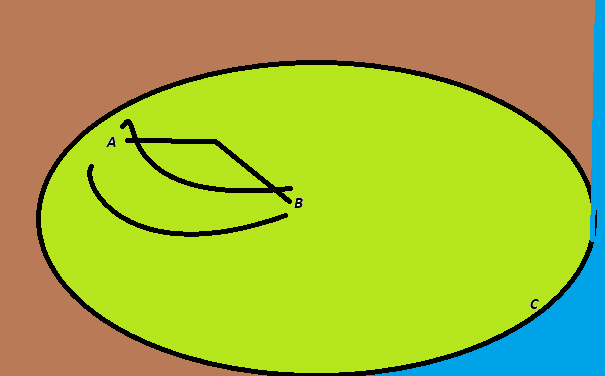
Lets say the green area is a forest, brown is mountain, blue is sea.

In an hex map, if you're going from "B" to "A", you can try different ways - assuming you cannot simply draw a straight line because you don't know the EXACT location of B.

But it doesn't make a difference. It is all forest. Same speed, same chances of getting lost, same random encounters.

In fact, even if the PCs suddenly decide to go THE OPPOSITE DIRECTION, to C, or if they get lost and wander into the mountains of the North, or travel South until they see the ocean... you STILL know exactly what is going to happen in the next week or so (if that's the distance from A to B).

Of course, this does not feel like a railroad if you have interesting, preexisting, features in EACH hex (which I don't).

Random features and random encounters, however, do not change the railroad "format" of this experience. If you roll to find out there is a cottage or an ogre in the new hex, it still doesn't matter if the PCs went North or South: the result would be the same.

Anyway, I don't think this is an actual railroad, because, while the PATH seems identical, the destination is different. The PCs haven't had their choices negated. Their choices are irrelevant for this week (they literally have a random encounter with an ogre whichever direction they go), but ultimately they'll arrive in a different destination.

But this is an interesting aspect to consider. There are SEVERAL dungeons scattered across my sandbox, and I'm always a bit worried that the PCs choose to go to a dungeon I'm not entirely familiar with (I cannot memorize all this stuff, TBH). 

I don't want to "force" them into a dungeon , but I'd really like to spend at least half an hour reading it before they enter.

The fact that I know exactly what happens on the way to the dungeon - NO MATTER WHICH WAY - might be an interesting tool to give me time to prepare. 

Maybe I could even roll/prepare half a dozen encounters beforehand (I'm currently using this) and know exactly what is coming in the next session - regardless of the direction the PCs take.

Sunday, September 22, 2024

Random ticking clocks - simplified!

When PCs go back to civilization, roll 1d100. If the result is  lower than the number of days passed since they left, an interesting event might have occurred. If the result is EQUAL than the event happens in the day they arrive! If the result is higher, there is no event for now (but it can happen in a few days...).

If there is an event, roll 1d100 again and check the table below:

1-10. A random important NPC dies. Roll for motive: old age, accident, disease/infection, adventure/travel, battle, assassination/execution.
11-15. A random important NPC is diseased/maimed.
16-20. Extreme weather (heat, cold, storms, floods, drought - according to season and place).
21-22. Mass heresy.
23-24. Natural disaster (earthquake, volcano, tornado, tsunami - according to season and place).
25-26. Ominous cosmic spectacle (comet, eclipse, etc.).
27-30. Famine.
31-33. Fire.
34-37. Plague.
38-42. Important birth or marriage.
43-45. Arrival of an important NPC/creature.
46-49. Rebellion.
50-55. Random encounter with a creature from nearby territory.
56-60. Invasion (roll random encounter, multiply NA by 1d6).
61-52. Internal strife/feud.
63-65. War with nearby community. 
66-67. Foreign invasion.
68-70. Shortage of essential supplies.
71-72. Mass hysteria/paranoia.
73-75. Robbery.
76-77. Exceptionally good harvest.
78-79. Supernatural event.
80-81. Tyranny – draconian laws.
82-83. Anarchy – laws are ignored.
84-86. Inflation.
87-89. Important NPC decides to leave place/function.
90. Meteor strike.
91-100. No event.

Roll 1d6 to measure severity. 1 is mild, 6 means total disaster.

A natural disaster of severity 6 may kill/displace 1d100% of the town's population.

Let me know which other entries I can add to the list!

---

How did we get here?

As if often happens, my first attempt at creating a new house rule ended up being more complex than I'd like.

In response to my last post and questions, I got a couple of good "random disaster" lists that are relevant - one in Oriental Adventures, the other in the RC.

The Rules Cyclopedia lists "Dominion Events" on page 142. It mentions 1d4 events per year, and lists both natural (tornadoes, earthquakes, etc.) and unnatural (rebellion, assassination) ones.

Here is a brief excerpt:


The other source mentioned was Oriental Adventures, which also has a pretty good list. 

My list is a combination of the two, reducing them to the entries is found most interesting. 

Ideally, I'd turn that into 100 entries, each with a bit more detail. Most entries should be mild to avoid wiping up the place every year. OTOH, I want to keep boring/subtle stuff to a minimum.

Please let me know if you have any ideas on how to improve the table!

One thing to notice is that some entries will be notice by the PCs while travelling - comets, earthquakes, etc. So maybe I should roll beforehand.

Well, this will do for now... I'll run a game this week and the clock is ticking!

Anyway, let me know what you think!

Note: some Classic D&D modules and OSR stuff are included in the current setting sale. I definitely recommend checking out Night's Dark Terror if you haven't. I'm tempted to buy Night Below for myself.

Friday, September 20, 2024

Random ticking clocks

I'm having a hard time with making the passage of time consequential to my current campaign. The PCs take their time to do everything. Without ticking clocks, I think this will always be the case - PCs will retreat and recover all their HP and spells before pressing forward.

Well, I could set arbitrary consequences for the passage of time, but since I prefer to be a referee than an author during the game, I want to have these things considered beforehand.

There must be multiple tables for random events in any number of RPGs, but I simply don't remember any. So here are some ideas. 


1 - Aging and death 

There are some rules in AD&D (which one could use for PCs), but I want something more straightforward. In a medieval, dangerous environment, I think giving every NPC at least 2% chance of random death per year. In theory, elderly people might have bigger chances than that (say, 4% you're over forty, 5% over 50, 6% over 60, then probably 10%, 20%, 30% and 40% if you get to be  a hundred), but people of any age can be randomly eaten by a monster, slain in war or affected by a plague. 

Maybe the risk of debilitating accidents/disease is similar.

The death of a ruler can lead to a peaceful succession... or war and anarchy.

2 - Random monsters

PCs roll for random encounters every day while travelling. It is likely that villages will be randomly attacked form time to time - maybe 10 to 30% chance every month, depending on the surrounding terrain? (BTW, may if you roll 1-3% the entire LAIR attacked the city). If this happens, you can roll an encounter as usual and evaluate what happens. For example: 

- No losses, the city is too fortified to be bothered by a dozen kobolds. 
- Some losses, a group of 40 orcs would certainly leave a mark. There is a chance of death or debility for each important NPC in town. 
- Total loss, the city is taken by an enemy force. 
- Obliteration. There is no way the city could defeat 3 aggressive dragons or storm giants. 

The best part is that the PCs will be very likely to look for revenge... could be the begging of a cool adventure.

3 - Natural disasters

Small natural disasters are accounted in part 1. Big earthquakes, tsunamis, eruptions, plagues, etc., are less likely. 1% per year sounds reasonable. Maybe roll once for every region that could be affected.

4 - Pillaging

If there is rumor of treasure, it is very likely that some other party will hear it eventually. Maybe 10% of chance per month that another expedition tries to plunder it... whether they succeed or not is another matter.

5 - Campaign-specific events 

This would be optimal, of course - if you already established a threat, the PCs have a meaningful choice - do they deal with it, or risk waiting and seeing what happens? You definitely should write some for you setting, as these are probably the most important and noteworthy events you can have. If EVERY relevant location has a list of specific dangers, that is even better!

However, I don't want these to be the ONLY ticking clocks in the setting.

Do things always get worse?

Well, most people die eventually, but that includes inimical NPCs. You might roll for the likelihood of new towns emerging, etc., but in most fantasy settings the evil forces are always pressing until the story ends. And I like my fantasy DARK, with danger and ruin in every corner.

STRICT TIME RECORDS

Needless to say, you need STRICT TIME RECORDS for this to work.

Putting it into practice

How do I like the idea in principle, this would require a lot of dice rolling, usually to no effect, and has little nuance (e.g., if you only check once a year, it doesn't really matter if the PCs are out for a month or two). 

Maybe I could invert the reasoning. Let's say, a certain event happens, on average, every 100 days. So when the PCs get to town, they roll 1d100 and compare to the number of days they have been away to see if something happened. With online dice rollers, you could roll 1d356,1d777 or whatever. Even better, you could automate this online. Otherwise, you need some math... and time. 

Let me hear some ideas. I'm sure there is a simple way to do this. My ideal result - maybe using perchance.com or something similar - would be randomly generate a table like that: 

- NPC 1 dies on day 357.
- NPC 2 dies on day 758.
- NPC 3 dies on day 23. 
- The city gets attacked by a monster on day 37. 
- Natural disaster hits on day 8756.

So, if you spent a couple of months away, you have a dead NPC (IF there are three relevant NPCs in town) and a monster attack. If they spent exactly 36 days away, they are in for a surprise (but this is unlikely). 

After they leave town, you can ignore unused results and "restart" the count.

Is there anything like this in any game you know? Any ideas on how to make this easier?

Continued here:

Additional reading:

Tuesday, September 10, 2024

Corrupt + Evil = good? (factions)

A quick thought about factions.

In my current campaign, I have two "empires" fighting for a land that is divided into several unaligned clans. The PCs are within the eastern empire and assume these are the "good guys", despite my (too subtle) hints that they can be brutal invaders.

They heard tales about the western empire and it looks undeniably evil. But I didn't want to turn this into a "good versus evil" game. What am I missing?

One thing might be the absence of selfish, corrupt traitors in the OTHER side.

The PCs met several bad people on THEIR side (although they haven't always realized that). But the opposition seem too orderly; everyone is a zealot for their evil cause (well, most of them are undead...).

Against such a determined enemy, there is not much to do - except fighting.

Now, if we add some opportunists to the opposition... the PCs have someone to deal with. Evil, despicable maybe, but someone who can be reasoned with.

Not simple turncoats that "become" good like Han Solo or even Lando, but irredeemable foes that can still be USEFUL.


Come to think of it, adding some corruption and backstabbing to the "evil" side might be an important aspect of dark fantasy. In "epic" fantasy, it seems you only leave the "dark" side by joining the good guys.

Of course, making deals with mercenaries, opportunists and sadists has a price - and they are likely to turn on you later on.

In having a hard time coming up with examples other than Elric, who uses the help of the Lords of Chaos until they finally turn on him (or vice-versa).

In addition, dark fantasy may include people that ARE good fighting for the dark side BECAUSE they have an oath etc. to fulfill. But these are people the PCs are not likely to reason with, no matter how noble they are.

Thursday, September 05, 2024

Amarod (I) - Creating a sandbox

I started my current sandbox campaign in late 2022. 

I'm using Dark Fantasy Basic with a few updates.

We play a bit more than a couple of hours every couple of weeks, so it went slowly... but the system is simple and I hand-wave some stuff, so things hopefully are not too slow.

As it approaches a (possible?) ending, I thought I'd make a brief recap - but this post also has some advice on how to build your own sandbox campaign, including sharing some of my mistakes.

The first thing you have to do is to draw a map. This is really easy - I do NOT recommend random generators here. 

I used (and recommend) Hextml. It allows you to expand the map as you go. The PC map currently looks like this:


MY map in Hextml is a bit bigger, but the PCs haven't explored much of it. Their map was even smaller when they first arrived in Belarte (the capitol) by boat, from a distant land that is NOT part of the campaign.

My advice here is start small and add more stuff as the PCs explore.

I wanted to try an hexcrawl, but I'm thinking maybe a pointcrawl would be better, with an old-looking map. 

In any case, as you can see I eventually wrote down the distances in the map (6d = 6 days, and so on) to make things easier. There are few roads beyond Aplos, so they are currently back to counting hexes.

I wrote a brief story of the region (Amarod), which is very simple: an ancient (western) empire fell, now the land is full of warring clans, but the (eastern) new empire is invading these lands. The PCs are mercenaries trying to make a buck, owning no allegiance to either "side", but taking advantage of the eastern invaders relative safety.

These are some important aspects of most D&D settings: ancient empires, ruins/dungeons, a social order that is between stable and flexible, factions and shades of gray.

The second step is scattering a few dungeons, caves, towers and villages around. In my case, I used various BFRPG modules plus Doom of the Savage Kings, The God That Crawls, etc. Mektlan is Tamoachan - the PC's latest exploit.

I did not have all these modules memorized, of course, which caused some issues. Read this post - it contains some important sandbox experience IMO.

Using mostly 1st-level modules was sub-optimal; when they got to level 3 or so, things quickly became too easy. In a future campaign I might start them at level 2 or 3 so the curve is less steep.

I assigned the area around Belarte as "safer", meaning encounters are less likely.

Now, I could say that PCs were free to roam around... but they'd be lost. So I offered them a few rumors and quests about nearby places, and several NPC expeditions they could join. 

It kinda worked. By level 3 or 4, they were planning their own expeditions and hiring their own guides without me having to offer anything.

I recommend starting with three suggestions per session. Some of them should be time-sensitive, but I haven't really implemented a system for that. This deserves further reflection, as the PCs have been treating time as an endless resource ("let's rest for three days to recover", "we will come for the goblins some other day", etc.).

NPC guides and hirelings are very useful, but RUNNING them was a hassle. Now I leave this mostly to the players.

So far, we have the PCs basically going around exploring rumors and places. As they went, I wrote down questions about the consequences of their actions:

1) What will happen in the village of Marval after the priest’s death?  A: A new priest (Father Ostid) has been appointed, you don’t know him well yet.
2) Did Polgrim and  Wolson - the NPCs who went with you to the church in Marval - talk to anyone about what happened? Remember they left when you planned to attack the evil priest.
3) Who sent a letter to the priest saying “the Lord suspects nothing”, signed only with the letter S?
4) Are the kobold ruins empty now the PCs have cleared most of them?
5) What will happen to the Jarl of Savakir (and his seer) now that the beast is dead?

Also some notes, such as "The PCs became heroes in Peranegra after defeating the local elves", etc.

One mistake is that I should have written MORE notes. Maybe every session. It would help me to get a clear picture of the events potentially unfolding.

I've been answering this questions as the adventure advances. Again, the question of TIME deserves reflection. The answer may be different depending of how long it takes for the PCs to go back to any location.

I organize ALL of this in discord channels. The players have access to maps, NPCs, questions, etc. One channel is exclusively for momentary concerns (monsters, dungeons, etc.), other channel is for dice rolls. The list of text channels goes more or less like this:

# general
# rules
# setting maps
# local maps
# adventures (momentary concerns)
# PCs and NPCs
# rolls
# questions

The map channel contains a summary of known cities and events. Each entry after the first was added as they visited new places.

Belarte: the largest port, where you arrived. Lord Belarte. 
Peranegra: famous for its pigs. You expelled the elf king who kidnapped children, and you are well-liked there. Lord Figworth (count). 
Marval: a small town with a church that has a giant slime underneath. You threw an evil priest down there. 
Savakir: a town surrounded by palisades. You killed the local monster but fled because the Jarl was chasing you. Bernier (the Jarl) and Sylle Ru (seer). 
Ilmare: a swampy city with rumors of monsters and bandits roaming the area, as well as abandoned mines. Lord Montegel. 
Mektlan: a cursed place with ruins of an ancient buried pyramid. 
Glani: a prosperous city in the region, but occasionally attacked by native clans. Duke Darvon. 
Aplos: the largest city in the region, famous for its large cathedral, with somewhat labyrinthine streets. Cardinal Godebert lifted Pete’s curse and spoke about the Heretic. You rescued the Cardinal during the siege of Glani.

To sum it up, if you want more advice: TAKE NOTES and KEEP THINGS ORGANIZED.

Anyway, that is what I've got for now. Let me know if you have any questions so I can expand this further in an eventual part II!

UPDATE: I just realized I was missing one important channel: #calendar. KEEPING TIME is extremely important. See here:
https://methodsetmadness.blogspot.com/2024/09/random-ticking-clocks-simplified.html

Friday, June 28, 2024

12 odd things about B/X wilderness encounters

While I was writing Basic Wilderness Encounters (now a silver bestseller!), I noticed lots of strange things in the B/X encounter tables I hadn't noticed before.

The B/X tables are inspired directly by OD&D tables. Notice that the OSE tables are identical.

In my book, I addressed/fixed some things to give the tables a more coherent feel, and I quite like the results.

Anyway, here is the list. Let me know if you have other items to add!

---

1. A dragon encounter is about 100 times more likely than finding a group of halflings. They are more common than wolves and hawks. Dragons are encountered in all environments regardless of color; i.e., a green dragon encounter is not more likely in forests despite the fact they live in forests.

2. Adventurer groups are incredibly diverse, considering how difficult is to find dwarves and other "demi-humans" in the tables. Any adventurer in a group of experts in 36% likely to be a "demi-human".

3. Expert adventurers, up to level 10-12, still adventure in the wilderness (despite many people thinking you should start "domain play" sat level 9 and stop adventuring.)

4. There are parties of high-level clerics, MUs, and fighters, but no thief parties (thieves only appear in more mixed parties, or as groups of "bandits" that apparently have no thief skills/talents). This might be because there were no thieves (as class) in the original D&D.

5. Mountains are extremely dangerous - at least 50% chance of encounter per day, and 25% of encounters are with dragon-like creatures (mostly dragons but also hydras, etc.), not to mention the possibility of a 36-HD giant Roc.

6. Swamps are dangerous too... Troglodytes are horrific; 2 HD, 5d8 appearing, camouflaged and always murderous. Desert and "barren" encounters are just as dangerous and almost as frequent (2-in-6, like forests), which I find odd, as desert fauna should be scarcer.

7. Swarms of common insects only appear swamps, but killer bees are everywhere.

8. The "unusual" table contains basilisks, which are more common than bears or ordinary hawks - or Halflings, etc.

9. In fact, there are NO ordinary bears in the tables, only cave bears and werebears.

10. Pirates (Chaotic, Morale 7) and Buccaneers (N, ML6) are nearly identical. They are also the largest groups; fleets can have more than 200 people in it.

11. You can find sharks in lakes and rivers, and even whales aren't uncommon. I replaced some with big alligators (of similar HD), that were sorely lacking.

12. Giant scorpions dwell in deserts according to the monster description. But they can't be found in the desert table. Only in swamps, jungles, forest, plains and settled lands.


Anyway, check Basic Wilderness Encounters if you want some reflections about these tables and 1000 entries to simplify you job as a DM. It is half the usual price if you get it in one of our bundles!

Wednesday, June 19, 2024

Sandbox detour

Yesterday, something happened in my game... that might be worth discussing briefly.

The PCs in my sandbox were hunting a few goblin tribes. I had the entire area (hexes) and a couple of goblins caves prepared in advance (adapted from a published module).

But when the game started (right after they had slain one of the goblin tribes - there were two more to go), the PCs suddenly decided to abandon the quest and traveled to the nearby haunted ruins, which they thought would be more profitable.

I had already decided on a module for those ruins... but I hadn't read it.

They had two or three nearby places to go (in addition to goblin territory). The thing is, I'm unable to memorize them all.

[Also, notice, it is USELESS to memorize them; now, the goblin "plotline" became partially obsolete because they will NOT be able to rescue certain hostages anymore, which changes the whole thing... there is little use in preparing too much for things you'll never face].

Sometimes I just need a dungeon that I can read while I'm running it. Or, even better, a complete sandbox like Qelong or Curse of Strahd - it allows me to familiarize with the whole setting at once.

The ideal sandbox would have a significant number of "IFs" so I didn't have to come up with my own. "If the PCs refuse, the hostages die", etc.

[Notice Qelong is surrounded by mountains and Ravenloft by mists; an island would work too. It seems the ideal sandbox is somewhat limited: "we are playing in this area, if the PCs leave the adventure will turn into something else, which requires some time to prepare"].

The game turned out well, although it felt clunky reading and refereeing at the same time. I made a few mistakes (e.g., said a door was open when it was locked) and it took a bit longer to describe each room.

Fortunately, it was a short session, and I had my Basic Wilderness Encounters with encounters for EVERY biome in the setting, which made the wilderness part a breeze.

I will familiarize with the dungeon better for next week, since they are unlikely to change course soon, so things will be smoother.


What I DIDN'T want to do is "improvise" in any way.

I had two goblin lairs ready to go. Should I have used THAT maps for the ruins? 

NO! I want my setting to be a real place, not a Schrödinger's simulation.

Could I have rolled a new map randomly?

No, that would be equally bad. 

See, they had two nearby dungeons to go, each with its own "backstory". If I generated them randomly as they explore it, their choice would simply not matter.

Anyway, it is fun to have a sandbox and allow them to go anywhere. One of the players started asking, "wait, why don't we BUILD something?".

I have no plans for this type of campaign. Might be fun, I don't know.

One thing I do know is that the players can surprise me - and this makes running the game way more fun for me.

Thursday, June 06, 2024

Author x Referee GMs

The GM is BOTH an author AND a referee.

The author creates a setting, adventures, NPCs, etc. - even rules.

The referee enforces the setting and rules.

As you can see, GMs do both - but these roles are somewhat incompatible.

How can you be expected to be the impartial judge with rules you create yourself?


One method many GMs use to deal with this is separating the functions in two distinct moments:

- I'm an author during "prep", when I create worlds, dungeons, NPCs, or even random tables to sue during play.

- I'm a referee during play. I stick to the rules, respect the rolls, and do not changing the HP of an important NPC during a combat.

But, since you are expected to play both roles, some GMs prefer do to BOTH AT ONCE.

This is what "improv" is about. You cannot improv as a referee - when you do that, you are in author stance.

To each their own - but I find that confusing.

For example, an author can definitely "fudge" the dice. If he can create a dragon (or nation) out of nowhere, deciding a single hit missed is well within his powers.

This solves a lot of problems.

For example, the classic "quantum ogre". There are two doors. The PCs choose the door on the right. Can the GM decide there is an ogre behind it AFTER the PCs choose?

Well, author-GM can, but referee-GM cannot.

Likewise, is changing the result of a random encounter roll adequate? It is for the author-GM, but not for the referee-GM.

And what about "balancing" encounters to suit the level of the PCs? Same thing.

Come to think of it, this separation is the reason why I avoid "improv". 

I want to use the author stance as little as possible during the game.

Maybe that is also why I feel the need to write (and sometimes publish) my own material, despite my constant urge to tinker and house-rule.

[Basic Wilderness Encounters was created precisely because of this reason. I didn't want to "author' encounters during the game. I wrote it is an author, and I use it as a referee].

And why I prefer to run other peoples' modules - and even campaigns - rather than creating my own.

To be clear, I LIKE to be an author-GM, just not during the game.

Anyway, I cannot be the first to have this thought, but I think the distinction should be more popular, and probably more discussed in game master's books.

There are probably more things to tackle around this subject. 

For example, I am thinking players have a specific stance during the game (they are almost NEVER authors in my games), but it is fine to give players author role between sessions, while writing a backstory, or when scheduling a game (e.g., agreeing in advance WHICH dungeon the PCs will tackle next).

But I think this is enough for today.

Monday, January 22, 2024

Clans of Amarod

These area few clans for my current hexcrawl. If my players read this: there are dozens of clans, you might encounter these ones or not. 

Otherwise, feel free to use them in your own settings! Some entries might be specific to my setting, adapt as needed.

One thing that occurs to me is that I should have decided this beforehand - see this. I think I'm doing this for every setting from now own, as I cannot stand orcs anymore (I unfortunately already introduced dwarves and kobolds from published modules - dwarves are useful, as goblins IMO, but kobolds scream "we are in D&Dland" for me).

I think you should try it too - even if you like orcs, it is nice to have distinct clans, some more aggressive than others. And having FEWER creatures gives a setting a stronger theme and feel.

The last part is from Dark Fantasy Places (which you can get for free/PWYW), and not particular to this setting. I pasted here for convenience.


Uzumaki (goblin cannibals)
One of the most hated groups. Easily recognizable for their sharp teeth and spiral-shaped ritual scars. Hide in the woods, attack on sight, and laugh as they fight to death. Probably insane. When fighting other goblins, they prefer capturing to destroying, and will buy/ "rescue" goblin slaves if they are available.

Moonchildren (tabaxi mystics)
Curious students of the occult. Wear silver amulets, usually moon and starts. Like spellcasters, enjoy wine and singing. Collect books and memorize songs, exchange information. Usually nocturnal.

Ironfolk (silent dwarves)
They do not speak much Common, but do not look for trouble either. Found in mines and forests. Use body paint, usually white, with red and black details. Not much armor (bare chested), but carry heavy iron weapons. Their caves are decorated with stone statues - rectangular cuboid carved to resemble dwarves.

Skullfolk (human skeletons)
These thin folks use white and black paint to resemble skeletons when they are in battle (or raiding, invading, stealing, etc.). They are pale and have no body hair at all. A few of them cut their own noses. Their weapons are poisoned and they are extremely hostile when in paint (50% chance).

Dragon claw (wild elves)
These tattooed, scantly clad elves have a deep respect for dragons, although they recognize not all dragons are good. They are distrustful of anyone wearing heavy armor, as these are more common in the invaders. Discreet body paint, long braided hair, curved blades. Nomadic, claim no lands as their own.

Glowtoads (shy frogfolk)
They live in the marshes and avoid getting close to civilization. Sometimes they use special paint (usually curves and dots) that make them glow at night. Will use as a diversion tactic when needed. Otherwise, they are usually friendly to humans but hate mantisfolk.

Warp folk (human mutants)
These misshapen humanoids worship a green rock which has a strange glow. A few generations of natural selection made them a bit more resilient to negative mutations, but they still look ugly (scaly skin, asymmetrical features). Feared and despised by most, but not actually as aggressive as other clans.

Sky terrors (cupendiepe hunters)
Nocturnal, blood-drinking, winged humanoids that fight with moon-shaped axes. Very aggressive. Live in caverns near mountains tops, steal treasure for no apparent reason.

Firestarters (human/goblin pyromaniacs)
The worshippers of the Lord of Fire cover their bodies in ashes and burn their enemies to commemorate victories. Fight with oil flasks and fire traps. Occasionally worship at the crater of an extinct (?) volcano, but the location is secret to everyone except their shamans, who have been "touched by fire" (burn scars).

Greenscales (powerful lizardfolk)
The greenscales are the most powerful lizardfolk clan in the land. They take a nuanced view of the invaders; they know they are feared, but can make powerful allies. They might engaged peacefully with smaller groups. They were enslaved under some of the ruined empires and they hate magic and the cult of Apopep with its corrupted sorcerers.


Random clans

Type (1d20)
1. Tabaxi
2. Lizadfolk
3. Goblin
4. Cupendiepe
5. Dwarves
6. Elves
7. Mantisfolk
8. Frogfolk
9. Kobold
10+. Humans

Looks (1d20)
1. Naked
2. Tattoos
3. Body paint
4. Skulls
5. Sharp teeth (in mouth or necklace)
6. Demon mask
7. Colorful silk
8. Spikes
9. Ritual scars
10. Reptile hide 
11. Camouflage
12. Feathers
13. Wood armor
14. Jewelry
15. Snake motifs
16. Jaguar skin/motifs
17. Shell necklace
18. Light robes
19. Colorful hair/ beads
20. Braids

Like/dislike (1d20) - [or: respect, fear, worship, etc.]
1. Heavy armor
2. Strangers
3. Cannibalism
4. Spellcasters
5. Nearby tribe
6. Dragons
7. Castles
8. Undead
9. The Water Lord (main Lawful deity)
10. Alcohol
11. Commerce
12. The Ruined Empire (Apiaka, etc.)
13. Lord Belarte (or other nearby leader)
14. Monsters (like: 50% chance of pets/mounts)
15. Hallucinogenic plants/fungi
16. Other species (like: 30% chance of mixed clan)
17. Mercenaries / dungeon delvers (like: can be hired)
18. Agriculture
19. "The Natural Order"
20. Slavery/slavers

Some additions and variations

Tabaxi. Cat, cougar, red, blueish. A rare lionfolk might be found in the North. Many tell legends of ruined Muru, the circular city that stands in ruins - but ascended, "in spirit", to higher planes.
Lizadfolk. Red, mustard, blue, dwarf, horned, rarely white, black, chameleon. Most distrust magic, but a few are loyal to Apopep and the serpent-people that enslaved them in the past.
Goblin. Alchemists, tree-jumpers, burrowers (gray and earthy).
Dwarves. Albino, explorer, slaver, merchant.
Elves. Types vary, but mostly the typical "wood elves", closer to nature, or "underground elves" that enjoy tricks and illusions. Both are familiar with fey, dryads, etc.
Mantisfolk. Dark, mustard, red, green. A few clans are psionically held to a "hive mother" like bees and incapable of independent thought while near. Some gain individuality to perform outside jobs, and some gain it permanently due to genetics, accidents or death of a hive mother.


Morlocks.

Other clans

Orcs - None. Replace by lizardfolk.
Hobgoblins - None. Replace by morlocks, pictured above. As hobgoblins, "dwell underground, but commonly seek prey above ground."
Aaracroka - None. Replace by cupendiepe, a more aggressive species of bat-people.

Etc.

Villages & Cities

From Dark Fantasy Places. Unlikely to be used until the PCs decide to interact with one of the clans.

d20 Appearance
1. Intertwined with trees
2. Buried
3. Lifted from the ground
4. Made of moving tents
5. Camouflaged
6. Suspended over water
7. Built amidst ancient ruins
8. Huge and mostly empty
9. Dug up in rocks
10. A single building
11. On a mountain top
12. Brightful colors
13. Tall buildings
14. Misty
15. Narrow streets
16. Inside a crater
17. Constantly flooded
18. Poor and ruined
19. Beautiful and frail
20. Heavily fortified

d20 Society
1. Property is communal
2. No concept of privacy
3. Identity is defined by masks
4. Rigid protocol for every conversation
5. Universal vow of silence
6. Adults are cast out
7. Appropriate clothing is mandatory
8. Visitors have no rights
9. All burials must be in pairs
10. Children are raised by all
11. A proper season for each action
12. Travelers welcome for a single day
13. Weapons are forbidden
14. “Couples” are always three
15. Those who can’t fight must serve
16. No activities during daytime
17. Violence is never the answer
18. Everything is permitted
19. Might makes right
20. Casual cannibalism

d20 Problems
1. Besieged by monsters
2. Ruled by tyrants
3. Plagued by poverty
4. Infected by disease
5. Fiercely territorial
6. Infiltrated by demons
7. Filled with criminals
8. Resentful of outsiders
9. Ongoing power struggle
10. Cursed with madness
11. Violently expansionist
12. Falsely utopian
13. Mutated by Corruption
14. Malignant religion
15. Screwed morals
16. Widespread panic
17. Hopelessly defeated
18. Hiding dark secrets
19. Inhabitants cannot leave
20. Periodic human sacrifice