I must create a system, or be enslaved by another man's. I will not reason and compare: my business is to create.

- William Blake

Showing posts with label bloody sun. Show all posts

Saturday, May 18, 2024

Fallout: Carcosa


(Nine years. Whoa. That is quite a lot. And it was fast. I have to think about that. Anyway.).

At that time, I mentioned the Fallout series as one inspiration - besides Barsoom, Carcosa* and Dune.

A few things have changed since then - maybe one or two authors mentioned in that post turned out to be contemptible at best, so I'll avoid them - but, once again, I've been thinking of Fallout and Barsoom, and wishing to run a campaign in such setting.

It was probably the TV series that made me want to play Fallout again. I had only played Fallout 3, and now I'm playing New Vegas. 

It really makes me want to create my own post-apoc setting - "with blackjack and hookers", as the saying goes, but New Vegas already has some of those...

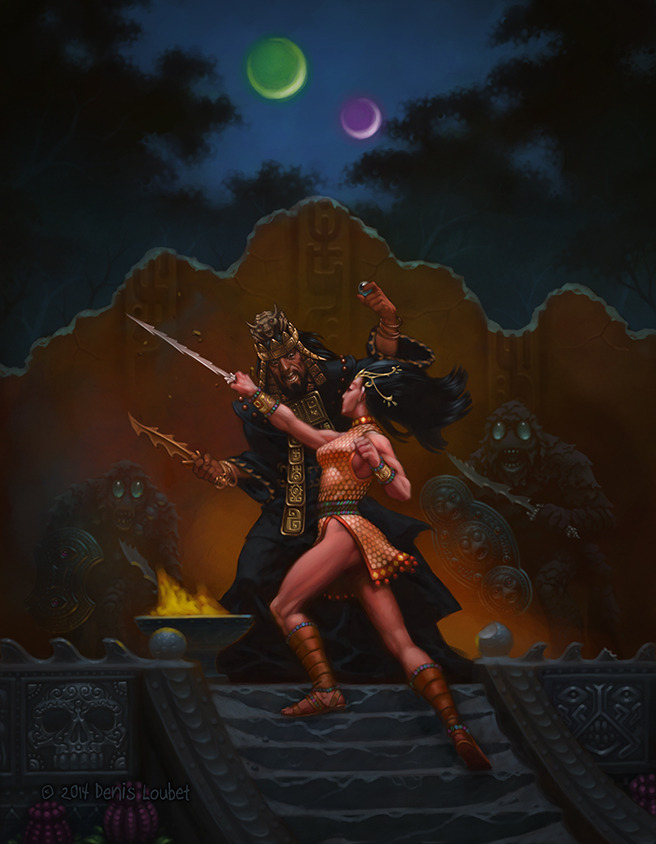
Carcosa* is one of these games that I always wanted to run but never quite got around to it. It is full of awesome ideas, but I think it stops just a bit short of being an amazing setting like Dark Sun. I hear that the author has other modules in the same setting, but these are not in DTRPG.

Here are a few elements from New Vegas I'd like to add to Carcosa in order to make the setting more interesting.


Vaults

Fallout vaults are a source of endless possibility and fun. 

First, each one is a dungeon to explore - but a dungeon with a real purpose and history. 

Second, vaults are created as different experiments, so each vault can be unique and even contain different creatures (including mutants, robots, etc.). Some experiments are social, so different forms of government are to be expected - you can check this post or Dark Fantasy Places for ideas.

Factions

New Vegas has several interesting factions. Some evil, some neutral, some trying to do 
good, with many shades of gray,

"Everyone wants to save the world, they just disagree on how" as the show mentions.

There are several factions that think that things will be a lot nicer when THEY are in power, even if they need to brutalize some folks to get there.

Carcosa doesn't have much of that - all groups are similar, and governed by a single individual. Add a few details and things start to get interesting.

In addition, Carcosa has "men" int he encounter table, but doesn't give you anything else - are these merchants? Explorers? Adventurers? We should probably add some ideas here.

Lost technology

This is another fun part of both Fallout and Carcosa - projectile weapons, power cells, power armor, robots and cyborgs are in both settings.

Maybe the system deserves some kind of "repair/tech" skill, allowing some PCs to try to access technology they cannot fully understand.

Mutated monsters

In Carcosa, "The spawn of Shub-Niggurath are the innumerable and typically unique monsters [...] These [...] are the most common type of monster on the planet of Carcosa". There are also numerous oozes, jellies, worms and dinosaurs.

Which is fun. But I think mutated/giant insects (or other beasts) might be an interesting addition to the setting. 

Unique monsters are cool, but not every monster needs to be unique - sometimes, fighting a bunch of giant cockroaches or giant scorpions can be fun.

Sandbox & Hexcrawl


It doesn't make sense that an adult wouldn't know at least vague directions to nearby lands. The idea that you enter a new hex and suddenly see a new city (or the sea!) sounds absurd. There are exceptions - maybe when discovering a new continent, etc. Still, if there are intelligent people around, it should be easy to ask for directions.

Unless...

What if the PCs are vault dwellers? When they come out to the world, they have no idea where they are! They still can see a mountain at a distance, but not much more than that. It would be a nearly ideal setting for a hex-crawl.

Can we use Carcosa hexes?

Carcosa hexes are often interesting but sometimes very repetitive and terse ("Castle of 29 Black Men led by a neutral 5th-level Fighter"). 

Human groups are very small, somewhat similarly to Fallout.

Maybe we can combine existing hexes with some random tables to add detail.

Do we still need magic?

Fallout doesn't have magic spells. Carcosa has rituals, but they are very unique - unlike anything I've seen in other RPGs. Dark Sun has proper spells. But do we need them?

Maybe psionics would work better here. And, of course, technology that is "indistinguishable from magic".

But the rituals in Carcosa are so interesting and unique that I'm doubtful about getting rid of them.

---

Well, that is it. I hope I can actually do something with this before nine more years have passed!

* Affiliate links.

Tuesday, February 13, 2024

The Gods of Mars (book review)

After finishing (and thoroughly enjoying) A Princess of Mars, I started the sequel almost immediately (if you haven't read APoM, read that review first).

Despite being quite similar to the first one, this book gave me mixed feelings.

This will be a short review - if you enjoyed the first (a must read!), this book is well worth checking out. If you didn't, you will probably not like this one either. Overall, I'm glad I've read it.


This book has all the trappings of the first one: the pulp action, cloak-and-dagger intrigue, fast pacing and, my favorite part, the awesome world building.

New types of Martians are introduced. Maybe they are not as imaginative as Green Martians, but still very interesting. New monsters too; the plant people are fun if a bit too weird.

The influence on D&D is less obvious here, but it's still very likely this book was an inspiration (even if indirectly) to the Drow, for example. The Drow are said to come from Margaret St. Clair (which I am yet to review, but has some interesting ideas), but they might as well have been lifted directly from this book. Barsoom's "first born" have ebony skin, beautiful bare-naked bodies, and a war-like society that worships some kind of she-demon.

The first half of the book is top notch. The sinister plot behind Barsoom's religion is a great twist, and the "dungeons" are ready to be used in your D&D games. We already had ships, swords, psionics and ray guns in the first book, and now the author adds pirates, cannibals, labyrinths and exquisite traps to the mix. What is not to like?

Well, everything is in this book cute feels bigger in the scope than the first one. There are chaotic battles with multiple sides and multiple sites (with fires, floods and traps). There is more intrigue and secret plans. Instead of one princess, we have three - and they all fall madly in love with John Carter, of course.
 
As you can see, everything that was a bit exaggerated in the first book becomes more so in this one. The sheer number of “deus ex machina” instances become almost unbearable, as an incredible number of unlikely coincidences keeps happening to our hero for no apparent reason other than making the plot more interesting and exciting.

By the end of the book, the stakes are incredibly high, but it is difficult to believe any danger the heroes find will be enough to pierce through their plot armor.

In short, is a fun book, not as awesome as the first, but it still gave me plenty of inspiration.

I am not particularly eager to continue the series (but I might read the third book just to finish the original trilogy), although it keeps introducing cool elements: cloning, mind-transferring, walking heads, and more princesses.

[Maybe I'm being too harsh to Carter; Conan has had his share of queens and princesses, and often in a less platonic manner].

In spite of my reservations about the writing, the series will probably continue to serve as inspiration for my D&D settings for a long time.

You can get the book for free here and here.

Read more about the Appendix N and other fantasy books HERE.

Sunday, January 07, 2024

A Princess of Mars

 "A Princess of Mars" is a classic novel by Edgar Rice Burroughs (the creator of Tarzan among other things). It is a classic in a " foundational" way, since it has influenced innumerable other authors (Vance, Clarke, Heinlein, Wells, Bradbury), movies (Star Wars, Avatar), comic books (including Superman), RPGs (it is not only in the appendix N, but also has monsters included in the original D&D, and inspired Dark Sun, Tékumel and Carcosa, among others), etc.

The book tells the story of a Confederate veteran, Jonh Carter, that gets transported to Mars (which natives call Barsoom) in a mysterious way while being chased by Apaches.

Carter soon finds out that the conditions of Mars (e.g., lower gravity) give him superhuman strength and other amazing powers. In this planet, he first faces the Green Martians, tall, four-armed creatures that are warlike and primitive, but still occasionally noble and courageous (the typical “noble savages”). Carter soon earns their respect due to his fighting prowess, and gets welcomed in their ranks. 

Later on, he will meet and fall in love with a captured princess from the Red Martians – a people that is closer to humanity and more technologically advanced, but also have their own violent feuds.


As you can guess, we are in the " science fantasy" genre, mixing sword and sorcery, western, and scientific speculation (about the Martian environment). 

Even though there might be some obvious parallels between Carter's fight with the Apache and the martians, or Arizona and Mars, the author doesn't dwell on it. For the most part, this is a two-fisted tale about a man thrown into a strange world, and forced to solve most of his problems with a fist to the jaw. 

The book grows progressively more violent until civilizations clash in open war, with Carter willing to kill unwary enemy soldiers who gets on his way.

While the plot feels formulaic at times (the foreign hero who unites the disordered people to save the princess, etc.), the narrative is fast and full of action, and the world-building is simply superb. The ending feels a bit rushed and unexplained, but this doesn't detract much from the rest of the book.

Fortunately, there are several sequels – the series has a total of eleven books. The first few books in the series including this one are in the public domain in most places - you can get it for free here.

Overall, I found it a great read, not only because of its huge influence on D&D and pop culture, but also because it's a fun adventure book, with an awesome setting and good action.

Recommended!


Read more about the Appendix N and other fantasy books HERE.

Tuesday, March 07, 2023

20 rumors about the City of Evil

A "City of Evil" is part of many dark fantasy settings... Carcosa being the first one that comes to mind, and Babylon the original evil city. You can find more inspiration here. For this post, however, I found inspiration elsewhere...

1. It is built of gold.

2. The queen sits naked on the throne.

3. It's a dwelling place for demons and unclean spirits.

4. It deals in jewels, myrrh and fine linen.

5. Its wine is often poisoned.

6. It attracts merchants and sailors from the whole world.

7. It is home to a beast with ten horns and seven heads.

8. Anyone can become a king.

9. The radical leaders are blinded in chains.

10. People become beasts to avoid the pain of being human.

11. The land around is barren, no oasis in sight.

12. This land is called "bat country" for a reason.

13. Soulless men stand silent on the streets.

14. A prophet sheds light on the lost.

15. People get stabbed in the dark.

16. Everyone is eager to throw the first stone.

17. Poisonous fumes and venomous come out at night.

18. A killer prowls the street searching for vengeance.

19. When the stars align, war will break.

20. The city will be burned to the ground, destroyed in an hour.

(If you like alt/prog metal, the source should be obvious... thanks A7X! Images by AI)

Sunday, August 15, 2021

Postapocalyptic Strahd

A long while ago, I've adapted Lost Mines of Phandelver to the Ravnica setting (before it was an official 5e setting). I really like this module, and I really like the Ravnica setting. It was a good fit and I enjoyed it thoroughly.

Was other modules - and settings - could generate something similar?

Well, Curse of Strahd has a decent structure, despite its bad organization. And I've spent so much time reading and running it that I know it quite well by now.

The gothic feel of CoS is nearly perfect. It nails all the appropriate tropes. But what if...

Well, my favorite D&D setting is Dark Sun. Now, think of Barovia as a desolate valley, where resources are scarce, and a handful of small villages survive in walled cities despite the violence outside of the walls.

All fear the local Warlord...


...who controls the main source of water from his castle...

...and has an army of "ghoul" cultists...


...and a bunch of captive brides.


Of course, there are other tribes (or biker gangs?) in the valley. They call themselves "nomads", "werewolves", "savages", "blood brothers", and so on. 

Most tribes bow to the Warlord, except for the mysterious Raven clan.


There are also those weird witches... Well, that's what the folks call them, although elsewhere they'd be called "psychics". There are universally feared and respected.


Of course, it's hard to run CoS without magic.

Fortunately, I like my Dark Sun in a "kitchen sink" setting that includes mutants, wizards, psionicists, demons, and maybe aliens. I might avoid guns but I'd still have forgotten technology.

So, Dark Sun, plus Mad Max, Talislanta, Carcosa... you know the drill.

Sounds crazy enough... it might even work!

Wednesday, January 01, 2020

2020 is here, what do YOU need?

Happy new years folks!

Welcome to the year of the double-crit!


If you've been reading this blog, you might have seem my last post, with my plans and ideas for 2020.

In this post, I'm looking for suggestions.

(And if you already commented on that post, thank you! I am writing this down!)

Why, do you ask? Well, I enjoy writing, but I also enjoy being read. It's way better than writing for myself. I enjoy the feedback, the exchange of ideas, etc.

There are some things that I have to write, and I'll write them regardless of readers. Others are stuff I'm interested in, but there are so many possibilities heard that I'd rather focus on whatever people want to read about.

Of course, there is also lots of stuff that I am just not interested in. I am probably not the guy to create new spells for 5e, for example. Now, if you want a new spell system...

Anyways, here are the questions I wanted to ask you. What do YOU prefer? What do YOU want to read about? I'll keep my eye on this post for the entire year of 2020, so drop by in any moment to leave a comment.

Here are some dichotomies to think about... and choose from, if you will.

Blogging x Publishing

I'll do both, but I'm curious: are the readers of this blog interested in the stuff I publish? Do you like to see some of the ideas discussed here in an organized, finished manner? Or do you prefer the back and forth of brainstorming, discussing ideas, etc.? Maybe both?

Blogging is a lot easier than publishing. The advantage of publishing is that I can finally finish stuff... make choices an compromises instead of just coming up with ideas. And present my ideas in a condensed and polished manner for me and others to use. Harder than blogging, yes - but, I think, more useful in many ways.

There is another issue... Since we lost G+, I don't entirely thrust this anymore. Blogger could be gone tomorrow, and backing everything pu is a hassle. Now, about my books, I have backups up in multiple places... they aren't going anywhere.

OSR x 5e

Nowadays, I play only D&D and derivatives. My favorite editions are Basic (B/X, RC) and 5e. There are some similarities, but not always. Like many, I want a version of 5e that is closer to Basic. Something simpler, less convoluted. 

Dark Fantasy Basic does something like that, but it is more OSR than 5e, and has some 3.5x thrown in.

Are you interested in OSR stuff? 5e stuff? Or a mix of both?

Print x PDF

I have never published anything in print, and I have no experience with that. Some people have been asking me for print versions.

Even if you are not interested in my stuff, I'd like to know if you prefer print books or PDFs.

Art x Writing

Most of my small PDFs are pretty plain: a good cover and no interior art. Easy to print and to use, which suits me. 

Now, "big" books are a different matter. Without art, they become big wall of texts, and this is tiresome to the eyes. DFB has lots of (public domain) art because I wanted it to look a certain way. I'm sure I could do something similar with layout, etc., but again, I'm not an artist.

Manual of Arms has SOME art, providing illustration for new weapons (saber, falchion, etc.).

I could introduce more art to my small books, but I'm not sure how useful this is (and this means extra work, of course). What do you think?

Crunch x Fluff

I discuss mechanics quite a lot in this blog. Analyzing existing systems, creating house rules, etc. Its been quite a while since I gave you monsters, settings, etc. Here are a few examples: 1, 2, 3, 4. Would you like to see more of that? Or an adventure (based on this)?

In any case, I'll keep publishing random tables to generate monsters, settings, adventures, etc.

There are other types of content that I do not usually post... Do you like reviews? Posts about actual games I've run, like these two? Non-RPG book reviews like these three posts? Let me know!

One last thing: Curse of Strahd

I am in the final stages of running Curse of Strahd. I have a LOT to say about this module. However, this would only interest people that also want to run it - I assume the number is small. If you're interested in this, let me know!

Anyway...

This is what I've got for now. One of the most difficult things about writing is getting feedback - so I'll appreciate any feedback you can throw my way. Of course, if you enjoy reading my stuff, here is a good chance of tilting me towards stuff you're interested in. Thank you! 

I hope you have an awesome 2020! 

Monday, December 30, 2019

Some RPG plans por 2020

I know, the best-laid plans of mice and men and yadda yadda. I didn't succeed in everything I wanted in 2019, but I wrote some RPG stuff that made me happy.

And 2020 is the year of the double critical, so I'll stay optimistic!

RPG-wise, what I want to do in 2020 is publish a few books. Some are already written, some are just vague ideas at this point, and some are in the middle.

ALL are related to the stuff I write in this blog, mostly because this is the stuff that is on my mind.

Here is what I've got so far.

Dark Fantasy series

I have two more books for my Dark Fantasy series: settings and magic items

I also wrote a book with 100 magic weapons for Dark Fantasy. I like the result. If people like it, I might make a few more (have a few ideas for armor and other magic items).

I am planning to have these three books out before the end of the third trimester.

I'm very, very tempted to write a Dark Fantasy Cyclopedia of sorts. That would include ALL the stuff I have plus a few things from the Teratogenicon (see below). And I want to revise and update a few things from Dark Fantasy Basic. If I do this, I think I'd like to have a print version to use at my table.

This might be lots of work, so maybe I'll leave it for last.

UPDATE [2020]100 magic weapons was made available in January. Dark Fantasy Magic Items and Dark Fantasy Settings are available since February.

Teratogenicon

The Teratogenicon is written. Now I've got some revising to do. The art (by Rick Troula) is not finished yet, but it is looking GREAT so far.

I think we might get this finished before July.

I really like this project, and I want it to be huge. However, I'm not sure if everyone feels like me about monsters. In short: that they should be more varied and interesting, and that this is more important than stat blocks.

Anyway, this is happening regardless. I really hope you like it. If lots of people want it, there might be a print version.

UPDATE [2020]: Teratogenicon is here! And it's beautiful!


Fifth Edition stuff

I have been thinking a lot about 5e lately. I feel I could create an easier, faster version of 5e without losing anything significant. I think I could reduce the relevant parts of 5e to about 100-200 pages. It looks like hard work, but I have the SRD to work with. I dunno. There are a few good books on the market that do that already.

My manual of arms book didn't get much traction, reviews, comments, etc. I'm unsure about making one for armor (and stunts, options, etc.).

There is no date for that so far.

UPDATE [2020]: nope. See here.

Setting stuff

I have a few settings in mind, but nothing is written. Well, some ideas were added to the Teratogenicon and Dark Fantasy Settings, but a have no "setting book" yet. 

I feel a bit silly about inventing names for places, races, people... I don't even USE published settings as written, I added stuff from multiple places, and my books are like that, more suggestions than hard rules, so not sure how useful it would be for other people.

Anyway, I am curious about creating a gonzo, post-apocalyptic setting from this and this. And maybe this and this. In short, my own version of Dark Sun.

There are other ideas too, maybe I'll test the waters a little before I dive in.

There is no date for that so far.

UPDATE [2020]: nope. See here.

Stay tuned!

Here is my idea if you want to keep track of this stuff. I'll update THIS post during the entire year, giving you links as these things come out. See how I wrote "UPDATE [2020]" under each topic? Yeah, I plan to use these blank spaces as soon as I can.

If I fail, well, feel free to call me out in the comments!

Also, I'm writing a second post about my "2020 RPG resolutions" in a couple of days, specifically to ask what would YOU like me to do

Do you want more blogging or more publishing? Do you want OSR, 5e, or both? Lots of arts, lots os writing, or both? Print or PDF? Let me know in the next post... Or, if you can't wait, let me know right here!

Wednesday, October 18, 2017

My four favorite (meta)settings

I've written a few settings, modified more than a few. When I start a new campaign, I ask my friends in what setting they want to plan, unless I have some specif idea in mind. These are the four options I usually give them; they include all my favorite settings and most settings I can think of (Forgotten Realms, Planescape, Dark Sun, Dragonlance, Yrth, Tékumel, etc). You'll see there is plenty of overlap, but I like to keep these four separate - it helps my keeping the tone consistent and might point you to the kinds of settings you want to read about in this blog.


Adryon - Vanilla twist fantasy

Adryon was my first effort at creating my own world, full of fantastic races, different languages, exotic kingdoms, weird magic, portals and lots of cliches. Only after writing 300 pages I realized there are other more famous and well developed kitchen-sink settings such as the Forgotten Realms and Golarion out there, and they are not even my favorite type of setting. But Adryon, like these settings, has some hidden gems, and became my go-to setting for "vanilla fantasy" with a twist.

One thing I avoid is firearms; I like to keep technology limited and prefer a sword and sorcery vibe over renaissance and faux medievalism (although knights and inquisitor can often be found) .

Characters: the usual suspects, maybe a bit twisted, plus cat-folk, lizard-folk, elephant-folk and some others.

Locations: distant realms, barbarian wastelands, villages, cities and castles.

Inspirations: classic D&D setting and appendix N stuff (specially Howard, Liber and Moorcock, but also Tolkien), Old World (WFRP), Golarion.

In this blog: the empire of the dead; tag Adryon.


Days of the Damned - Dark Videogame World

I love "gothic videogames" since I was a child. Their settings, monsters and traps are better fitted for RPG than gothic novels and most horror movies (although mangas such as Berserk an Claymore are also big influences). Dark Souls is the most important inspiration in recent years. The idea is to put the PCs heroes in dark, desolate worlds where every institution is unreliable, there is no central government to keep things stable (also, no law and no boundaries) and the monsters are bigger and nastier than anything you will find in other settings. The gods are absent or unreliable, non-humans are rare and usually evil (although monsters of all kinds - even Hammer horror - are everywhere), and magic is corrupting. Nights are long and days are foggy and gray.

My (unpublished) Days of the Damned RPG focuses on this genre (here is a comparison with D&D e 13th Age mechanics). Although there are some good RPGs with similar themes out there (Dragon Age, SotDL, WFRPG), my own writing focuses on human PCs and avoids playing for laughs or embracing nihilism. The overall feel is of decadence and chaos, instead of post-apocalyptic badassery and rebirth.

Characters: human (or near human) eager to fight terrible monsters with limited resources. Don't get attached.

Locations: giant ruins, near-empty villages, haunted forests.

Inspirations: Dark Souls, Castlevania, Ghouls 'n Ghosts, The Witcher (haven't read the books), Berserk, and to a minor extent Bloodborne, Dragon Age, Skyrim, Ravenloft, Lamentations of the Flame Princess. Also, if you're looking for gothic RPG stuff, you can find awesome ideas in Tales of the Grotesque and Dungeonesque.

In this blog1000 Lawful Deities; tag: Days of the Damned.


Ecumenopolis - High fantasy Multiplane Teradungeon

Other type of setting I enjoy is the "super high fantasy", where heroes deal with multiple planes of existence, mega-cities with endless dungeons, and magic so powerful and advanced that it can become indistinguishable from high tech.

Society is very urbanized and as complex as our own; warring factions are bound by byzantine laws enforced by sorcery; and the (very strange) gods will often meddle in the affairs of the City. Civilization is booming; it could reach singularity or destroy itself any day, although it has lasted for hundreds of years. Magical creatures and items are commonplace, but "traditional" fantasy are almost verboten: no orcs, dwarves, or traditional elves. Ravnica is my main inspiration here, but I there is plenty of other stuff I can find no better place for, such as Planescape and China Miéville.

D&D 5e seems to be a perfect fit; characters become extremely powerful and might even shape reality but are still susceptible of being brought down by a powerful gang of thugs.

Characters: anything goes, except the usual stuff!

Locations: mazes, enormous buildings, endless cities, back alleys, courtrooms and arenas.

Inspirations: Ravnica, Talislanta, Ptolus, Star Wars, Planescape, China Miéville.

In this blog: my "Lost Mines of Ravnica" series; and Planet Asterion has a similar vibe in some (but definitely not all) aspects. tag: Ecumenopolis.


Beneath the Bloody Sun - Post-apoc Survival Savagery

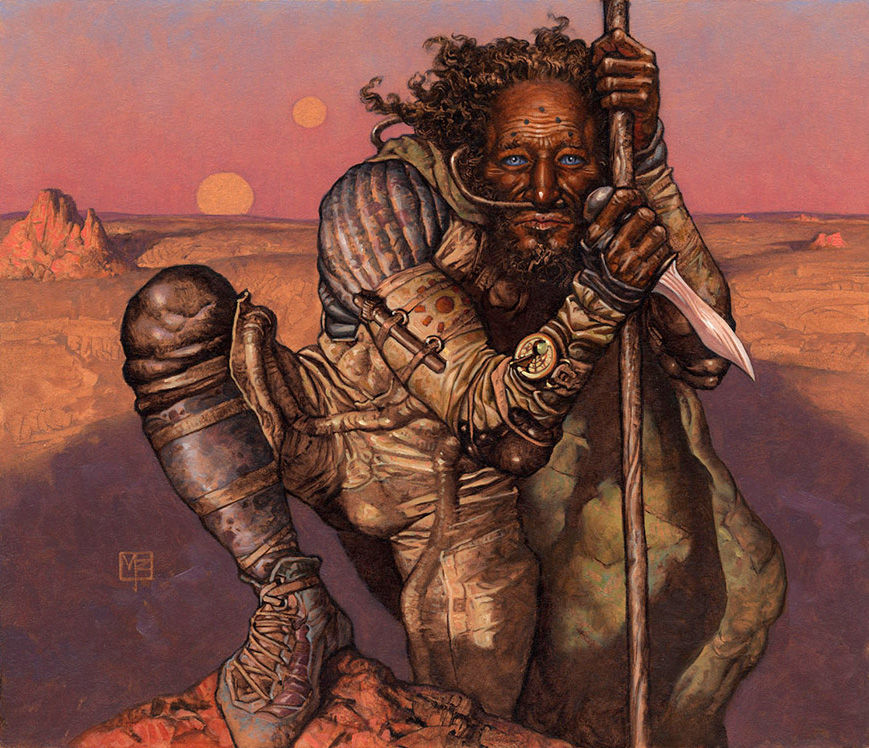
My own version of Dark Sun, with lots of Tékumel, Clark Ashton Smith and french comic book artists. Mother Nature was made barren and the world itself hates life. Now, the post-apocalyptic wastelands are ruled by city-states inspired by ancient history. Life is cheap and every resource - metal, magic, water - is scarce. Instead of horses and lions, you get feathered dinosaurs, giant worms and insectoid-people. There is radiation, teleportation, and lasers from ancient times  - but even the simplest technologies are indistinguishable from magic to the people of this primitive planet.

Characters: mostly humans but also other mutant and alien types.

Locations: great cities surrounded by walls, ziggurats, endless wastes of scorching sun.

Inspirations: see the complete list here, plus Talislanta, GURPS Fantasy II, etc. Tags: bloody sun.

Other settings

These are not the only settings I like, but only my favorites. I seldom write about settings that use honor and reputation as central themes, but I certainly enjoy using them (Pendragon, Westeros, L5R, etc.). I always wanted to play a nautical campaign, going from one exotic island to another, but never managed to to it. These are all fantasy settings, obviously - there is plenty of other stuff to use for horror, sci-fi, and so on.

Saturday, September 09, 2017

Dark Sun - 10 house rules for 5e (part II)

Here is part I.

Last part was easy. Here come the hard choices. But hey, that is what role-playing is about!

No gods! No healing!

The fluff: the burned world of Athas is, quite literally, a godforsaken place. Did the gods abandon the people of Athas, or was it the other way around? Doesn't matter anymore. There is no one to hear your prayers, no one to bind your wounds, and no one save your soul.

The crunch: there are no active deities in Athas, but, traditionally, Dark Sun allows the sorcerer-kings and the elements to be worshiped instead of actual gods, so you still have cleric-like classes. The main difference is that healing magic is uncommon in Athas. The easiest way to do that is to ban healing magic from the spell lists (trade them for something appropriate), and disallow some features that restores hit points ("lay on hands", etc.). Using the "healing surges" option in the DMG (page 266) is a good idea to balance things out. Any optional rule to raise an stabilized characters to 1 HP after combat would also be useful (just make a DC 10 medicine check or use a healing kit, as long as you're not in combat).


No class!

The fluff: as you might have guessed, some classes don't make much sense in Dark Sun. Traditional clerics and paladins do not fit. Sorcerers, warlocks, and druids must also be adapted to the setting. Some races simply do not exist.

The crunch: personally, I don't like banning classes outright. Warlocks make decent templars, and clerics can worship the elements with the appropriate domains. Sorcerers feel a bit redundant to me, and wild magic is certainly too much if you're using random defilement rules (although you can certainly consolidate one single table and create a new "pure defiler" class from there). Monks make some sense thematically (unless you're using the mystic), although there were banned in 2e Dark Sun. Even paladins can be refluffed as templars, ascended champions of the sorcerers kings (I love the idea of a paladin of vengeance gaining dragon wings or causing necrotic damage whit lay on hands!), or even inspired zealots of forgotten gods. Druids must choose appropriate animals; bards might be assassins with an adequate background. There are enough choices an options to fill a whole book on the subject. Fortunately, there are already some good ideas online. Here is one example.


No races!

The fluff: the original version of Dark Sun forbids some of the traditional races and introduces new ones - some of which aren't available in 5e.

The crunch: you can always re-fluff the the races like you did with the classes, but some options will be inadequate, especially the ones that can cast spells by default. You have enough races in 5e to cover most of the races that are characteristic of Athas: Aarakocra are already oficial, you can use goliaths for half-giants, some variations of dwarf (or orcs!) for muls, etc. The Thri-kreen are trickier, but not much: natural armor, claws, reduced sleep, etc. already exist in the official races. As for the extra arms, my favorite option is saying they can do whatever they want with the extra armas, but no extra actions! A two-handed weapon with a shield and a crossbow? Sword and board AND torch AND knife? Sure, why not!


No metal!

The fluff: Dark Sun is the most metal of all D&D settings, but actual metal is scarce in Athas. This means most weapons are made of obsidian, bone and flint. It also means the may break.

The crunch: coming up with an elegant solution that doesn't penalize fighters with multiple attacks is not easy, but there are a few options. My favorite is that some weapons (slashing and piercing) can break if you roll a natural 20 AND deal maximum damage in the first two dice. This makes breakage rare, but creates some tension when you roll a natural 20.
For example, if you're attacking with a 1d8 weapon, a critical hit would let you roll 2d8; if you roll 8 on both dice (16 damage), the weapon breaks from the impact. Greatswords break if you roll 6 in the first two dice (ordinarily, you roll 4d6 when you crit with a greatsword).
Making metal coins 50 to 100 scarcer also creates interesting situations; now the "price" column in the weapons section finally means something, and you have good reason to use a greataxe or maul.
I also did "no armor" in the first post, but if you want armor just make it heavier and more expensive. Encumbrance becomes relevant again - specially when you notice you will die of thirst before reaching the next city.
High level warriors should get their hands on magical or iron weapons, but there should be other ways of fixing weapons (the mending cantrip, artisan’s tools, etc).

Metal!
No psionics! No psionics?!?

The fluff: psionics are extremely common in Dark Sun, across all races and classes.... and even in animals and plants! On the other hand, psionics are extremely uncommon in 5e.

The crunch: this is the toughest one. 5e's psionics system is unfinished; all we have are a few classes in the Unearthed Arcana (i.e., playtest material). Which isn't nearly enough for a setting where everybody can have psionic powers. The simplest solution here is spells. Not the most elegant or creative way out, but it is the one the Monster Manual officially uses. And 5e is full of magic by default. So, psionics is (mechanically) just magic with no components and no possibility of defiling. There are other subtle differences: psionics are probably invisible, for example. The "spell list" for psionics should be significantly shorter, and "full caster" classes should be reserved for actual magic. All characters start with a random (psionic) cantrip. Again, not the fanciest solution - but it will do until WotC releases official material for 5e.


No rules!
I admit - this is rule #11 in a top ten list, and feels out of place in a list of, well... rules. But it might be the most important one. I do not treat anything in Dark Sun as canon, mostly because not all Dark Sun canon is good. Back in the day, I used to think the characters in the books did all the cool stuff, so there was little left for the PCs to do. 4e did a decent reboot, but I am not a fan of eladrin in Athas, among other things.
Another reasons is that I like to add stuff from other sources: Tékumel, Carcosa, Zothique, etc. Talislanta is a cool source that I failed to mention (the thralls, pictured above, are more interesting than the muls in some aspects), but any source that works for you is fair game.
In short, my favorite version of 5e is the one I fix - and my favorite version of Dark Sun is the one I make.

Friday, September 01, 2017

Dark Sun - 10 house rules for 5e (part I)

It's that time of the year again! When I miss Dark Sun and start writing my own version of it! Anyway, here are some house rules you may use in your Dark Sun games if you're playing 5e D&D.


No armor!

The fluff: who would use armor in the scorching heat of the desert? Gladiators, templars and city guards wear armor, but since you cannot really travel, sleep of even fight in armor in the desert without being exhausted, most are able to fight without armor.

The crunch: anyone can trade their medium armor proficiency for the monk's Unarmored Defense or their heavy armor proficiency for the barbarian's Unarmored Defense. Unarmored Defense can also be taken as a feat (and you get +1 to Wisdom or Constitution if take it), but only by certain classes (as a general rule, you can take the first if you're proficient in light armor and the second if you're proficient in medium armor).

I am tempted to make a Charisma version for Chainmail bikinis and loincloths, but nobody wants that, right? Right?


No rest!

The fluff: the wastelands of Athas are no place for idleness. Days are hot and nights are cold (or warm, I dunno). Sure, you are familiar enough with the desert - otherwise you would be dead - but if you need rest, you better look for shelter.

The crunch: if you are in the desert or a similar wasteland (and that includes jungles, etc.), the grittier rules in the DMG for short/long rests apply (a whole day doing nothing may grant you a long rest if you can find a tent, food, etc). Look for a city or oasis if you want better healing (this actually solves a lot of problems). Those ruins are looking quite inviting, aren't they?


No food and no drink!

The fluff: food and water are scarce.

The crunch: we will use starvation and dehydration rules that actually make sense. Also, finding food and water is twice as hard. This applies to everything: spells, class features, backgrounds, etc. Interpretation is up to the GM.


No easy magic!

The fluff: magic is rare in Athas. There is no petty magic. You're either a defiler, a preserver or you're not a true spellcaster. Everything else gets re-fluffed as supernatural or psionic abilities.

The crunch: that thing in 5e where everyone has spells no longer apply. As a rule of thumb, if you actually have spell slots, you can be a defiler or preserver. Otherwise, your powers come from something else. Monks (if you allow those in Dark Sun) and barbarians, for example, create supernatural effects with inner strength, psionics or experience.


No balance!

The fluff: there are two types of spellcasters: defilers and preservers. The difference is that defilers destroy all around them in order to cast spells, while preservers don't. Common people cannot tell the difference and hate them all. Most spellcasters can use magic both ways, but choose one path over another. Also, defiling is plain better. That is the temptation.

The crunch: when you use defiling magic, you cast spells as if they were one level higher. You also need to roll on a random table to see what effects you cause. Here are some ideas. All negative effects can be avoided by a saving throw (damage and HP loss are halved, not avoided).

1 - Desolation - flora and small fauna wither and die around the spellcaster.
2 - Destruction - people around the spellcaster suffer necrotic damage equal to spell level.
3 - Confusion - spell gets out of control and affects another random target.
4 - Exhaustion - spellcaster gains exhaustion. Nobody said it was easy!
5 - Inspiration - the next time the spellcaster casts a spell, he can pick any result from this table (except for this one!).
6 - Mutation - the spellcaster becomes permanently warped (it can be cured... probably).
7 - Exsanguination - the spellcaster  loses 2 HP per spell level.
8 - Transfiguration - the spellcaster becomes something else for a while. It might be just cosmetic. Black eyes, etc. It is very unsettling and will draw ire from the superstitious.
9 - Provocation - sleeping creatures might wake, the half-dead may rise, or hungry monster will hear a calling.
10 - Demolition - objects break and structures fail around the spellcaster.
11 - Extortion - the spellcaster gains 2 HP per spell level. A amount of damage eqaul to the total is randomly distributed to nearby people.
12 - Putrefaction - food and water are ruined.

Coming up: No gods! No healing! No rules!

Monday, October 26, 2015

Mad Sun, Part I - Inspirations

I am a fan of post-apocalyptic settings, specially Dark Sun. Watching Mad Max: Fury Road made me want to revisit it, so I made a list with 50 things I would like to find in a fantasy desert wasteland. Since then, I have been meaning to expand on it.

So, here is the idea: creating my own scorched fantasy wasteland, mixing Dark Sun with different doses of its influences and some of my own favorites. I am leaning towards a more sci-fi version of the setting, but without guns, laser, automobiles or space ships. When I am finished, I might put everything together into a short PDF so you can use it as you will (with some notes on adapting it to old school games and 5e, with alternate classes, rules, etc, if there is enough interest).

This post is about the stuff I'll use for inspiration; I listed things that might have influenced Dark Sun itself to some degree to a couple of new things that I think would fit well. This is not a literary analysis of Dark Sun, but a list of cool things that might be useful for my fantasy post-apocalyptic campaign. If you like this list, you might like the rest of the series. Here we go.

Source.

1. Dark Sun and Mad Max are the main reasons I'm writing this. Always been a fan of both, and Fury Road, of course, was one of the best action flicks in recent memory, with lots of gameable material - warlords, preservers, warboys, etc. Most Dark Sun books are still available to buy in PDF, and you can always turn to the Dark Sun Wiki for easy access to information.

2. Tékumel by M. A. R. Barker is, in many ways, Dark Sun "avant la lettre". Empire of the Petal Throne was published, in 1975, in the same year as Greyhawk and Blackmoor, using non-european mythologies to create an unique and very detailed setting. Hot weather, iron scarcity, strange beasts and bizarre races were played using D&D rules decades before anyone ever heard of a Thri-kreen. The best introduction to Tékumel, according to a recent post by James Maliszewski on G+, is Empire of the Petal Throne, available here.

Source.

3. The Zothique Cycle, or anything else by Clark Ashton Smith is an important influence in early D&D and pivotal to the "Dying Earth" sub-genre in which Dark Sun takes place. Necromancers and their undead legions, cultists and evil gods, all wither under a dying sun. You can find the whole series online here. A great summary of each short story can be found here. Other than Zothique, you can find inspiration in tales such as The Vaults of Yoh-Vombis, which reads like a D&D adventure, and The Abominations of Yondo, which takes place in a desert full of bizarre monsters and starts like this:

The sand of the desert of Yondo is not as the sand of other deserts; for Yondo lies nearest of all to the world's rim; and strange winds, blowing from a pit no astronomer may hope to fathom, have sown its ruinous fields with the gray dust of corroding planets, the black ashes of extinguished suns. The dark, orblike mountains which rise from its wrinkled and pitted plain are not all its own, for some are fallen asteroids half-buried in that abysmal sand. Things have crept in from nether space, whose incursion is forbid by the gods of all proper and well-ordered lands; but there are no such gods in Yondo, where live the hoary genii of stars abolished and decrepit demons left homeless by the destruction of antiquated hells.

4. Frank Herbert's Dune is another favorite. With noble families vying for power, political intrigue, psychic abilities, teleportation and giant Sandworms instead of dragons, I think one could use even more inspiration from Herbert to create something that would be at the same time more novel and more palatable to audiences accustomed to Game of Thrones and House of Cards.

Source.
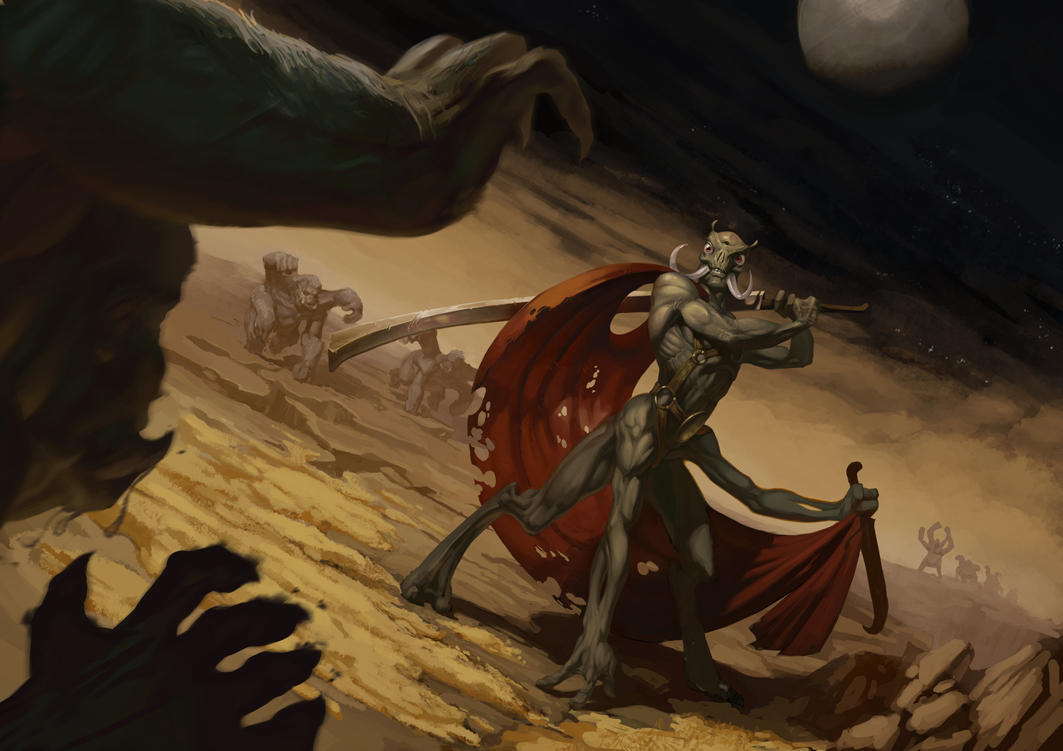
5. Edgar Rice Burroughs' Barsoom is another obvious inspiration. Taking place in the red deserts of Mars, with six-limbed monsters that have been already been included in some version of D&D or other (such as the white apes and banths) and humanoid "races" that would feel at home in Dark Sun or Carcosa (see below), Burroughs' stories of planetary romance make a great fit for D&D adventures, specially the more "epic" ones, with idealistic heroes saving damsels in distress. While the notion of damsels in distress is antiquated, there is plenty of awesome in Burroughs that you can use. See this snippet from wikipedia, for example:

Upon reaching 1,000 years of age almost all Martians undertake a pilgrimage on the River Iss, expecting to find a valley of mystical paradise; what they find is in fact a deathtrap, populated by ferocious creatures and overseen by a race of cruel, cannibal priests known as Therns, who perpetuate the Martian religion through a network of spies across the planet.

His works are in the public domain in the U.S. and can be found here.

Source.

6. Geoffrey McKinney's Carcosa deserves mention as a recent effort to create an interesting D&D wasteland, using Lovecraftian horrors instead of aliens or dragons, which is a great idea. Magic is evil, civilizations is ruled by "village states", races are separated by color (although with less interesting detail than Barsoom), and there are ruins of old, maleficent civilizations all around. Zak S has suggested using it a template for a new Dark Sun here. Although he doesn't sound like a fan of the original box setting in this post, the idea makes sense.

7. Brom is, of course, the quintessential Dark Sun artist, who created much of the look and feel of the setting, but you can look for inspiration in other artists, too. Here is a couple of ideas.
Richard Corben's comic book DEN is mentioned as an influence to Dark Sun by Steve Winter, according to Wikipedia - it looks somewhat like Barsoom with lots of nudity. Besides doing an adaptation of The Vaults of Yoh-Vombis, Corben apparently created the first graphic novel, Bloodstar, a Robert E. Howard adaptation that depicts the heroes fighting lovecraftian monsters in a post-apocalyptic land.
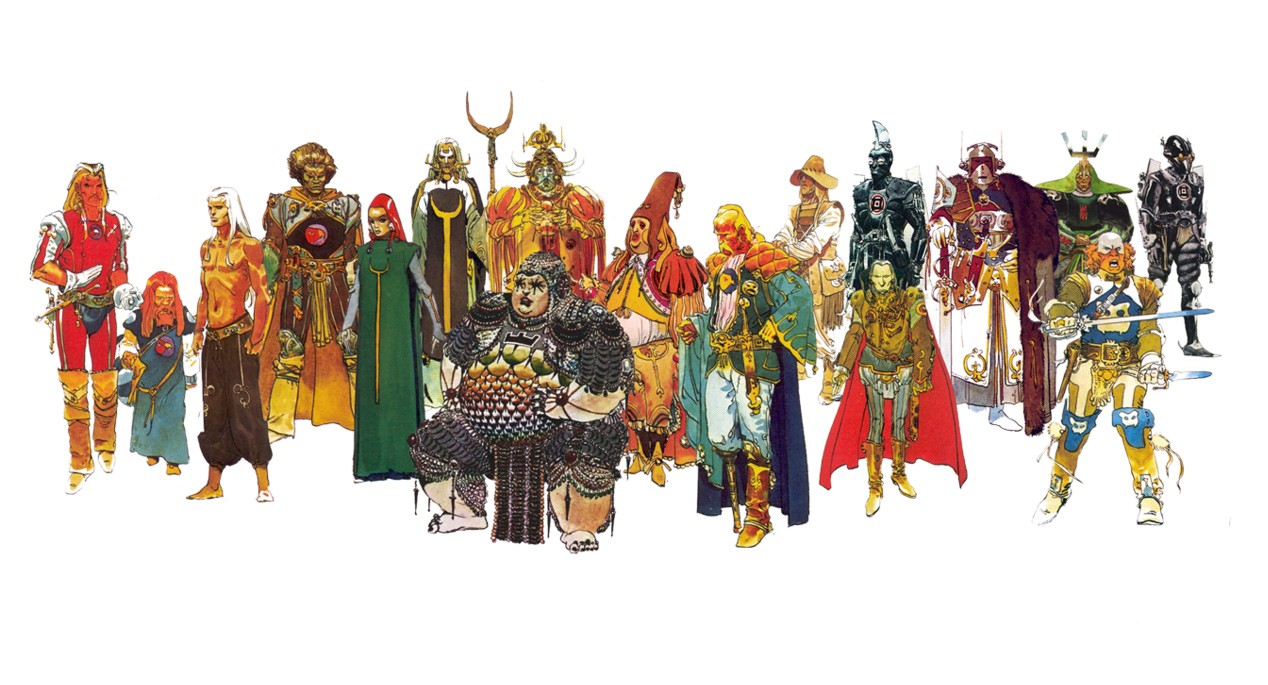
I am a fan of Moebius desert landscapes and weird vistas myself, and Moebius drawings for Dune can inspire a different vision from the more familiar one from David Lynch.

Source.

8. The Fallout videogame series is too good to pass. Although the retofuturistic vibe has little to do with Dark Sun, the series has lots of useful ideas that could easily be adapted to such setting - most of them related to radiation, mutation, factions and hidden vaults, besides using a sandbox structure that is ideal to my favorite style of play.

9. Robert E. Howard and H. P. Lovecraft. Since they have been mentioned a few times already, I feel they deserve an entry. Lovecraft you can use for monsters and gods, and Howard for the Sword&Sorcery vibe. As you know, Conan is often fighting monsters from the Cthulhu Mythos.

10. And, why not, Tatooine, from Star Wars. That's what people have been talking about these days, right? Sarlaacs, sand raiders, banthas, shady taverns and powerful hermits with mind-controlling powers would all fit the bill.

Sunday, June 28, 2015

Mad Max, Dark Sun and 50 random ideas

After watching Mad Max: Fury Road, I couldn't keep Dark Sun (maybe the most awesome D&D setting of all times) off my mind, and how cool it would be to create a new post-apocalyptic desert landscape to play D&D in, maybe with less elves and more mutants.

So here is a list of random ideas from Dark Sun, Mad Max, Dune, Fallout, and a bunch of different stuff. 1-10 are places, 11-20 are related to transportation, 21-30 are factions, 31-40 are visuals and apparel, 40-45 are dangers, and 46-50 objects.

Or, to sum up some ideas in the proverbial 25 words or less (almost):

Maniacs, mutants, and marauders, carrying obsidian and bone, ride oil-eating dragons through Endless Sands. Psionic monks battle radioactive sorcerers, dinosaurs and warlords in the apocalyptic heat. 

Places
1. Ziggurat city, ruled by the god-emperor and his templars. 
2. Endless “seas” of silt, salt, or glass (excessive Ss, sorry).
3. Sky-high monasteries where holy-people sharpen their martial skills. 
4. Underground vaults with the last surviving fragments of the Old World. 
5. A building with innumerable floors inside the tableland.
6. A hill labyrinth of colored sands. 
7. The Vermilion plains, where even the trees have red leaves. 
8. The moving metropolis. 
9. The green places, filed with cannibals and dangerous animals. 
10. Cursed pyramids, with the remains of alien humanoids. . .  and their destroyers. 


Creatures & Transportation
11. Petrol-eating, fire-spitting, many-legged drakes that run around like crazy after a good meal.
12. Velociraptors, tyrannosaurs, stampeding apatosaurs and, why not, pterosaurs. 
13. Flying ships and stingrays. 
14. Sandworms, purple-worms, or bulletes. 
15. Giant insects. 
16. Tree-hoping people. 
17. Relentless runners. 
18. Gigantic warmachines. 
19. Psionic teleportation. 
20. Caravans, controlled by merchant-princes. 

People
21. Bloodthirsty youngsters eager to die in epic ways. 
22. The genetically engineered, with perfect bodies and deranged minds. 
23. Scorpion-smoking religious assassins. 
24. Preservers of the last seeds. 
25. Mutant sand raiders. 
26. Psionic monks. 
27. Rabid cannibals. 
28. Woman-hating slavers. . . 
29. . . . and the Amazons who survive them. 
30. The great desperate mass.

Style
31. Leather, piercings and unusual hairstyles. 
32. Shaved heads, black and white paint, faces like skulls. 
33. S&M apparel. 
34. Demon masks and bizarre armor. 
35. Half naked with sunburns and unkempt hair. 
36. Heavy brown robes, kerchiefs and goggles. 
37. Silk robes with vivid colors. 
38. Ritual scarification. 
39. Bones and human ashes as accessories. 
40. War paint or lots of tatoos.

Hazards
41. Sandstorms and lightning.
42. No ozone layer, sunlight slowly kills you. 
43. Water is scarce, non-radioactive water is scarcer.
44. Sinkholes and the things that cause them. 
45. Desert monsters above and below the ground. 
46. Flowers as signs of extreme wealth. 
47. A spice that causes hallucinations, mutations and increases psychic abilities. 
48. Weapons made of obsidian, glass and bone. 
49. Spikes in armors, mounts and buildings. 
50. Sun-powered death-ray lenses.


(image credits: right-click and "copy image address" for sources)