I must create a system, or be enslaved by another man's. I will not reason and compare: my business is to create.

- William Blake

Tuesday, November 01, 2016

Fighting skill: STR, DEX, both... or none?

In OD&D, Fighters didn't need to rely too much on Strength; it was a (fairly modest) bonus to XP, nothing else. Then, abilities got more and more important (mostly, in other RPGs), until it reachead  peak in 5e. Now, because of bounded accuracy, the fighter's Strength (or Dexterity; see below) is often as important as level when determining how well you can hit your opponent.

Even though HP and number of attacks will still make the higher level character win most of the time, in WotC era D&D (and, to be fair, in much of TSR-era D&D), having a fighter with low Strength is unthinkable.

There is nothing inherently wrong with that idea. In fact, I'm more annoyed with the opposite: the fact that now Strength is the most likely dump-stat for Fighters based on Dexterity, since it does so little aside from combat (which the DEX-Fighter doesn't use), armor (which the DEX-Fighter doesn't use), and encumbrance (which the DEX-Fighter doesn't need, since he is probably wearing no armor).

The purpose is obvious (and laudable): to allow players to create nimble, fast warriors archetypes like Robin Hood or Legolas. The downsides are also obvious (and laughable): strength becomes useless when wielding a longbow!

Conversely, DEX might be a good dump stat for STR Fighters: they cannot use it to gain better defenses when wearing heavy armor (which is silly IMO), or to get a combat bonus. The reason that "Dex as a dump stat" happens less often is that DEX is so useful to so many things: combat with finesse weapons, AC, initiative, acrobatics, lock-picking, driving a chariot, playing stringed instruments and crafting small objects.

This list (from 5e, as written) sounds a bit ridiculous; in the game, it seems like too much cramped in a single ability, and in reality there is no direct link (that I know of) between an ability to play the guitar, dodge a punch and shoot a bow! Even leaving "gamism" and "realism" aside, the fact that this things are tied to a single ability is detrimental to creating archetypal characters that are good with longsword AND longbow, for example, or that can move fast while in armor, can play the lute but not dodge a punch, etc. Why would Robin Hood be as talented as Will Scarlet with a lute (at level 1 anyway), for example?

This is NOT a D&D-only problem; DEX is the uber-stat of many RPGs, that often manage to be a lot WORSE than D&D in this regard by making combat solely dependent on dexterity.

Also, can you think of an archetypal fighter that is a weakling? Even fighters that are known for their speed and accuracy over raw strength (say, Legolas, Robin Hood, Black Widow) would beat an ordinary person in an arm-wrestling contest, in my mind. What about the hulking brute that is an excellent fighter despite having no dexterity at all? That archetype is more common, but is most often used to be defeated by the weaker protagonist. Conan, Fafhrd, the Mountain (ASOIAF), etc, are certainly NOT good examples of clumsy heroes!

No dump stats for this guy!
What is worse, the current system DISCOURAGES "well-rounded" fighters with both good STR and good DEX, which goes against archetype, fiction AND reality!

If STR and DEX affect how you fight your battles, they should BOTH be important; letting STR define damage and DEX affect defense (no matter which kind of armor you're using) sounds good to me.

Now, which of the two should define "to hit" capabilities? Well, since "hitting" an enemy is an abstract thing is D&D, any solution could work.

Maybe both, since strength and dexterity are both obviously useful for a fighter? Again, nothing wrong with that, but it makes the game needlessly more complicated. In fact, one could argue that intelligence is very important to a fighter. Willpower certainly is, and perception too. Fitness, obviously (although this is reflected in HP). And so on. Potentially, any ability can be useful for fighting. IIRC, the Radiance RPG does exactly that, allowing characters to use their main ability for fighting.

Still, fighting is very much its own thing. The best fighter isn't necessarily the strongest, or the fastest. Connor McGregor's (the current UFC Featherweight Champion sentence after beating the (awesome) former champion José Aldo (using plenty of provocations and mind games, one might add - not to take anything from such an impressive victory, but just to show how the mental aspect is important in a fight) sums it up nicely: "He’s powerful and he’s fast, but precision beats power and timing beats speed".

Charisma and willpower are often important for fighters
Dexterity and strength are important, but not as important as how you apply them. If that is the case, why not just let fighting be a separate thing, as it was in OD&D? After all, magic-user didn't get spells of higher levels because of their INT (although they did get extra spells in some versions).

The damage boost is good enough for the strong fighter, the AC bonus is good enough for the nimble fighter, and (although no fighter can completely ignore any of these aspects), if fighting ability is defined mainly by level, an expert fighter can succeed against a faster or stronger foe.

This seems more in tune with reality, archetype, and, what might be even more important, makes the game a bit simpler and more flexible at the same time.

Saturday, October 08, 2016

Dungeonborn (New 5e Background)

Here is a 5e background inspired by "The Outsider" by Lovecraft, some of Poe’s claustrophobic short stories, a bit of Dumas (The Count of Monte Cristo, The Man in the Iron Mask), Mervyn Peake, Horace Walpole, and this awesome post by Jack Shear. There might be some Fallout in it too. Or Room, although I haven’t watched it or read more than a few pages.

The name was quite difficult to decide upon: “Castle born” sounds like a traditional noble background, something equivalent to “silver spoon”; “Tomb child” sounds vampiric or undead; “Shadow spawn” sounds like something out of the Shadowfell, etc. Of course, you can use any of them if you prefer.

This background is quite close to Sage, with a bit of Hermit, Noble and a Gothic flavor. If you like the idea but dislike the rules I’ve written, use Sage instead.

There are many interesting ways you can use that. A character like Bane, born in a prison, is one possibility; but a D&D version of they guy who spent all of his life in his mom's basement is also viable. Also, Rapunzel, Edward Scissorhands, etc.. A post-apocalyptic survivor like the protagonist of the Fallout games allows you to play the outsider who knows nothing of the current archetype in a fresh way. An artificial being, or a Quasimodo character are some of the possibilities I haven't explored to avoid making it too long.

In any case, here we go. Click here for a good-looking PDF, made with The Homebrewery.com.


Dungeonborn

You were born and raised into the depths of a huge castle, dungeon or tunnel complex. You have lacked nothing - you slept in fine linen, studied in huge libraries, and there was always a friendly hand to feed you. Whose hand is that, you don’t quite know – maybe a servant of your ancient family, or some forgotten creature or undead. You have never seen much of the world outside the walls (or maybe not even the light of the sun), or talked to common people, although you know they do exist somewhere. When you finally got out, you felt alienated from everybody, but also curious and eager to explore.

Inside & out
Why were you kept inside? Who raised you? You can create your own story with your GM or roll in the table below. You might also choose to not know all details beforehand, and find them out during play. Likewise, think of how you got out (did you escaped, reach maturity and was left to fend for yourself, walked away when all servants disappeared, was expelled, rescued by other PC’s), unless the adventure starts while you’re still inside.

1. I was a bastard unwanted by my highborn parents, kept secret to avoid shame.
2. I was abandoned and raised by benevolent spirits.
3. My caretakers were overprotective to the point of insanity, although I didn’t realize that.
4. I was kidnapped by a maniac and protected by another prisoner.
5. I was part of a doomsday cult that tough the world had ended.
6. The usurpers took my titles, but wouldn’t dare to kill me. 
7. My parents were imprisoned and killed by underground creatures that took pity on me.
8. I am a child of the undead or inhuman – I should never be living in the first place!

Skill Proficiencies: Arcana, History.
Languages: Two of your choice.
Equipment: fancy and peculiar clothes, a lantern, a necklace with two old portraits (your parents?), 25 gp.

Feature: Born in the Darkness 
You are used to move in the darkness, and you can see in dim light within 30 feet of you as if were bright light. You also have an instinctive sense that tells you of the existence of any secret doors or passageways within most buildings, as well as the purpose of most rooms.

Variant feature: Forgotten lore
You have acquired a huge volume of curious forgotten lore. Even when you do not know a particular piece of information, you often know some ancient and relevant trivia related to it. You might not know a particular noble, for examples, but would have heard about his ancestors or past landowners.

Suggested Characteristics
Darkness and isolation leave permanent marks on the dungeonborn. Whether curious about their own origins or eager to get away from them, they are still quite alien and ignorant of common people’s customs and manners. They can be shy, strange and socially inept, or adorable in their exotic naiveté.


Personality trait
1. I lack social skills and often commit innocent but embarrassing faux pas.
2. I am shy and get embarrassed when dealing with extroverted people.
3. I am eager to make new friends and treat everyone I find as a potential ally.
4. I am extremely curious about the outside world and marvel at the simplest things.
5. I am dismissive of people with little or no book learning.
6. I constantly quote from forgotten books that no one else has read, expecting to be immediately understood.
7. I do not know how to deal with money.
8. I am incredibly patient and think long–term in most of my actions.

Ideal
1. Freedom. No one should be forced to live in a prison of any kind (Chaotic).
2. Knowledge. I must learn as much as I can from this huge, strange world (Neutral).
3. People. Most people are inherently good and should be treated as such (Good).
4. Traditions. I must keep the traditions of my family, no matter how the world sees them (Lawful).
5. Power. I will show this degenerate, ignorant people that they should do as I say (Evil).
6. Self-knowledge. I must find where I came from and what I can become (any).

Bond
1. I am the last heir to my family and I must protect their good name.
2. These people are my first friends and I must treasure them forever.
3. I is my duty to maintain my lands and castle.
4. This picture is the only remainder of my ancestors, I shall never lose it.
5. I will take revenge against the ones who imprisoned me.
6. I will return to the castle one day, and make it a better place.

Flaw
1. I look down on the ignorant masses.
2. I cannot trust anyone.
3. I was imprisoned by my own fault and want to keep it a secret.
4. I am vengeful and cannot forgive an insult.
5. I am oblivious to other peoples’ feelings.
6. I believe everyone should pay attention to my needs.

Tuesday, October 04, 2016

The fallacy of unified mechanics

In the classic TSR-era, D&D famously had a big number of task resolution mechanics. Some things used 1d20, roll high. Others, 1d20 roll low. Thieves skills used both a d% and 1d6 roll low - same as most other tasks. Reactions and morale used 2d6. Initiative, 1d6 roll high. And so on.

The number and type of dice were not the only thing the varied: attacks with a weapons would be rolled by the attacker, while spells would grant a roll to the defender, etc. A number of tasks would require having the necessary resources (spells, equipment, HP, etc) and no roll. Some stuff seems to be decided by GM fiat (a witches reaction to a high-charisma PC, for example).

And, of course, many old school enthusiasts believe most challenges would be resolved without using the dice, just by describing the PCs actions. Some will even rage against thieves skills as detrimental to the whole game.

Nowadays, I'm somewhat used to it. But at some point in the nineties that irritated me greatly; the "new" D&D stuff that I liked (AD&D 2e and the Rules Cyclopedia) insisted in the same confusion as the original versions, when there were more streamlined games around. Why not just use one single method of resolution?


As you might know from my last post, I eventually started playing GURPS, and when D&D 3e hit (to supposedly fix such problems, but we all know how that went) I already thought D&D was too complicated. One of the things that attracted me in GURPS is how everything was "roll 3d6 under your attribute or skill". So simple!

People call this "unified mechanics" - all "modern" games do it. And, of course, D&D eventually followed suit in the year 2000. 1d20, roll high, for everything! Quite elegant!

Well...

It is easy to see how old school D&D might look messy at first. Let us take what, in my opinion, is the simpler, cleaner, and easier version of D&D ever (Moldvay´s) as an example:

- Attack and saving throws use a d20 - you want to roll high.
- Well, there might be a saving throw for falling, if the GM allows it. It uses a d%.
- Thieves skills use d%. Well, except hear noise. It uses 1d6, like most other tasks anyone can do (forcing doors, etc). Roll low.
- Oh, initiative also uses a d6. You want to roll high.
- There is also some uses of 2d6, but the GM rolls them. Monster reaction uses 2d6 - rolling low means the monster is aggressive. Morale (optional) uses 2d6 - you want to roll low, because rolling high means surrender.
- Other tasks use a d20. Except you want to roll low, lower than your ability score. A "20" is always a failure. Climbing a rope, for example. No, climbing sheer surfaces use a different mechanics. Yes, most thieves might have better chance at climbing sheer walls than climbing ropes...

Compare this to 5e (and most WotC D&D):

- Attack roll? Roll a d20, and roll high. Saving throw? Same thing. Skills? Yup, d20, roll high. Thieves too? Yes. What about ability checks? Same deal. Initiative? d20. Morale (optional)? That is a d20 check. Roll high.

Pretty good, huh?

However... Skills and abilities become quite unreliable. Your dexterity 18 gives you 40% extra chance in succeeding in some crazy acrobatics test in B/X (if you use "there is always a chance"), but only 20% in modern D&D. And a 3rd level thief can often succeed where a 10th level thief has failed.

Same with initiative - you could be quite sure of acting first in B/X, but with a d20 your dexterity means very little. Forcing doors with Strength 18? That would be a 5/6 chance in B/X, more than double the usual 2/6 - but in modern D&D your Strength bonus will mean nothing 80% of the time. Likewise, morale becomes quite the coin toss.

The problem isn't numbers; the problem is my players that don't even care about the math realizing the dice is more important than their characters when resolving most tasks (and they do).


Well, at least everything is resolved the same way now, right? From fighting to, say, climbing? Really straightforward! Not quite.

When you climb, you roll a d20. If you roll high enough - success!

When you attack, you roll a d20. If you roll high enough - success! But wait, roll for damage. No, no d20s here - a d4, d6, d8, d10 or d12, depending on the case. Rolled a 1? Yeah, not such a great success after all. What if you rolled the maximum number? Well, then your enemy loses some HP. Success? Not quite, you must roll the d20 again next round to attack again. Did we roll initiative? Yeah, you must roll a d20 BEFORE attacking, to see who goes first...

I see no honest way to say that combat and skills use the same mechanics in any version of D&D. And, if they don't, using a d20 for both seems forced - because there are many more effective ways that have been used before.

Even when 5e tries to fix the d20 problems - but giving reliable skills to rogues or reliable strength for barbarians - it does so by adding NEW mechanics, often more complicated than just rolling a different kind of dice.

Back to GURPS then! At least 3d6 creates a good bell curve, making skills reliable, and all damage uses d6s. Not 3d6, but, still...

The problem is that "reliable" and "combat" don't mesh too well. Fighting can become quite predictable, and depending on the rules you're using, you can spend rounds and rounds with nothing happening because both foes have more than 70% chance of blocking an attack! There are some critical hits, but they are hard to come by... and then you roll in a critical hit table where "nothing happens" is what you 37% of the time!

You can imagine "reliable combat" got a bit boring after a while.

Now, let us make a few things clear. B/X. GURPS, and D&D 5e are some of my favorite RPGs.

And I quite LIKE the idea of unified mechanics - as one possible goal, not as a straitjacket. Yes, I have proposed some for B/X in this very blog and I use them in my own RPG, Days of the Damned.

But, here is the point:

The most important thing about a game mechanic is that it is FUN and it WORKS.

The rest is secondary. The fact that mechanics are similar to each other is a nice addition, but not a requirement. Games are meant to be PLAYED, not to be admired by the reader ("oh, how elegant, armor class is equivalent to difficulty class"...).

If the price for fun is using some different types of dice, I'll pay it gladly.


ADDENDUM: how to solve all my problems with GURPS, B/X and 5e, "unified" style!

These ideas are old, but they work well enough.

- Combat uses 1d20. A "bell curve" effect is created by dividing it in many rolls. Saving throws use the same because the risk is exciting. Skills uses 3d6. "Natural" bell curve.

- For 5e: use 3d6+mods, 4d6 if you have advantage, 2d6 for disadvantage. DC 30 is actually "nearly impossible" now. Or just fix the DCs accordingly (maybe 10/14/18/22/26).

- For B/X: everything but combat and saving throws is now 3d6 roll under, 4d6 if the task is hard, etc. Thieves have no skills, but they get a bonus equal to their level when trying to hide, climb, open locks, etc. It is not hard to remember: roll high with 1d20, roll low with d6s. Natural 20 good, 666 bad. Morale and reactions stay as they are, because they work.

- For GURPS: use a d20 in combat and high-risk scenes. And no more "nothing happens" results in the critical hit table!

Wednesday, September 28, 2016

GURPS D&D, part I: some quick thoughts on the matter (and attributes)

As you probably know, there is a kickstarter  for GURPS Dungeon Fantasy going on. For all I know, it should be great. And I should know a little about the subject, since I've been playing GURPS fantasy for more than 20 years until switching to old school D&D, a few years ago.

Reading about new GURPS stuff fills me with nostalgia. It is an awesome game and I should probably write more stuff about it.

So, why did I stop playing? Well, I think GURPS can do a lot MORE than D&D with fewer rules. For all the "complexity" fame that GURPS has, I am constantly reminding people that I played GURPS because I though D&D was too complicated and made little sense - of course, had I know B/X before, my experience might have been different.

Still, I switched to old-school D&D because I think there are quite a few things that D&D can do a lot BETTER than GURPS.

First, GURPS combat got boring after a while, for reasons I will explain later. But this might be contentious; a better example is old D&D adventures and OSR stuff - GURPS has nothing quite like it (on the other hand, it has great sourcebooks on everything, and you can use most of those for any RPG). And those Monster Manuals! GURPS has a few good ones, but nothing compared to D&D.


Much of this is OGL's fault. Anyone can do D&D nowadays, and, although there is lots of trash, there are also more hidden gems than I can count. On the other hand, only SJG can do GURPS. The upside is that I used to buy EVERY. SINGLE BOOK. that SJG published because I already knew that they would be good (more than I can say about WotC, to be honest).

In my last years of GURPS, I spent lots of times trying to convert D&D stuff to GURPS. Eventually, I didn't see the point anymore. GURPS is quite simple, despite what people might say; but there is just TOO MUCH stuff (too many skills, advantages and disadvantadges, for one).

So I probably won't back the kickstarter, for lots of reasons - mostly, time and money, but if you have those available, I think you should. I can guarantee GURPS has useful stuff for pretty much everyone.

In any case, there is still a place in my heart for GURPS stuff. There is so much I learned from it, and I reckon some people that never played GURPS can find something useful in it. There is so much I would change too - that is why I play D&D.

And I think Ic an explain GURPS in D&D-speak, which might be relevant to some readers.

If there is enough interest, this might become a long series of posts; if not, maybe I will go back to writing about D&D sooner (who knows, I love when people read and comment on my blog, but I'm doing this for fun).

This probably beats most D&D settings, Seriously.
So, how would my version of GURPS D&D be like? Let us start with attributes.

First, if you've never played GURPS, it has "attributes" instead of abilities. Strength [ST], Dexterity [DX], Health [HT] and Intelligence [IQ].

All attributes start at 10. You can roll 3d6 in order, if you want, or use point-buy, which is quite central in GURPS. Most skills are based on DX and IQ, so they cost 20 points to raise (from 10 to 11, 11 to 12, etc). ST and HT cost 10.

All combat skills are based on DX, unlike D&D, and although ST is what causes damage, a good DX can make up for it, by targeting the throat, etc. This made lot of sense to me back in the day. For combat, DX is probably the main stat.

IQ is another important stat. It is Wisdom and Intelligence rolled up in one, as it includes magic, many skills, perception and will power (and you thought D&D was silly to use Wisdom for the last two!). It also includes Charisma stuff - fast talk, diplomacy, etc. I am not the first person to suggest this is just too much stuff for a single attribute; there are lots of house rules that address this in one form or another.

There is no easy way to elegantly fix that that I can think of without making it too complicated.

One could just use D&D abilities, and it would actually IMPROVE the game in lots of ways. Everything should cost 10 points per level - this is actually very close to how GURPS does things (see Sean Punch /Kromm about charisma cost here).

DEX and INT are too powerful in GURPS terms, since it is a skill-based game and most skills are based in DEX and INT, but INT can be easily fixed if you move some of the skills around.

DEX, on the other hand, is harder. Not only is the one you use to attack, but is also useful for dodging, no matter your armor. And, of course, most "thief skills" are also DEX-based. This is one thing you could change - maybe lock-picking and sneaking require more attention than agility - but then you've got a lot of wise thieves walking around... Not a good idea when you are trying to create archetypal characters.

You might just keep the cost at 20 points per level, if you want the six abilities or think the ability to dodge a punch is akin to the ability of picking as lock. In my own game, I just use two "Dexterity" and "Agility" instead, but adding a new ability kinda ruins my whole "GURPS D&D" theme. To stay true to my D&D house rules, I could rule there is NO combat attribute, and you must rely on classes/skills instead, like in OD&D. This seems quite natural to me in D&D, but feels very strange in GURPS, which has no other skills without attributes that I can think of.

In short, to make this compatible with both GURPS and D&D in some way, I guess I would prefer to have six abilities with DEX defining all attack rolls but having twice the cost of other abilities.

GURPS' way still makes a lot of sense to me, but this whole exercise always makes me reflect on how elegant and effective the six D&D abilities are for this kind of fantasy. There are plenty of reasons to like D&D, but some good ones' for playing GURPS too - which we will cover on future posts.

Wednesday, September 21, 2016

One mechanic per (archetypal) trait

When I started playing GURPS, I was instantly hooked by the idea that I could create ANY CHARACTER I WANTED. And I still like the idea. Unfortunately, I eventually realized that in practice this meant character creation took two to three hours, as the players browsed the books with innumerable traits and skill and got decision paralysis (also, combat had some boring bits, and the sheet got to complicated, etc., but I don't think you came here looking for my GURPS house rules anyway).

By comparison, D&D started looking a bit boring - I could no longer accept Magic-Users being unable to use swords, for example. Eventually, I "got" lots of aspects and started ignoring the ones I dislike, and I fell in love with D&D again.

This whole thing color my preferences to this day. Even after D&D reclaimed its spot as my favorite RPG and I fully embraced levels and classes, I still like the option of customizing characters.  Here is how I do it in B/X, for example.

The dilema is: how can I have a game with a maximum number of options without adding complexity or decision paralysis?

And my answer is: by taking away every mechanic that means nothing.

Well, there is another answer I should explain first. I realized that, as much as I like GURPS, I don't really need rules for an albino psychic with a bad back. What I DO need is some way of creating an albino sorcerer who can hold a sword, like Elric, or a strong warrior that can fight without armor or even kill an opponent with a chair, like Conan, because those characters are important in the Appendix N. And nowadays I do need paladins and clerics and "beastmaster" rangers, because they have become important D&D archetypes.

In short, I need at least one way to create every relevant archetype for the campaign I'm playing.

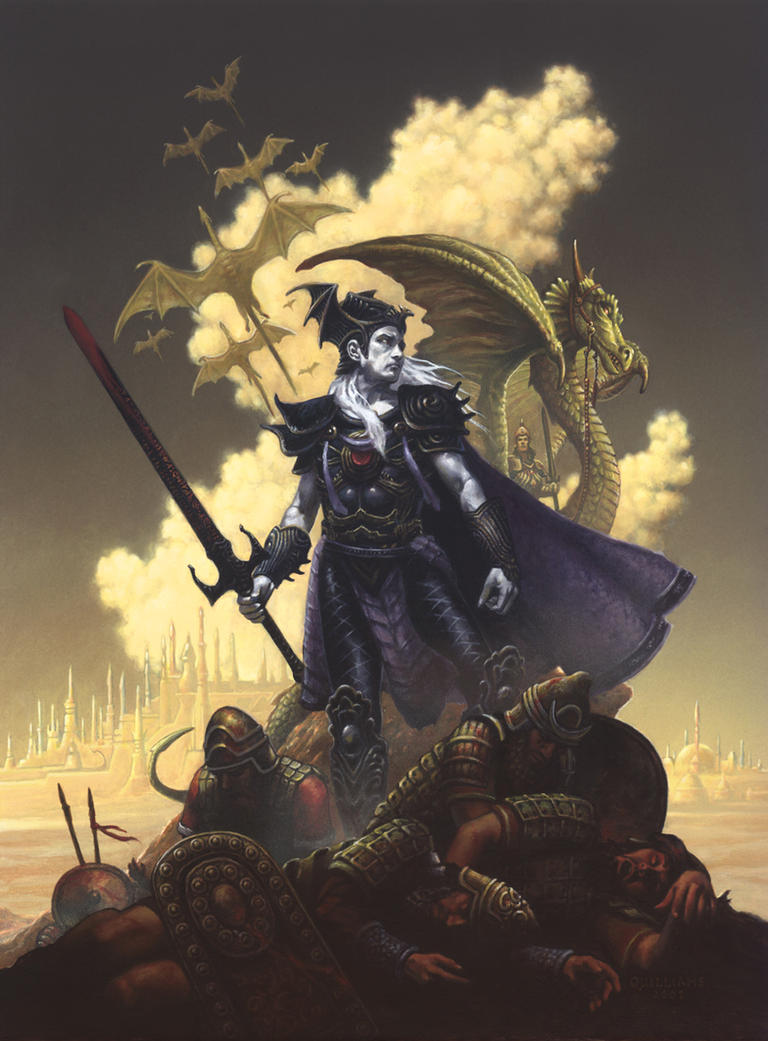
by ChrisQuilliams - Source.
Now, the current version of D&D pretty much covers every archetype I would like to use in my game. A few things might be missing - a non-magical ranger, a 4e-style warlord - but my problem with 5e is actually the opposite: there is just too much stuff. I would prefer something simpler.

Well, old school D&D is simple enough and has enough methods of character creation, including multi-classing, dual-classing and so on (and even elves that can use swords and magics, so, Elric). Still, I feel this is still needlessly complicated.

The reason is that there are too many rules that mean nothing.

Take the "wizards cannot use swords" example; in old school D&D, there was a reason for that - the magic item charts. But if you're not using it, the rule accomplishes nothing, and creates lots of obstacles - now, for every new class, you must describe which weapons it allows, and so on. Last year, this caused me to write a whole series of articles about doing away with those limitations, starting here. It is amazing to think that, to this day, D&D still has rules concerning "wizards cannot use swords" (well, they can, but get no proficiency bonus, or they do, but they need a feat for that... why not just ignore this stuff and make everything simpler? A wizard with a sword is more likely to be hacked to pieces than to break the balance of the game).

But these limitations are not the only problem. There are whole concepts that could be thrown away without great loss. I know a lot of people will disagree here, but do we really need saving throw charts? What do they represent that cannot be better portrayed by a single saving throw (S&W style), or ability-based saving throws?

Basing this stuff on abilities, you can ditch saving throws and even different hit dice for different classes (check this, for example). Of course, you can go the other way and just ignore abilities altogether; everything is based on class instead (maybe like this?).

But having a lot of different mechanics (for example, a fighter with d8 HD, constitution bonus to HP, and good petrifaction saving throws) for a single archetypal trait ("Fighters are tough" or "dwarves are even tougher") seems like needlessly complex to me.

So here is my new design goal: one mechanic per archetypal trait.

Need an absent-minded genius? Intelligence is separated from perception (Wisdom) - that is why I have a hard time dealing with RPGs where wizards are necessarily charismatic. A fighter that can cast spells? We need some multi-classing or specific class for that too. A charismatic coward? Well, I guess will saving trows cannot use "the best of Charisma or Wisdom", then. A valiant, if inept, warrior? Then using Wisdom as the only option for courage will not do either. Characters that are better with swords than spears? Yeah, I probably need some form of proficiency or feats after all. And so on.

On the other hand, I really DON'T need a handful of different mechanics that all mean "deal more damage" (more attacks, more "crit range", re-roll 1s and 2s, minimum damage, is all pretty much the same to me) or "your skill or ability actually works", like some mechanics in Fifth Edition and other games. In this case, a single mechanic ("bigger strength", "better skill bonus") will do just fine for me.

I hope this allows me to have a game with almost as many character archetypes as 5e, but with half the page count - it would fit my preferences very well, and, maybe, would please other people too.

Friday, September 16, 2016

Intimidation: should it be a skill? (also, Diplomacy)

A few weeks ago I said torture, as a game mechanic, is a tool of intimidation, so both things should share the same skills, abilities, checks, etc. But do we need an intimidation skill?

Of course, I'm assuming you are o.k. with skills (and, worse, social skills) in the first place; else, the discussion has no meaning. I like skills, although I take a pretty minimalist approach, using the bare minimum of skills I need to portray the archetypes I want in my games (big post on that coming soon, unless I found out it was already written by someone else).

Intimidation is a recurring skill in WotC D&D, and (IIRC) was a proficiency even before that. Its existence makes some sense, as far as archetypes go: you can easily think of character types that are intimidating despite having no other social skills (for example, ASOIF's The Mountain) - hence, the need for a specific skill.

One problem with this skill is that it is commonly based on Charisma (or a similar stat), making characters that are suave, diplomatic or empathetic good at intimidation (and vice-versa - being the nest at intimidation requires a charismatic type), which is pretty much the opposite of many RPG archetypes; the brute, the bloodthirsty tyrant, the unrelenting fanatic, can all be very intimidating without having any social graces.

One common solution is basing it on Strength, so the character with mighty thews is the most intimidating foe. Again, it seems to make sense, but is he really? Is the dumb brute, by definition, more intimidating than the skilled martial artist or, say, the guy with a gun? Will he be able to intimidate the king with 10 bodyguards between them?

Anyone writing about the subject can tell you intimidation needs something to intimidate with; if you're severely outnumbered or outgunned in one form or another, being intimidated is not that different from plain common sense.

In many cases, intimidation is nothing more that an extreme and violent form of negotiation: "Give me your purse, or I will cut your throat", "surrender and I'll spare your troops", etc. There needn't be a skill roll involved, just a decision about the costs and risks one is willing to take. Charisma and Strength may play a part, sure, but reputation, status, martial skill, and specially the circumstances will be more important than the specific ability of intimidating people.

Having "intimidation" as a skill may encourage players to look at the character sheet instead of focusing on this negotiation (perhaps the same can be said of all social skills, but I don't think so; read on).

What about empty threats? There should certainly be a skill to allow you to intimidate people when you have no real leverage?

Well, there is - it is called "deception", "bluff", or something similar. The sweet-talking character archetype can paint itself as your friend and your foe at the same time, intimidating and seducing at the same time.

Basically, intimidation is about getting leverage, or faking it. The first is probably better handled through role-playing and common sense, the second makes more sense as a skill (since "lying convincingly" is probably a skill in real life too). Different archetypes, such as the brute and the sweet-talker, can achieve the same result through different means, which is why using a single skill might be a bad idea.


Still, I can see some cool uses to intimidation, specially if you want it to play a part in combat; but maybe intimidating a foe during combat to force him to make a mistake is a part of combat skill (or a fighting technique, akin to taunting, etc), not a separate thing that the sweet-talker does better than the seasoned fighter; and in any case I will probably take morale rules and common sense over this.

By the way, e same reasoning can apply to diplomacy: most diplomacy will be some form of etiquette, and thus be covered by "lore", "history" or familiarity with the culture you're dealing it; or be some kind of negotiation, involving common sense (reputation, circumstances, etc) or deception.

In any case, Courtney Campbell was written about the subject herehis whole skill deconstruction series (including one on intimidation) is a big inspiration and well worth a read.

Saturday, September 03, 2016

The Inverted Skill Roll (and Static DCs): fixing randomness (where none should be)

Although this post isn't about Basic D&D, specifically (it might be useful for ANY role-playing game), I want to begin with a side note: I'm reading BD&D for the hundredth time, and Moldvay never ceases to amaze me in how concise and to the point the book is. I wish more RPGs were like that.

Look at page B8:

Open Locks may only be tried once per lock. The thief may not "try again" on a difficult lock until he or she has gained another level of experience.

Pick pockets is even better. In a short paragraph, it explains that the DM makes the roll, the thief has a change of being caught, and that the victim will react in accordance to GM's decision and the reaction table.

...anyway....

One of the downsides of the "d20 skill roll" that modern D&D (including 5e) uses is that it doesn't work (see my reasoning here; and also here). Alas, 5e makes it even worse with bounded accuracy.

Basically, that situation where the hulking fighter fails to break down a door only to see the wizard roll well and succeed happens too often. It also makes "trying again" a very tempting and effective solution, since the difference between two subsequent rolls are very often 10 or more (the key here is "very often", which doesn't happen with 3d6, for example).

But this isn't a problem of them d20 roll only: it can obviously happen with a d6, 2d6, 3d6 or any other variation, albeit less often.

In fact, the problem might be conceptual, in many cases: in what circumstances can a weak character succeed in a feat of strength that was unattainable to a stronger one? In what circumstances can the same character try again after a failure?

This should be determined by the GM in a case by case basis, of course; but some cases are so common that clear rules become, if not a necessity, at least incredibly useful.

Such is the case with picking locks and forcing doors.


So, for a quick solution that - dare I say it? - may even better than Basic D&D (depending on your tastes, of course), try this inverted skill roll: for stationary objects, the GM rolls the dice, and the results never change (because the object doesn't move).

For example, if a regular person has 2-in-6 chance of forcing a door open, and the GM rolls a 2, anyone without a Strength penalty can open it. If the GM rolls a 5, you would need a +3 bonus to open it instead. There is no rolling again; if you lack the required Strength, you are simply not strong enough (you might get a +1 bonus with a crowbar, etc).

Alternatively, roll 3d6-2 to find out the door's Strength; if you roll 11, any character with Strength 11 or more can open it.

The same applies to lock-picking; if you want to use a d100 roll, like Basic does, and the GM rolls a 53, the thief will be unable to open it until level 7.

The DM doesn't have to roll for every object; ha can just pick a number when building the adventure. "This is a Strength 14 door, this is a quality 37 lock, this is a Intelligence 15 information", etc.


This doesn't apply to contested rolls against other creatures such as hiding or picking pockets. It might apply for such contests where no risk or randomness is involved: the Strength 15 girl IS stronger than the Strength 6 guy, all the time, and will ALWAYS win in an arm-wrestling contested unless duped, cheated, etc. A combat is a different matter; the Strength 6 guy may be quicker, more experienced, better armored, etc.

However, this DOES apply to knowledge checks, if you use them. The smart wizard will ALWAYS know that bears live in forests and caves (which is not the case for most characters in 4e, as you might remember), and the merchant will ALWAYS know the approximate price of a common item (again, not necessarily the case if you use 3e's rules).

As an alternate solution for modern D&D, I offer you the Static DC (or sDC): When you are testing a skill that doesn't rely on luck (which is often the case against an stationary object), you do not roll; the result of the d20 is always considered to be 10 ("take 10"). So if a challenge has sDC 15, it means that the DC is 15 and you cannot roll against it; you take 10 and automatically succeed if you have a +5 or greater bonus, automatically fail if you don't.

UPDATE: It has been brought to my attention that someone had that idea a long while ago. Oh well...
http://www.knights-n-knaves.com/phpbb3/viewtopic.php?f=9&t=6641