I must create a system, or be enslaved by another man's. I will not reason and compare: my business is to create.

- William Blake

Saturday, June 16, 2018

Multiclass-ception: MCing into your own class (D&D 5e)

I hear people ask this on the internet, but never in my group. It sounds like an interesting thought exercise: could your D&D character "multiclass" into a subclass inside of your own class?

For example, could a champion fighter "multi-class" into a battle master fighter? Or, more interestingly, could a thief get one or two levels of assassin or arcane trickster?

Here is why - and how - I'd allow it.

First, it seems like a fair idea in terms of fluff - maybe you want your thief to gain a few arcane trickster features, like Gray Mouser, without multi-classing into wizard, or you like the four elements monk to have some aspects of the kensai.

Also, if my 2nd level fighter can become a battle master... why wouldn't my 12th level champion be able to do the same?

In terms of balance... I cannot see any problems at a first glance, although I'm sure we can find something. I'd rather forbid one or two problematic cases than ban the concept altogether, although I suspect that these rules will seldom be more powerful than simply multiclassing.

Anyway, my first instinct is to treat this as "school credits" or something similar - you do not have to take the "credits" you already have. Or like "prestige classes" that require a few levels in other classes to get to.


This is how you multiclassing work by 5e rules (emphasis mine):

Multiclassing
Multiclassing allows you to gain levels in multiple classes. Doing so lets you mix the abilities of those classes to realize a character concept that might not be reflected in one of the standard class options. 
With this rule, you have the option of gaining a level in a new class whenever you advance in level, instead of gaining a level in your current class. Your levels in all your classes are added together to determine your character level. For example, if you have three levels in wizard and two in fighter, you're a 5th-level character. 
As you advance in levels, you might primarily remain a member of your original class with just a few levels in another class, or you might change course entirely, never looking back at the class you left behind. You might even start progressing in a third or fourth class. Compared to a single-class character of the same level, you'll sacrifice some focus in exchange for versatility.

One random example:

Character Level
1 Fighter 1
2 Fighter 2
3 Fighter 3
4 Fighter 3 Rogue 1
5 Fighter 3 Rogue 2
6 Fighter 4 Rogue 2
7 Fighter 5 Rogue 2
8 Fighter 6 Rogue 2
9 Fighter 7 Rogue 2
10 Fighter 8 Rogue 2
11 Fighter 9 Rogue 2
12 Fighter 10 Rogue 2
13 Fighter 11 Rogue 2
14 Fighter 12 Rogue 2
15 Fighter 13 Rogue 2
16 Fighter 14 Rogue 2
17 Fighter 15 Rogue 2
18 Fighter 15 Rogue 3
19 Fighter 15 Rogue 3 Warlock 1
20 Fighter 15 Rogue 3 Warlock 2

It is obvious that you cannot multiclass from pure fighter to rogue 2 without going through rogue 1; you haven't complete your "credits" in rogue school until you do!

If you are a you're a "pure" fighter, you have three paths to choose from: champion, battle master or eldritch knight.

Character Level
1 Fighter 1
2 Fighter 2
3 Champion 3 BM 3 EK 3
4 Fighter 4 Fighter 4 Fighter 4
5 Fighter 5 Fighter 5 Fighter 5
6 Fighter 6 Fighter 6 Fighter 6
7 Champion 7 BM 7 EK 7
8 Fighter 8 Fighter 8 Fighter 8
9 Fighter 9 Fighter 9 Fighter 9
10 Champion 10 BM 10 EK 10
11 Fighter 11 Fighter 11 Fighter 11
12 Fighter 12 Fighter 12 Fighter 12
13 Fighter 13 Fighter 13 Fighter 13
14 Fighter 14 Fighter 14 Fighter 14
15 Champion 15 BM 15 EK 15
16 Fighter 16 Fighter 16 Fighter 16
17 Fighter 17 Fighter 17 Fighter 17
18 Champion 18 BM 18 EK 18
19 Fighter 19 Fighter 19 Fighter 19
20 Fighter 20 Fighter 20 Fighter 20

To get the 10th-level battle master features, it is not enough that you're a 9th-level fighter gaining a level - you need to have walked the whole path, and that includes having the features of a 3rd and 7th level battle master.

But - here is the house rule - once you've been through the path, you can take a step in any direction you like, including your own sub-classes. You can even change your course if you want to!

Let us some examples.


Say you're a 10th level champion.

Can you multi-class into monk or rogue? YES, if you meet the prerequisites. You start at level 1 in any of those classes.

Can you get a level three monk feature? NO, because to get that feature you need to have walked the whole path through Monk 1 and Monk 2.

Can you multi-class into battle master 3? YES - you meet all the requirements, since you'e already been through Fighter 1 and Fighter 2.

Can you multi-class into battle master 10? NO, because, even though you have all the fighter levels that are required, you do not have levels 3 and 7. On the other hand, you CAN reach you goal in the next three levels. You can even switch your path to Battle Master once you get a few more levels:

Character Level
1 Fighter 1
2 Fighter 2
3 Champion 3
4 Fighter 4
5 Fighter 5
6 Fighter 6
7 Champion 7
8 Fighter 8
9 Fighter 9
10 Champion 10
11 Champion 10 BM 3
12 Champion 10 BM 8
13 Champion 10 BM 10
14 Fighter 11 Fighter 11
15 Fighter 12 Fighter 12
16 Fighter 13 Fighter 13
17 Fighter 14 Fighter 14
18
BM 15

Notation would be something like Fighter 10 (Champion)/Fighter 1 (Battle master 3) at level 11, and  Fighter 15 (Battle master)/Fighter 3 (Champion 10) at level 18. A bit confusing, I admit, but should work well enough.

But... feats!

Yes, feats are a fair solution too. In this case, the Martial Adept feat. If we used this house rules, would the martial adept feat become obsolete? Not quite. Battle master 3 STILL requires fighter 1 and 2, so the feat would still be useful for other classes, while the champion and eldritch knight would gain a significant boost when taking maneuvers. Sounds good to me!

Would that work?

I have never tested it, but what do you think? Any pitfalls I might be missing?

All images copyright of Wizards of the coast.

Wednesday, May 30, 2018

RULES TRUMP COMMON SENSE

Yes, you've read that right.

Regardless of what people might say, this is how most RPGs work - and that DEFINITELY includes "old school" RPGs.

It's pretty obvious when you think of it, but I've heard the contrary repeated so many times that I think it is worth addressing. In fact, I think this is so obvious that a few people will find it hard to see - like a fish trying to discern water, to use a common metaphor.

A few points that might make things even clearer:

* Most of the process of playing RPGs is made through conversation, with a fair amount of common sense. This does not require using rules, so there is no conflict.

* If the rules comes into play, they trump common sense. You'll choose the rules over common sense almost all of the time; if the rule becomes too absurd, you either make an exception or create a new rule. You do not use common sense to overcome the rules often. If you do, the rules are either bad or a bad fit for your group.

* Of course, the rules must be used WITH common sense. Most of the time, you'll use BOTH. It is also good if the rules are BASED on common sense, but they might also be mostly abstract. Does a sword to the gut kill you? Well, it depends on your HP.

* You also use common sense when there is NO clear rule.

* Frequent use of common sense to replace the rules may lead to GM tyranny, but may also lead to greater freedom for the players - it all depends on the specific examples (see below). This doesn't change the point I'm making.


Let me give you some examples.

Combat: How many attacks can a fighter make with a sword or dagger in six seconds? What about a dagger? Can you shoot a crossbow four times in six seconds? Is a short-bow any faster? The answer is found in the rules, despite what common sense or real life might indicate.

Weapons and armor: do you benefit form using a helmet or from taking it off? Can you use padding under plate to improve your AC? Can you attack twice in the same round by using a rapier in one hand and a dagger in the other? This is determined by the rules.

Movement: How many feet can you move in a second? How many miles can you travel in a day? Look at the rules. The answer is only 42 if the rules say it is.

Falling and other hazards: can you survive a 200 feet fall? Three days or 30 days without food? Check the book.

Encumbrance: can you carry 150 pounds without ill effects, or 50 pounds are enough to slow you down? Depends on the rules you're using.

Conflicts: how often can the Str 13 paladin beat the Str 14 demon when arm wrestling? What about the Str 8 wizard? And what if each of them is attempting to perform a similar feat of strength? Just do whatever the rules tell you to do.

I think that's enough to make a point. Let us discuss a few related issues.

GM tyranny x  Player Freedom

Ignoring the rules in favor of perceived "common sense" may make the PCs feel powerless and frustrated.

- "What do you mean my Str 13 paladin has no chance against a Str 14 demon? Don't I get a roll?"
- "Penalty for traveling in armor? Since when? I wish I knew that when I made my character!"
- "So, I get 10d6 damage from the fall and... Dead? But I have 70 HP left!"

If the GM decides to change the rules, we should do it in advance, with player's consent, or both.

On the other hand, the GM is free to ignore rules in order to allow PCs to do things the books forbid. For example, you may want to treat a rapier as a light weapon when holding a dagger in the other hand in 5e, or allow an elf with a Charisma bonus, instead of Intelligence. But it doesn't hurt to do so in advance, to, to allow all PCs to benefit.

These changes to the rules are usually made with balance, not only common sense, in mind. Can the wizard use Wisdom instead of Intelligence to cast spells? Probably not.

If you follow this blog, you may have noticed that I allow wizards to use swords too. Common sense says this is obvious - but, again, the rules trump common sense, so your wizard can only use a sword if the GM allows.

Reductio ad absurdum. Magic and the gods.

There are extreme cases in which the rules will be so absurd that they should obviously be disregarded - for example you shouldn't be able to break a wall with a whip in most circumstances, but you might do it with a pick, no matter if they both deal 1d6 damage (for example).

This is a small minority of the cases. Most of the time, they both deal 1d6 damage and that's that.

If the rules require common sense to fix all of the time, they are bad rules. If a rule says "if you roll a natural 20 you can achieve anything you want", this is a bad rule. If a rule says "if you roll a natural 20 you can achieve anything you want, within reason", this is not a bad rule, but an incomplete rule that requires common sense to actually use. You might say that "within reason" is implicit - in this case, the rule is just badly written.

There are also rules meant to fill any gaps in other rules - Moldvay's "there is always a chance" comes to mind.

Of course, intentional misuse of the rules are the fault of the users, not the rules!

- Using a helmet gives you +1 AC!
- Cool! I'll fold this piece of paper into a helmet!
- ... Yeah, this is not a helmet.

Magic and the gods may change the rules of the universe, but, ordinarily, they cannot change the rules of the game. If Thor has 100 HP in your game, he should die after taking 100 points of damage. If he has no stats... then it's up to the GM.

To roll or not to roll (shades of gray)

Sometimes, it isn't clear if you should use the rules or common sense. I've wrote a post on that a while ago. But, basically. it's not black and white.

But I like changing the rules!

Me too! That is why I write lots of house rules which, in my opinion, make more sense than the ones used in the game. Still, these are rules. They are BASED on common sense, but they are not common sense, they are rules.

In any case, I'd be curious to hear from you if you think common sense trumps rules (except for extreme cases).

Saturday, May 26, 2018

5e D&D melee weapons: one-by-one analysis... and FIX!

[UPDATE 10/12/19: blogger keeps destroying my tables - specially when I'm using Chrome... So I substituted tables for images. Click to enlarge. I also update and srtremalined all ideas presented here into a book - see below!]

People seem to like this post, so I'll try something similar that has been going in my mind lately... In this post I'll analyse every single weapon from the 5e list.

I also wrote a detailed analysis of each weapon property, and a perspective on weapon damage. Might be worth checking those ones out first.

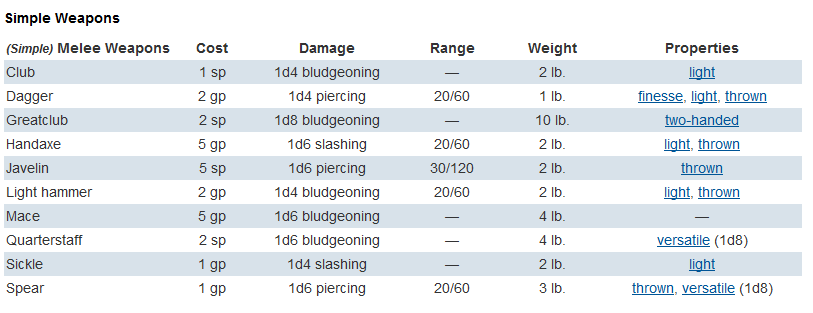
Anyway, here is the table for easy reference (source):


(Martial) Melee Weapons
Cost
Damage
Range
Weight
Properties
Battleaxe
10 gp
1d8 slashing
—
4 lb.
versatile (1d10)
Flail
10 gp
1d8 bludgeoning
—
2 lb.
—
Glaive
20 gp
1d10 slashing
—
6 lb.
Greataxe
30 gp
1d12 slashing
—
7 lb.
Greatsword
50 gp
2d6 slashing
—
6 lb.
Halberd
20 gp
1d10 slashing
—
6 lb.
Lance
10 gp
1d12 piercing
—
6 lb.
Longsword
15 gp
1d8 slashing
—
3 lb.
versatile (1d10)
Maul
10 gp
2d6 bludgeoning
—
10 lb.
Morningstar
15 gp
1d8 piercing
—
4 lb.
—
Pike
5 gp
1d10 piercing
—
18 lb.
Rapier
25 gp
1d8 piercing
—
2 lb.
Scimitar
25 gp
1d6 slashing
—
3 lb.
Shortsword
10 gp
1d6 piercing
—
2 lb.
Trident
5 gp
1d6 piercing
20/60
4 lb.
thrown, versatile (1d8)
War pick
5 gp
1d8 piercing
—
2 lb.
—
Warhammer
15 gp
1d8 bludgeoning
—
2 lb.
versatile (1d10)
Whip
2 gp
1d4 slashing
—
3 lb.

As a general rule, simple weapons deal 1d6 damage, and have one or two positive properties.


Club - This is just a very simple, cheap weapon, not much better than an improvised one. Fair enough. Use this if you have no money or no options.

Dagger - 1d4 damage, three good properties. Nice weapon for multiple occasions.

Greatclub - This weapon is useless when compared to the quarterstaff.

It has a single negative property, deals 1d8 damage, and is significantly heavier than a quarterstaff, which is equal or better in every aspect. There is no class, feat, or special rule that can make this weapon useful. Which is a pity, since the weapon looks kinda cool for cavemen-type barbarians (and Bobby, the Barbarian!). This weapon would be fine if we had a costlier two-handed simple weapon with 1d10 damage... Or just change the damage to 1d10 and be done with it.

Handaxe - 1d6 damage, two good properties. Good, as expected.

Javelin - 1d6 damage, one good property, plus increased range. Also good.

Light hammer - same deal.

Mace - This is the worst offender IMO.

1d6 damage, NO properties. Having an useless weapon might not be a big deal. But having an useless mace, the most iconic weapon for clerics, including Aleena the cleric - arguably the most memorable in D&D history - is adding insult to injury. I can only assume this is a mistake by the designers, or a typo. Making the mace versatile fixes some of those issues. It would become a worse, more expensive version of the spear, but close enough that I wouldn't care that much.

Quarterstaff - This is a bit ridiculous.

 It manages to be better or equal to BOTH the mace and the greatclub, two weapons that have no function in the game RAW. It is 25 times cheaper than the mace, for example. If you want to show that weapon prices do not matter, please don't include useless text in the game. Also, there is no reason for the wizard's iconic weapon to be better than the cleric's one.
But that's not the worse part. Making the quarterstaff versatile allows you to use it with a shield, or even one quarterstaff in each hand if you have the right feats - which I personally find ludicrous.
This is probably a mistake, which is illustrated by the PHB errata: "Two-Handed (p. 147).This property is relevant only when you attack with the weapon, not when you simply hold it.". So, this weapon was probably meant to be two-handed, but before the errata it would make it useless for wizards - they often need a hand to cast spells.
This should be a cheap, light, two-handed weapon, 1d8 damage, mostly intended for wizards and monks. Or even a double weapon.

Sickle - this weapon isn't bad, but could be better. Small, 1d4, slashing, light... In short, good enough. I don't remember many characters that go around fighting with a sickle, but it is in D&D's history (through the druid). The designers probably wanted to portray this weapon as a suboptimal farming implement. Fair enough. But we should have a small, finesse, slashing weapon too, because this is a very common trope.

Spear - very good for a simple weapon, not good enough for all spears. This weapon is good as written, but we should have some "military" versions of the spears as martial weapons. A heavy spear, a long spear (not a pike!), a finesse spear... Well, there ARE a couple of "spear-like" weapons in the martial list - the trident and the pike - but unfortunately they are really, really bad.


Martial Weapons

As a general rule, simple weapons deal 1d8 damage, and have one positive property (often versatile 1d10, which isn't a great property). If they are heavy/two-handed (all heavy melee weapons are two-handed), they deal 1d10 to 1d12 (or 2d6) damage.

Battleaxe - As expected.

Flail - As expected. Lighter than the battleaxe, but not versatile. I am not sure this is a real weapon, but I like how it looks...

Glaive - As expected. The fact that there is an identical weapon called halberd bothers me. I can only assume this is made for nostalgia's sake. 5e really like weapons that have no clear mechanical function.

Greataxe -  As expected - see greatsword.

Greatsword - The greatsword is better than the greataxe the vast majority of the time, ESPECIALLY if you have the GWF style; the greataxe might be marginally better for barbarians. It is also a bit more expensive. Fair enough, I guess, although I, personally, would like to see some reason for non-barbarians to use the greataxe.

Halberd - see glaive.

Lance - a special weapon, only useful if you're mounted.

Longsword - As expected, more expensive and a bit lighter than the battleaxe.

Maul - a cheaper, heavier version of the greatsword. I have a difficult time understating why this shouldn't be a cheaper, heavier version of the greataxe. Barbarians with mauls look cool.

Morningstar - Sigh. Someone at WotC hates maces.

So, this is a spiked mace. Also, a heavier, more expensive version of the war pick. Not a single reason to use it. Why is a mace a simple weapon and the spiked mace a martial one? Also, piercing damage? I would think most of the damage would be bludgeoning. So, the morningstar is bad against skeletons. Go figure.


Pike - well... 

Nothing terrible about this weapon - but there is not much use for this extremely heavy weapon, either. Also, why is this so heavy if it has the same reach as a halberd? Yeah, real pikes should have a longer reach, with the same "caveat" as the lance ("You have disadvantage when you use a lance to attack a target within 5 feet of you."). They should also be treated as a "formation" weapon, not something you carry around in a dungeon.

Call it "half pike" or something equivalent to a heavy spear and you're done.

Rapier - Good. Too good, maybe. 

Why did they make this the only 1d8 finesse weapon I cannot understand. They basic encouraged all Dexterity builds to pick it unless they dual-wield. It is the ideal weapon for them to use with a shield, which looks a bit off. But I'm not overly concerned with it.

Scimitar - as expected - 1d6, two proprieties. It is a light weapon. It weights 3 pounds. The rapier weights two pounds. It is not a light weapon. But that's okay because "light" means "small" in 5e. VERY easy to understand.

Shortsword - 1d6, two proprieties, fine.

Trident - Useless. Identical to spear, heavier, and five times more expensive. Some argue that WotC put this in there to show some weapons are useless. Well, we should have figured that by now anyway. So, the trident isn't mean to be a "real" weapon, only something that gladiator's used for show. If that's the case, it didn't deserve a separate entry. In any case it is surely nice that the designers pay this homage to realism before they describe 200 spells... Now I can sleep peacefully because I know they care.

War pick - as expected; no proprieties, but light and cheap. See morningstar.

Warhammer - as expected.

Whip - a special weapon. Little damage (1d4), but the only one-handed weapon with reach. Could be 1d6, I guess, but good enough. The low damage must be another homage to realism, I guess, since the whip doesn't seem like a real weapon to me.

Versatile spiked club/mace. Why not?

But... weight and price do not matter!

If they don't they should have been kept out of the book, there is enough useless data as it is. But, really, you can ignore price all you want, I agree - it doesn't really matter for PCs. But there is a whole world out there where prices should make SOME sense, at least WITHIN ordinary weapon lists (balancing it with magic weapons is hard, I know). Weight is hard to ignore, specially for weapons such as the greatclub and pike. If you're using the encumbrance variant, you cannot wear plate and carry a pike if you have Strength 15, for example.

What about the ranged weapons?

Honestly? They are mostly good as they are. Balanced, well thought out... People who insist that weapon's needn't be balanced must really dislike these ones.

But how can we fix it?

Glad you asked! I'm writing a whole "Manual of Arms" for 5e. If that sounds like a good idea, stay tuned. If you just want a better table... Here you go.


Notes:
Yes, I do realize that I made a light spear without the light property, and a heavy spear without the heavy property. As I've said before, the "light" and "heavy" property mean "small" and "bulky" and have nothing to do with weight. In any case, "agile spear" and "military spear" might work too.

I'm certainly not the first one to rework this list and I probably got many ideas form other people.

I've seem some suggest 1d4 bludgeoning/1d4 piercing for the morning star. I love this idea, although it might be a bit too fiddly. I would even dare to make the morning start identical to the mace, PLUS 1 extra point of piercing damage. Again, probably too fiddly. The 3e solution seems decent: "Some weapons deal damage of multiple types. If a weapon is of two types, the damage it deals is not half one type and half another; all of it is both types. Therefore, a creature would have to be immune to both types of damage to ignore any of the damage from such a weapon."

I "fixed" some weapons by giving them the versatile property. This is not a great property, but it makes plenty sense for these weapons (versatile weapons tend to be heavier), and keeps them on par with the others.

I DO have an even simpler solution, but it includes introducing new mechanics. I'll leave it to the next post.

Wait, do I even NEED a list of weapons?

Not really, but I like it. Anyway, if you don't:

Simple weapon: 1d6 damage (choose bl/sl/pi), 2 gp, 2 lb., and choose one or two properties (you can choose 3 if you change the damage to 1d4).

Martial weapon: 1d8 damage (choose bl/sl/pi), 20 gp, 2 lb., and choose one property (you can choose two if you change the damage to 1d6):

Properties:
* Versatile, double weight and cost, cannot be combined with finesse or light.
* Finesse.
* Light.
* Thrown.
* Cheap: the cost is converted to sp instead of gp if the weapon is simple, or halved if the weapon is martial.
* Two-handed (triple weight and cost, cannot pick other properties). Bump the damage by two steps (1d6 to 1d10, 1d8 to 1d12 etc.) You can swap 1d12 for 2d6 if desired. Martial weapons that are two handed also gain the heavy property.
* Reach + two-handed + heavy + 1d10 damage (must be martial, triple weight and cost, cannot be combined with other properties).

Adjusting cost and weight:
* If your weapon deals 1d6 damage or more, you can cut the cost in half by adding 50% weight.
* If your weapon deals 1d4 damage, you can halve the weight by doubling the cost.

Final note

If you find any of this useful, or if you'd like to see  a "Manual of Arms" for 5e, let me know in the comments. I think I've been focusing on 5e weapons too much lately, so I might change subjects soon.

---

UPDATE [10/12/2019]: I finally updated and organized this post (and more!) into a small book - my 5e Manual of Arms: Weapons! If you liked this post, you'll certainly like my book.


Try my 5e Manual of Arms: Weapons or any of my books. If you prefer comic books, check The Displaced series. Many titles are free!

Alternatively, click here or on the DriveThruRPG banner on the right. Any shopping you do through this link - even form other authors - helps us!

In addition, there are many other ways to support this blog! Share and recommend it, leave comments, etc. 


Thank you all for your audience and support!

Friday, May 18, 2018

5e quick fix: Help Action

5e quick fixes are exactly what they say on the tin. Small house rules to fix D&D problems you probably don't have. Use them wisely!

This is how it works in 5e:

Help

You can lend your aid to another creature in the completion of a task. When you take the Help action, the creature you aid gains advantage on the next ability check it makes to perform the task you are helping with, provided that it makes the check before the start of your next turn.
Alternatively, you can aid a friendly creature in attacking a creature within 5 feet of you. You feint, distract the target, or in some other way team up to make your ally's attack more effective. If your ally attacks the target before your next turn, the first attack roll is made with advantage.

Second paragraph makes sense and we will not discuss it here.

First one is needlessly tied to "turns". What if you're going through an ancient library and looking for a forgotten tome? Seems that the help action would be applicable even if there are no turns to be counted.

But it also seems to rely too much on GM fiat.

When can I help? I assume I  must declare HOW I'm helping, and the GM must find my idea reasonable. But HOW reasonable?

Should the Int 8 barbarian be that useful to the Int 20 wizard trying to find the tome? What about that Int 5 NPC that can barely read? What about the Int 14 cleric, should she be MORE helpful than the barbarian?

Can your cat familiar help the Str 20 champion to move a huge boulder?

"Volo's Brazen Strumpets? Dear lord, can this brute even READ?"
Many people would say "the DM will decide arbitrarily depending on the circumstances".

But you know me, I always prefer a simple mechanical solution to "the system is bad, but the GM can fix it if it gets ridiculous".

So here is the fix: the helper must succeed against he original DC divided by two to actually help.

Let's see some examples:

Find a forgotten tome in a huge library (DC 20): the barbarian with Int 8 will roll against DC 10 to be of any help. The chances that he will be useful are fifty-fifty.

Perform an ordinary task (DC 10): it only takes beating a DC 5 to help someone with an ordinary task, so in most ordinary circumstances two heads think better than one. Easy task? You can help 90% of the time even with no bonus.

Moving an impossibly huge boulder (DC 25): the Str 3 cat is unlikely to beat the DC 13 difficulty to help the champion, but at least there is a 20% chance. The Str 8 wizard would be more helpful, and the Str 16 paladin has more than 50% chance of being useful - 60% or more if trained in athletics.

Of course, the difference between cat, wizard and paladin looks too small, but that's an effect of bounded accuracy. I'd prefer using 2d10 instead of 1d20 for skills anyway!

Another way of dealing with this is group checks. But, as you know, if the Str 20 champion is trying to move a boulder, having a couple of Str 16 folks at his side can actually HINDER his chances! To fix that, try this post: Harder stealth (5e quick fix).

Saturday, May 12, 2018

Slashing/Piercing/Bludgeoning... Hacking!

Fun story: while writing this post, I realized I fixed 80% of the issues I have with 5e weapons with a single sentence:

"If you score a critical hit, you also add the weapon's weight to the damage (maximum 10)".

Anyway...

From the long list of issues with D&D 5e weapons, one thing that bothers me is that there is not enough differentiation between slashing, piercing, and bludgeoning weapons.

There are a (very) few monsters that are susceptible (or vulnerable) to one type or another, slashing can cut nets, and bludgeoning can destroy objects, maybe.

Adding more detail without adding complexity is hard. We'll try to do it anyway, and - here is the challenge - WITHOUT changing anything about the weapon list!

I want to avoid creating new mechanics, as a general rule, so I'll pile my ideas on an existing mechanic: critical hits.

(Random digression: I've considered using margin of success, like I did in Dark Fantasy Basic. Apparently, Pathfinder 2 will do the same. Dragon Heresy has something similar. "Margin of success 10" is something I had recommended for 5e in general, and "AC plus 10" is REALLY easy to calculate. But since margin of success isn't a thing in D&D combat - although there are some ideas in the DMG - I will not add it to the game... for now. Read on.)

WotC people, hear me out: the mace should be a decent (and versatile!) weapon.
Now, while critical hits already have their rules, there space for adding more stuff - including more damage - to them. The best parts of critical hits - divine smite, Brutal Critical, backstabbing - will not be affected.

Also, I do not see how making crits more powerful would cause imbalance. Barbarians get most of their damage from brutal critical anyway. Champion fighters can certainly use the boost. Most other classes won't be too affected.

So, in addition to the normal effects of a critical hit, when you attack with a weapon, you can also choose one of:

* Crush! Add the weapon's weight to damage (maximum 10).
* Bleed! Add half the difference between your attack roll and the target's AC to damage - weapon must be slashing. 
* Impale! Add the difference between your attack roll and the target's AC instead of one of the weapon's damage dice to damage - weapon must be piercing.

(The wording is clunky, but you got it, right? If you beat the enemy's AC by 11, you can deal 11+Str damage instead of 1d6+Str, for example. You can roll the d6 before choosing).

You'll notice that the bludgeoning weapons get nothing... until you realize they are the heaviest weapons in the game. Except for the pike, but that's why the limit is 10 - and the pike automatically gets a much needed upgrade.

Crush your enemies!
What is the point?

This simple fix has a number of interesting effects:

- It makes slashing and piercing weapons better against light armor, and heavy weapons perfect against heavy armor. Yes!
- Barbarians and champions will favor heavy weapons. Nice!
- It automatically redeems the greatclub and the maul. Mace is still a problem...
- It favors "weak" weapons such as the pike, the trident, and the morningstar.
- It makes crossbows devastating (although I might rule that the weight of the projectile/ammunition is 0, giving a nice bonus to thrown weapons - they need it).

Enough with the talk, just give me a random table already!

You see, the point of this exercise is not turn 5e into rolemaster, but actually carefully balance the different aspects of...

RANDOM TABLE I'VE SAID!

Okay, okay.... Here you go.

Critical Hits
When you score a critical hit, roll 1d6 (in addition to usual crit rules):

1. Crush. Add the weapon's weight to damage. For example, if you are attacking with a 4-pound mace, add 4 to damage.
2. Force. Double your relevant ability modifier when calculating damage. For example, instead of causing 1d6+3 damage, you deal 1d6+6.
3. Bleed. If you're using a slashing or piercing weapon against a creature that has a circulatory system or something similar, you can choose to add half your margin of success to damage. If you don't (or can't), use entry 1, instead.
4. Pierce. If you're using a piercing weapon against a creature that has internal organs or something similar, you can choose to pick one damage dice you rolled and replace it with a a bonus equal to your margin of success. If you don't (or can't), use entry 2, instead.
5. Break. If you're using a bludgeoning weapon against a creature that has bones or is made of hard or brittle material, you can choose to pick one damage dice you rolled and replace it with the maximum number you could roll with it. If you don't (or can't), use entry 1, instead.
6. Kill. Choose any two options above and combine them.

Hacking weapons: an addendum

When I stated writing this, I wanted to make axes and similar weapons (maybe morningstars too) some kind o hybrid weapon: part crushing, part slashing. A battleaxe doesn't work like longsword, for example; it is more "chopping" than slashing, better against wood and heavy armor, worse against nets and spiderweb. I considered calling it "hacking" damage. But the "weight" thing solved the issue - now you have a good reason to use a greataxe against someone in heavy armor.

Sunday, May 06, 2018

Minions! (5e quick fix)

The problem: 

Tracking hit points for 12 different orcs at the same time - especially if you're not using miniatures.

The (other) problem:

"Warrior" classes have few ways of fighting mobs. Maybe this isn't such a big problem for everybody... but I don't like thinking of a 10th-level barbarian or fighter being taken down by a dozen orcs. How many did Boromir kill? I didn't run the numbers, so maybe I'm wrong about the odds here. Let me know. Anyway...

The solution: 

When you are fighting against a group of minions, all damage is dealt to the group, indistinctively.

There is one single number you track: excess damage.


For example, each orc has 15 HP. If you deal 10 damage to an orc and an ally deals 7 damage to another orc, one orc is killed, and there are 2 points of excess damage. (This doesn't necessarily mean the second orc is dead - it means some orc, for some reason, dropped out of the fight).

If you cast Burning Hands and deal 8 points of damage to four different orcs, total damage dealt is 32 HP. Which means you killed to orcs and caused 2 points of excess damage.

When excess damage reaches a certain threshold, another minion is killed. In the simpler version of this rule, when excess damage reaches 15 HP (the same HP of a single orc), another orc is killed.

But if you like the idea of losing some of the excess damage, you can set the threshold a bit higher - maybe 20 HP or even more.

Limitations:

To avoid absurdity, you can limit this options to melee (within melee reach) and AoE spells that affect all targets, or nearby targets. Ranged weapons are very good as they are, anyway. But then again you might just allow crazy results - imagine a thrown spear that pins two goblins at once! It all depends on the tone you're going for.

Have I seen this before?

Probably. 13th Age has something similar, and even the DMG has a "cleaving" variant that says "When a melee attack reduces an undamaged creature to 0 hit points, any excess damage from that attack might carry over to another creature nearby."

But notice that this isn't exactly the same - this doesn't require you if you wound two creatures with burning hands, for example, you can kill one and leave other barely hurt instead.

Also, I remember discussing this idea in forums and I'm sure someone else must have had similar thoughts.

What's the point?

Avoid keeping track of individual monsters HP. Make running mobs in "theater of the mind" style games a lot easier.