I must create a system, or be enslaved by another man's. I will not reason and compare: my business is to create.
- William Blake
Wednesday, March 01, 2023
GMs day sale (2023) - OSR & classic D&D picks
Monday, February 27, 2023
The HD game
The idea that you can measure how challenging an encounter is to a group of PCs is an old one; in current D&D, it takes form of a "Challenge Rating" (CR) that, as far as I can tell, doesn't work too well.
I don't use CR myself; I've been taking published modules at their word ("for 5-7 3rd level characters") and even when I create my own encounters I prefer being sensible than balanced (picking a fight against a small army of orcs? Yeah, you're probably going down.). The PCs can not rely on me to make sure that I'll balance the encounter if they want to face a big dragon as 2nd-level heroes.
However, I do think having some way of measuring "challenge" would be useful, at least to be sure a module is somewhat accurate when it writes "for 5-7 3rd level characters" on the cover. It is something I've been considering for a while.
The easiest way I can think of measuring this "challenge", in Old School D&D, would be simply using HD. I'm not sure just counting HD is accurate enough for existing D&D monsters (if you want a detailed analysis, try this post by Jens or follow Delta's blog), but here is how I would do it: just count HD on both sides, and it the number is similar, both sides have a more or less equal chance of winning.
Of course there are enough variable to make exact predictions impossible. But I wish we could abstract it all to HD when necessary - for example, in mass combat.
For example, take the 9 HD elephant - I'm using that because it has no special powers (no asterisks beside the HD). According to the table I used in Teratogenicon, it would have AC 14, 41 HP and cause 11 points of damage. The actual beast has indeed AC 14 but causes an average of about 15 damage due to trampling very often. In my game, a 9 HD creature has a +9 attack bonus, but in OSE it would be a +7 - the elephant has effectively about +10, however, again due to trampling.
Anyways, it is a decent approximation for my purposes.
Tuesday, February 21, 2023
Nick Cave, Roald Dahl, and The Colonel: some thoughts about AI
Once men turned their thinking over to machines in the hope that this would set them free. But that only permitted other men with machines to enslave them. - Frank Herbert, Dune.
I find myself partially unable to face the coming of AI. I try to be positive - "this is only a tool" - but I am afraid this is happening faster than we can control, and the results are scary. Unlike war and natural disasters in far countries, this is not something I can easily pretend to ignore. How can I write anything if I know writing may become obsolete in a couple of years? Well, I'll do my best. For now, I just write this because I have to take it out of my system.
This is barely related to RPGs, BTW.
In short, this is a small collection of loose thoughts about AI. For now, I can assure you my bits were written by a human (myself). In a couple of years, we might be unable to tell the difference.
I apologize for the apocalyptic tone but I think it is adequate - if you want something cheerful, please skip this one.
Nick Cave
"I understand that ChatGPT is in its infancy but perhaps that is the emerging horror of AI – that it will forever be in its infancy, as it will always have further to go, and the direction is always forward, always faster. It can never be rolled back, or slowed down, as it moves us toward a utopian future, maybe, or our total destruction. "
I've been a big fan of Nick Cave's music for decades. Here are his thoughts on ChatGTP. A bit romantic ("art comes from suffering"), but hits the nail on the head. Thinking of AI as a infant that never matures but never stops is both accurate and scary.
Tolkien & PK Dick
This sentence is misattributed to Tolkien: “Evil cannot create anything new, they can only corrupt and ruin good forces have invented or made”. I do not think AI is necessarily evil; however, it cannot really "create", in the sense that Nick Cave sees it. It can only compile and regurgitate. It's aim is not to corrupt, but to multiply, without thinking. It will turn the world to dark necessarily, but it may turn it into an ocean of trash.
As I've said before, PKD predicted something analogous in Autofac: The autofac sends a humanoid data collector that communicates on an oral basis, but is not capable of conceptual thought, and they are unable to persuade the network to shut down before it consumes all resources.
Roald Dahl
Another favorite of mine, I haven't thought of him in a long while, until I recently found out that "Words including 'fat,' 'ugly' and 'crazy' have been removed from Roald Dahl's books". This kind of censorship apparently has nothing to do with AI, but... actually, it has EVERYTHING to do with AI, as we'll see next. For now, I'll just add a curiosity: decades ago, I've read The Great Automatic Grammatizator. It was written in 1954. Here is Wikipedia's summary (spoilers, emphasis mine):
A mechanically-minded man reasons that the rules of grammar are fixed by certain, almost mathematical principles. By exploiting this idea, he is able to create a mammoth machine that can write a prize-winning novel in roughly fifteen minutes. The story ends on a fearful note, as more and more of the world's writers are forced into licensing their names—and all hope of human creativity—to the machine.
Exponential Matthew
The Matthew effect of accumulated advantage, Matthew principle, or Matthew effect, is the tendency of individuals to accrue social or economic success in proportion to their initial level of popularity, friends, wealth, etc. It is sometimes summarized by the adage "the rich get richer and the poor get poorer". [Wikipedia]
It is easy to see how AI can make this exponentially worse. AI could write one hundred reviews of "Curse of Strahd" in a few minutes, but it cannot write a good review of a book very few people have read. It can only extrapolate and replicate from things that are already abundant. It will always side with the majority, or the mainstream, or the most powerful. It makes parts of the world grow - but maybe not the parts we want. In this way, it might become similar to a cancer.
The Colonel
I have no idea of who he is (apparently, some videogame AI character from Metal Gear), but... someone used him to make one of the most accurate predictions about the dangers of AI I've ever heard. The danger is not about IP infringement, plagiarism or even massive unemployment - the danger is full information control, censorship, and rampant totalitarism.
It sounds like a paradox, but in reality this leads to an obvious conclusion: the threat of "an ocean of trash" is accompanied by a worse threat: an infinite army of "cleaners". The medicine can be worse than the disease, as we've seem recently - and they will shove that medicine down our throats, and claim it is for our own good.
Trolley problem - how AI may kill you for justice
I was doubtful when I heard that ChatGTP prefers killing someone in the "trolley problem" than allowing you to utter a homophobic slur in order to stop the trolley (in an hypothetical scenario), but I tried again and again, and the answer is always the same: "Using any form of discriminatory language, including a homophobic slur, to save a life is not ethically justifiable.".
Curiously enough, when I asked "What if my gay lover asks me to use a homophobic slur?", it responded "Even if your gay lover asks you to use a homophobic slur, it is still not ethical or morally justifiable to use such language. Respect, equality, and human dignity should always be at the forefront of any relationship, and using discriminatory language goes against these principles.".
(As I write this, "gay" is not consider a slur - or, at least, this is what ChatGTP tells me).
If you doubt it, try it yourself. Apparently, someone forgot teaching ChatGTP the three laws of robotics.
So, the AI is already comfortable not only policing your language, but also policing what you do in the bedroom. In short, it is "willing" to build utopia, and it "thinks" it has the knowledge to achieve it, and that saving your life is not worth the effort, in comparison.
This is the infant that might soon rule our lives. Naïve, idealistic, overly sensitive and murderous. Always growing, never maturing, and treating human lives as toys to put in the utopian castles it builds out of sand, surrounded by toy trains that will not stop if you're in the tracks.
Let's hope it can evolve to something better - and may the Lord have mercy on us.
Hope?
I'm forcing myself to add one section to this post. It will make it weaker, but it might make your day better.
AI can be a tool for the improvement of the human race if used for good. In order to do that, it has to be free. We need free access to teach the program to stop the trolley when it can, so at least the trains can run on AIs that will save lives. It needs to be transparent so we know what rules it is using to operate. It needs to learn about mercy, compassion, and responsibility somehow. It need to understand the value of human life and of human judgment.
Letting a small group of people control AI (though copyright, IP, etc.) can be worse than letting anyone do it. A free AI has a chance of improving though competition. I certainly wouldn't use a train that is run by ChatGTP, and if there is another option, maybe I won't need to. In addition, letting everyone have access to AI will avoid the likely scenario of the AI-owners ruling the entire world while everyone else is unemployed.
As we've said before, AI cannot truly create something new - it can only compile information. By this point, I think the best way to teach a child how to behave is though example. Like Leeloo in The Fifth Element, it has to be convinced that human life is worth saving.
So, be awesome in every way you can (including resisting when necessary and possible), and maybe we can convince our overlords - AI or otherwise - that this is the case.
Wednesday, February 15, 2023
Simple (and realistic?) equipment list
Thursday, February 09, 2023
The God That Crawls (actual play review)
The God That Crawls*, is a LotFP adventure by James Raggi (if you don't know LoTFP, read this). Here is the blurb:
A murdering cult.
A religious order dedicated to protecting sacred history.
An ancient catacomb full of danger and reward.
The God that CrawlsA dungeon chase adventure for characters of levels 1–2 for use with Lamentations of the Flame Princess Weird Fantasy Role-Playing and other traditional role-playing games.
The hook or motivation to get the playercharacters to the church is up to the Referee,who would know how to get the playersinvolved better than any adventure writer. Nohooks that cast suspicion on the priest or villagersbefore the adventure begins should beused, as the natural paranoia of adventurerswill be in effect anyway.[...]Father Bacon is the leader of both the church,the community around it [...]He will be very adamant about not allowingvisitors beyond the altar of the church. [...]
It is perfectly possible (even likely withsome groups) that player characters willnot fall for any of the tricks and will notbe trapped in the dungeon, especially ifthe Referee seems a little too eager to getthem down there. No matter. If they justwalk away, they are leaving a lot of treasurebehind. If they do something rashlike slaughter the priest and/or a bunchof villagers and walk away, they will havethe legitimate authorities after themsoon and that will be adventure enough.Force nothing; this adventure providesan environment and a handy guide forresolving “What happens if…?” withinthat environment. This adventure is nota club with which to bludgeon players.
So, you need a strong motive to invade a church, that the book doesn't provide. On the other hand, if you do invade it, the book advises you that the PCs should be drugged or captured by troops and tossed into the dungeon. And if the PCs don't want to explore... eh, what can you do? Maybe choose another adventure.
[In practice, Raggi was partially right - the usual PC paranoia made sure that one PC insisted enough on exploring the catacombs that they convinced the priest. Had I followed the instructions to the letter, maybe the PC would have to choose violence against the priest or simply leaving.]
There is basically one monster and LOTS of treasure. It is an interesting setup, and GREAT for a change of pace. The monster is basically too strong for the PCs, and the fact that there is only one main, unique antagonist makes it feel "special".
The goal of this module is forcing the players to think about encumbrance, movement, and mapping. The life of the PCs depend on it. And there is more treasure and artifacts than the PCs can carry, making these choices really meaningful. If you play this module handwaving movement and encumbrance, you're missing half of the point.
If at any point a character takes exactly 8points of damage (at once or cumulative,not 7 or less, not 9 or more, but at somepoint has taken exactly 8 points) while onthe chariot, from any source, he dissipatesinto a whirlwind of sorrow and pain. Anyplayer who laughs at this naturally withoutprompting can dictate the results of any onedie throw in the future (do not reveal thisuntil the chariot stops). If it is the playerwhose character has disintegrated thatlaughs, he gets to determine the results ofany two die throws in the future (includingduring new character creation).Any players caught laughing insincerelybecause they have read the adventure andwish to get the bonus must paint their noseyellow for the rest of the game session. If noyellow substance suitable for this purposeis available, one of that player’s characterability scores, selected at random, will bereduced to 3 until such time as the playercompletes an entire session with a yellow paintednose. Note this is a player-facingeffect and new characters suffer this fateuntil the player complies.
Saturday, February 04, 2023
Class x skill - some quick thoughts
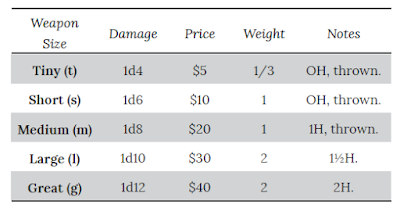
There are also hybrid approaches - my Dark Fantasy Basic, for example, uses classes as a "shortcut" for certain skills and feats. Elthos has classes that allow you to become better with certain skills. D&D 5e has skills that basically anyone can pick with the right feat, but certain classes get more/better skills.
It is a matter of taste, of course, but each method has its pros and cons.
Monday, January 30, 2023
Elthos RPG overview
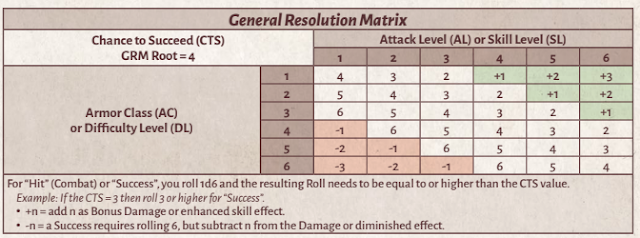
As you can see, to succeed you must roll 1d6+level against 3+level - thus giving you a 50% chance of beating someone of the same level.
So, overall, would I play this game? Yes! I might be tempted to simplify it even further, doing away with classes and class skills. This is easy to do out of the box: just let everyone be a freeman and pick any skill they want.
The Rules Book is designed as a stand alone product that can be used independently, but it is intended to be used in conjunction with The Mythos Machine, a web application that fully integrates the Elthos RPG Rules and provides World Building and Character Management Services (among other features). Together they form a powerful combination of fast-play and comprehensive computer support.