I must create a system, or be enslaved by another man's. I will not reason and compare: my business is to create.

- William Blake

Saturday, May 14, 2022

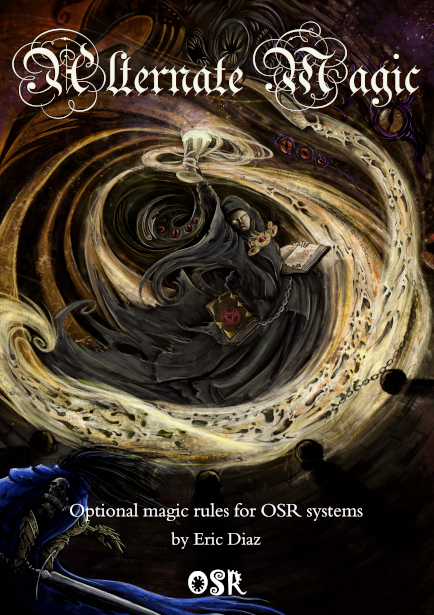
Alternate Magic is near!

Here is a small teaser for my next book. The cover is nearly finished, as the text... but let me know what you think anyway!


Alternate Magic is a collection of mechanics for OSR systems - especially compatible with "Basic" games and its clones (Old School Essentials, Basic Fantasy RPG, Labyrinth Lord, etc.; it is also compatible with Dark Fantasy Basic, including a specific chapter on conversions). Some ideas can serve as inspiration for any RPG system, but this is not the main goal.

It contains about 30 pages, including: new spellcasting classes, flexible spells, blood magic, chaos magic, spell points, cantrips, rituals, alternate clerics, and other tools.

The book is entirely modular; each chapter can be used by itself or in combination with other chapters. For example, you might use blood magic with the traditional spellcasting system or combine it with flexible magic. You can use random magic with spell points or cantrips, or by itself. You might use the new classes without changing anything else in your game.

I intend to publish it in less than a week! I'll make a blog post when it comes out. 

As usual, if you got any of my books form DTRPG and accept e-mails, I'll send an e-mail with a discount code (almost all of my books are included in the May D&D sale, BTW). If you're an alpha reader or play tester, I'll send you an e-mail too. 

Stay tuned!

Monday, May 09, 2022

Railroading in space and time (and the "future timeline" method)

Here is another post about a frequent subject in this blog. Tackling it from yet another angle...

In the last post, we talked about the quantum ogre; a form of railroading in space ("wherever you go, you'll find the ogre").

This type of railroading is almost universally condemned in the OSR (in modern D&D, it can go either way).

However, one could theoretically do railroading in time ("whenever you arrive, you'll find three goblins playing dice", or, even more extreme, "whenever you arrive, you'll see the bandits approaching a princess as she sleeps...").

This form of railroading (that reminds of Schrödinger's cat, maybe even more than the quantum ogre) is usually accepted without much questioning (or, at least, it isn't discussed as much).

Why?

My guess it is that it is almost inevitable. Even if you have a very detailed mega dungeon, it would be hard to add another dimension (time) to every place. You might make some concessions ("there are 1d6 goblins in the room at any time, with 1-in-6 chances they are sleeping..."), but it can never be perfect: what if the PCs take a month or a year before visiting the dungeon?

It might take hundreds or thousands of pages to realistically portray how a small community may change over time with enough detail (unless we are talking about undead, automatons, etc.).

It is usually assumed that the goblins are there in a state of suspended animation until the PCs enter (or listen to the door, or hear rumors, etc. - Schrödinger's cat indeed!). Adventurers are written in the present tense ("there are goblins..."). But the present is indeterminate (and fleeting); events happen in determinate times.

Let's illustrate this.


Here is one example from The Wretched Hive
Day versus night
The hive is active both day and night, but night makes it significantly more dangerous, because many creatures go out during the day to hunt for pollen, captives, etc. In addition, unless the PCs can see in the dark, their sources of light will make them easier to notice at night.
During the night, whenever you roll randomly to determine the number of creatures, re-roll all natural 1s. For example, if one room has “2d6 bee soldiers” and you roll a 1 and a 3, this would mean 4 bee soldiers during the day, but re-roll the 1 if the PCs enter at night (if you roll 1 again, there are four soldiers; if you roll 4, instead, there are seven soldiers total, and so on).
This rule applies to all encounters within the hive, random or not. On the upside, there is a 50% chance for every demon to be sleeping during the night.
Here is another example, this time discussing the time dimension:
[E] The Barracks
2d6+3 imps are here. During the day, half are asleep, but they do not seem to care with people coming and going. During the night, only a third of them is wake, but they'll be suspicious of outsiders.
The rest of the imps are playing disgusting games with small vermin and malformed dice.
A counter example would be the entrance to the Hive (room A). It is guarded by seven imps and a demon-ogre. No reference to time. Do they guard the entrance 24 hours per day? Obviously not. It is assumed that the PCs can wait for them to go to sleep, for example, but it isn't spelled out.

Finally, here is part of the aftermath (spoiler alert!):
If both the Queen and Malavor are still alive, the hive expands. In 2d4 weeks, the number of demons and bee-soldiers is doubled, and the hive’s defenses are reinforced. In another 1d6 weeks, Malavor manages to mutate himself into a bee-demon, half-insane, but with full control of the bee-people. The bloated and sick avatar dies after a while, but this no longer affects the bee-soldiers, that can now be cloned in the underground. Three months after the characters left, Malavor unleashes his army against the nearest village.
A list of pre-planned events? A pre-written ending? There are people that would think this is what railroading is all about! It is usually considered bad form if a module describes what happens next. You're supposed to find that out during play!

My point is: this does exactly the opposite.

A list of preplanned events might be the perfect solution to avoid railroading in space and time. I've made this point before, but I think it is easier to grasp with examples.

Here is a timeline of 12th century England:
  • 1135 Death of Henry I, accession of King Stephen to English throne
  • 1137 Beginning of a civil war between King Stephen and the Empress Matilda over the succession to the English throne; accession of Owain Gwynedd, the first Welsh ruler to style himself prince of Wales
  • 1154 Death of King Stephen, accession of Henry II to English throne
  • 1164 Constitutions of Clarendon, a set of laws which governs the trial of members of the Church in England
  • 1170 Assassination of Thomas Becket; death of Owain Gwynedd, prince of Wales
  • 1189 Death of Henry II, Richard I accedes to the English throne.
  • 1192 Richard is captured by Duke Leopold of Austria whilst returning from the Crusades
  • 1194 Richard is ransomed and returns to England; accession of Llywelyn ab Iorwerth to the throne of Gwynedd
  • 1199 Death of Richard I, King John accedes to the English throne
Since these are real events, most of them happen in an exact place and time. 

Now, let's say you're creating a campaign where the PCs are loyal to King Stephen, and the campaign lasts from 1135 to his death in 1154.

If you want your PCs to meet Owain Gwynedd before he ascends to the throne for some reason, but they decide to travel to Scotland instead, you just forced yourself to avoid railroading your players: they cannot meet Owain because he is fighting in Wales!

(Of coursing, using real events gives you much more information to play with; but even a brief biography of Owain could accomplish a similar result).

One important caveat: the PCs should not be included in the timeline. It is up to them to decide where to go, what to do, etc. Including them in the timeline will encourage railroading.

Of course, if you make Owain immortal before 1170, than you are back to railroading. too So you must plan the events... and let the PCs affect them, for better or worse.

(This is just an example; I know nothing about this period. Maybe The Great Pendragon Campaign works something like this; I haven't played it. I did run a Game of Thrones adventure 15 years before the books with a similar method, although I never had to decide "what happens if the PCs kill Eddard Stark", but I'd allow it. I found this easy to run, since I could turn to some GoT wiki for lots of information about what could happen.).

In short: the best way to avoid "railroading" might be building an explicit "railroad" of events and letting your PCs free to derail it, IF they are willing and able.

What are some of the practical implications?

Mainly, that it would be immensely useful if existing adventures and campaigns included future timelines. "This is what happens if the PCs do nothing". Having a note saying:
1137 Beginning of a civil war between King Stephen and the Empress Matilda over the succession to the English throne
Will give you lots of ideas about what might be happening in 1136. Rumors, tensions, enmities, alliances, discussions, scheming, skirmishes...

Knowing this is helpful even when deciding what happens if Matilda dies before 1137! Are there other forces that would oppose Stephen (maybe Robert of Gloucester?). Or would the whole war be avoided? If the PCs want to avoid a war, what should they do? 

These questions will inspire GM to find their own answers. But the book itself might add some "ifs" and "buts" in order to make things even easier ("If both the Queen and Malavor are still alive, the hive expands...").

This is the implicit assumption of most campaigns, BTW. "The cult wants to summon Tiamat, and the PCs have to stop them...". But since there is no set time for the coming of Tiamat, it can never actually be summoned. The final showdown will wait for the PCs, and even if the PCs die before that, a new group of PCs will rise to face the "final scene". Some campaigns will be explicit about the deadline; they make it easier to know if you're railroading or not.

Anyway.

One method I haven't used is planning weather and encounters/events in advance. Those two are clearly distinct; no one would object the GM having detailed weather for the next 30 days, since the PCs usually cannot affect it. Having a pre-planned encounter in 15 days sounds icky, as if you're forcing the players down a railroad - but it is not so different from rolling it in advance.

When I ran Tomb of Annihilation, such script would be very useful - much better than rolling every day.

Let's see if I can add some of that to my next campaign.

Saturday, May 07, 2022

The Disoriented Ranger talks: Gaming Culture

My friend Jens, from The Disoriented Ranger, writes good, thoughtful stuff. Just take a look at the blog and you'll see. 

He just published the first part of a blog anthology. Roughly 130 pages. The first part is about Gaming Culture. I only read the first few chapters, but I'm already looking forward for the next parts (especially part 2!). Jens really knows his old-school/OSR stuff - his advice in my upcoming B/X alternate magic book (among others) has been invaluable.

(BTW, Alternate Magic is coming soon! Stay tuned!)

Complicating blog articles is a great idea, IMO; organizing is more important than creating. I hope I'll write my own someday.

It is only one dollar - click here to get it.

Anyway, here is the blurb:

What's this about?

Nothing is older than yesterday's blog ... or so they say. After 10 years of exploring "all things D&D and role-playing" on The Disoriented Ranger blog, most of it during the Golden Age of the so-called OSR (and some of it in the Silver Age, I presume), it is time to look back and see what I deem worthy of conserving.

I talked several subjects over the years, many of them about game design and gaming advice, but the most general was about Gaming Culture. How we play, why we play, consumerism, DIY, about communities in general, about where we are and where we could go with this hobby of playing role-playing games ...

I shared my takes about these and they make a good first anthology. So here they are: 15 posts on roughly 130 pages with thoughts and musings about The Hobby, all edited and prettied up for this pdf.

What's to come?

There are five more anthologies to follow in the next couple of months, so look out for:

  • Part 2: D&D and the OSR
  • Part 3: Musings about DMing
  • Part 4: Storytelling Advice
  • Part 5: DIY & Gamedesign
  • Part 6: Theories in Action

Parts 1 to 3 as well as Parts 4 to 6 will also be compiled for a PoD option!

This is not a trip down memory lane, the topics presented here are still as important as they had been when I addressed them. My sincere hope is that sharing them here will encourage and inspire new readers (or fans of the blog, but with fresh eyes) to see the wealth of potential our hobby has, as well as its pitfalls.

Other than that: I can just provide the map, and even I get lost ...

Cheers,

The Disoriented Ranger

----------

What qualifies me, you ask?

Just so you know: "When the going gets weird, the weird turn pro." (Hunter S. Thompson)

Definitely worth checking out!

Thursday, May 05, 2022

Weapons and bonus actions (5e)

D&D 5e is lackluster when it comes to weapons. Only a few of them are unbalanced, but almost all are a bit repetitive and uninteresting. A longsword, for example, is nearly identical to a battleaxe (glaives and halberds are simply identical).

BTW, if you'd like to see some of these issues "fixed", check my Manual of Arms: Weapons (currently on sale!).

However, we could go even further than fixing weapons, by making them more fun, and a bit different from each other. 

In 5e, this is usually achieved through feats. Feats are optional, however, and it wouldn't hurt to boost martials a little. Some of the most interesting feats (Polearm Master, Shield Master, Spear Master, etc.) use bonus actions (or reactions, but we will leave that for another post) to do that. Bonus actions are also what "light" weapons are about:

Two-Weapon Fighting

When you take the Attack action and attack with a light melee weapon that you’re holding in one hand, you can use a bonus action to attack with a different light melee weapon that you’re holding in the other hand. You don’t add your ability modifier to the damage of the bonus attack, unless that modifier is negative.


What if we gave EVERY weapon something to do with bonus actions? With one caveat: Two-Weapon Fighting is quite weak after level 5. So, maybe these options are ONLY available after you get Extra Attack (or "only beyond level 5", like cantrips). Maybe we kill two birds with one stone: make TWF stronger after level 5. 

Even better, we don't add any complexity in the first few levels, giving warrior types more options as they level up, but do not make the game more complex for other classes. Notice many of these options will make a warrior with extra attack have two DIFFERENT attacks!

Here are some ideas. Each weapon would have their own trait, some could be up to choice. These are weaker than most feats.


Light (modification): when you use your bonus action to "attack with a different light melee weapon that you’re holding in the other hand", and you have Extra attack, you can do it once per attack until the end of your turn. You don’t add your ability modifier to the damage of the bonus attack, unless that modifier is negative.

Bash (any non-light, bludgeoning weapon, maybe axes): you can use a bonus action to bump your damage die by one step in your next attack (d6 to d8, d8 to d10, etc.). A maul could cause 2d8 damage!

Armor piercer (could be every weapon except swords etc.): +2 in your next attack if the opponent is wearing armor.

Extend (spears): add the "reach" property with a bonus action (maybe pikes etc. will extend 5 feet further).

Parry (shields, maybe quarterstaff): add +1 to your AC until the beginning of your next turn with a bonus action.

Duck (crossbows and some non-heavy ranged weapons): add +1 to your AC until the beginning of your next turn with a bonus action.

Speed (any light weapon or non-heavy sword): You can make one Attack with it as a Bonus Action on each of your turns. You don’t add your ability modifier to the damage of the bonus attack, unless that modifier is negative.

Sweep (any big, slashing weapon): When you take the Attack action, you can use a bonus action to attack a different target within reach.

Sword-and-dagger (rapier, longsword): When you take the Attack action and attack with a melee weapon that you’re holding in one hand, you can use a bonus action to attack with a different light melee weapon that you’re holding in the other hand. You don’t add your ability modifier to the damage of the bonus attack, unless that modifier is negative.

Anyway, this is just a rough draft for now, but I think it is a promising idea.

Monday, May 02, 2022

April 2022 Highlights - The Diamond Throne, The Last Duel, Raised by wolves

Here are some of my April 2022 Highlights. The first one is quite negative - you've been warned!


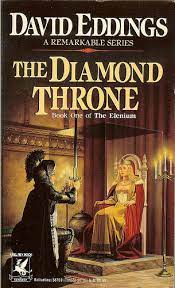
The Diamond Throne (1989 book)

This book is remarkably lame. I have no idea why I bought it in the first place; I probably heard the name of the author in something related to D&D, or some fantasy best-seller list. I've been underwhelmed by the fantasy novels I've been reading lately, but this one is specially dull: not a single cool monster, story, or idea I could identify. The characters are not especially interesting either. I should have given up halfway through but I'm guess I'm too stubborn for my own good.

The book begins with some version of the Nibelungenlied (*ahem*) and then goes on to tell a story of a brave "Pandion" knight (i.e., paladin) name Sparhawk (*ahem*) that has to find a cure for his Queen's malady... And then he goes from place to place talking to people for the next clue in a quest that goes nowhere.

The heroes use various ridiculous disguises and ruses throughout the book and foil every plan by the villains. The dialogue is puerile, as the jokes and situations - even when the heroes are confronting the antagonists face to face, they behave like brats. I thought I was reading some YA novel until one of the bad guys suggests beheading and sexual violence. 

But nothing actually happens. No important characters die or get hurt, no big twists or surprises, nothing. No shades of gray either - the heroes are noble and brave (at most, they are likeable thieves and adulterers), the villains are greedy and power-hungry, and that's it.

This is well below The Witcher. If you want something light-hearted, but funnier, try Kings of the Wyld (assuming you've already read the classics - if you didn't, go read Tolkien, Lieber, Dunsany, Moorcock, etc.).

I am not likely to read other books by the author and I'm certainly not reading the rest of the series. I've read the summaries - everything goes exactly as expected.

The Last Duel (2021 film)

This one was decent. It is basically the French-medieval version of In a Grove with some knight-fighting thrown in for good measure. The acting, cinematography, dialogue, etc., are all very good. It gets a bit repetitive and tedious - the story is not nuanced enough to be told three times - but it is really remarkable in showing the medieval point of view of the characters, instead of trying to shoehorn them in modern archetypes and sensibilities. I.e., the characters spend the movie trying to defend their (perceived) rights, as they see fit, in their context.

Also, if you care about this stuff, there is some good sword fighting and mass combat. Sometimes they use their swords as bats and other silly stuff, but overall the battles are bloody and realistic. I enjoyed it.

Raised by Wolves (2020 TV series)

I've only watched the first six episodes of the first season, them a summary of the rest (until the end of the second season, which got even better reviews than the first). The series is good but I've ran out of patience and time (I'm sorry if I sound grumpy today!).

Coincidentally, it is produced by Ridley Scott, the director of the Last Duel - who also directs the first couple of episodes here. Although it is mostly written by someone else (Aaron Guzikowski), it looks very much like a mix of Ridley Scott movies - especially the Alien franchise (including Prometheus), but also Blade Runner and Kingdom of Heaven.

Once again, the acting and the visuals are superb. The story is interesting - a couple of atheistic androids trying to raise humans in an inhospitable planet, until they got found by space-zealots, and so on. It is science fiction so deep into Clarke's Law that it becomes entirely fantastical, and often surreal. It is very violent and it kills dozens of characters per season (and there are not that many characters to begin with, but they introduce new ones as they go).

I'm guessing you'll like this one if you liked Prometheus, and MAYBE if you like the other movies I've mentioned. A bit slow and at times I doubt it is going anywhere but worth checking out if this piques your interest.

Thursday, April 28, 2022

Real time (dungeon) exploration

I've learned about the idea of "real time combat" in old school games a long while ago. It goes like this: since in Old School D&D combat turns take longer (usually one minute), the time it takes to resolve combat in real life is about the same time it takes inside the fictional world. If the players take 10 minutes to fight the dragon, 10 minutes have passed for their PCs too.

(This doesn't usually work for modern D&D, since combat turns are only six seconds and combat is more complex; a combat may take an hour to resolve in the table, but only one minute has passed in the fictional world).

Recently, I've been hearing about "real time downtime" or something similar (usually called "1:1 Timescale" or something; Jeffro Johnson has been talking about this recently, as have some YouTube channels). This means that if you spend one week (or one month, etc.) between sessions, one week has passed for the PCs, allowing them to heal, research, rotate characters, etc.

These are both interesting ideas that I have not tried extensively.

This post is about a similar idea, that I haven't heard elsewhere (AFAICT).

Old school D&D has strict rules governing how long exploration takes: one exploration "turn" takes 10 minutes and allow moving 120 feet (for an armored PC) or searching through a 10 x 10 square (or something; I do not remember the exact numbers). 

This is a simplification. It should be obvious that finding a key on the ground of an otherwise empty, featureless room is faster than finding it in a chest full of objects.

Of course, creating (or dealing with) different rules for every situation would be cumbersome. 

So why not try real time?


Take this example (a room with six statues, the only treasure is an emerald eye in one of them): 

GM: "You enter a small room with six painted statues. They depict humans in various poses." 
PC 1: "Do we recognize anyone" 
GM: "No, they look like ordinary people. One statue has sculpted fruits around its feet, another has a couple of dogs, a third one has coins and ...". 
PC 2 (interrupting): "I'll examine this one!" 
GM: "The one with the coins?" 
PC 2: "Yes! Can I take the coins?" 
GM: "No, they are sculpted in the rocks." 
PC 2: "Is there anything else in the statue?" 
GM: "When you look closer, you see one of the eyes is completely green... looks like an emerald (or: "roll perception", etc.).

As you can see, the longer the players and GM converse, the longer the PCs take. If the PCs are uninterested in looking further, they only see the obvious, but it takes less time. Conversely, detailed exploration will take longer both in the real world and in the fictional world.

Our example takes less than 10 minutes, of course, but that's only because the PC chose the right statue right away.

There are lots of caveats and exceptions, of course. 

Six PCs could search the six statues simultaneously; in that case, the DM should briefly describe there is nothing important about any of them except for one. Conversely, if a single PC wanted to examine every single statue, the DM could simply ask "how long will you take" and decide if the time chosen by the PC is enough to find the eye (one minute would not be enough IMO, but 10-20 minutes might).

Every time that the players or GM mention time units ("we will rest for 10 minutes", "it takes half an hour to climb the mountain", etc.) is an exception for the "real time" procedure.

As an aside: it is obvious that the "real time" rule applies to interactions, conversations, etc. Usually, we reproduce in the real world the conversations the PCs and NPCs are having. The same applies to conversations between the PCs - even if the players are talking about metagame issues ("Is anyone hurt? I can heal.", "Let's see, I lost 10 HP..."), we assume the PCs are having a similar discussion ("I have only a small wound....").

For outdoor exploration, applying "real time" is really hard; I wouldn't use it. For urban exploration, it would work when interacting socially, but transportation would require fictional time ("it takes twenty minutes to go to his house"...). Both of these are beside the point; this idea is for dungeon exploration, and you're not usually searching through 10x10 squares in the forest or city streets.

I it far from perfect, but I feel there is something to it...

What is the point?

My main goal here is the following experiment:

Get a timer. Mark 30 minutes (or one hour, etc.). When the bell rings, maybe you roll for random encounters, torches go out (if appropriate), and so on.

This happens no matter what the PCs are doing - exploring, resting, or even fighting. Torches might go out while you're looking at the statues; another encounter may happen in the middle of combat*! Maybe reinforcements? Or potential allies?

(*Combine this with real time combat for great results!)

It feels organic, and it is one less thing for the GM to worry about. You do not need to keep careful track of time... just use a timer!

(Make sure it is a timer you can readjust on the fly. If the PCs rest for 10 minutes and there is more than 10 minutes left, adjust the clock. If there is less than 10 minutes left, they might be interrupted during the rest).

This is not only for the GM - the players will hear the alarm too (being interrupted by surprise is the whole point), although it would probably be better if they don't try to "game" the system (to rest with no chance of encounters, for example).

I'm expecting that this will create a sense of urgency in dungeon exploration, increasing focus, and making conversation between players much more deliberate. Might even increase attention, etc. On the other hand, it might feel too intense for casual games.

Well, I think it is worth a try. Let me know if you ever tried something similar!

Sunday, April 24, 2022

The Random Quantum Ogre

Just a brief aside in a long series of posts about the subject (start here). I keep coming back to this subject. It has been discussed extensively, but it is of pivotal importance to RPGs IMO.
Let's imagine a gaming scenario where the group must search a series of woods looking for the MacGuffin - Woods A, B, and C.  The MacGuffin could be in any of the woods.  Pick a wood, pick any wood!  It could be the classic Shell Game in D&D!

One DM - we'll call him Scripto-DM - scripts the content for all 3 woods in advance, and locks the MacGuffin into Wood B.  The other DM - Improv-DM - makes a detailed encounter with an Ogre, and keeps that game content unassigned.  Regardless of which woods the players choose first, he'd like the party to have the opportunity to encounter the ogre.  The MacGuffin will be somewhere else.

Most folks will say that Scripto-DM has enabled player agency and free choice; Improv-DM is setting up a railroad.  Let's first take a closer look at Improv-DM.

When the party boldly announces they will head out to Wood C first, looking for the MacGuffin, they run into Improv-DM's (supposedly excellent) Ogre encounter.  He reasons that he could have improvised the woods with random encounter tables, but instead developed an encounter in advance.  By deciding at game time that the MacGuffin is not in Wood C, and the Ogre is there instead, has he *actually* violated player agency?  Player will or choice has not been thwarted.  They wanted to go to the woods, and Lo! - they are in the woods.  And yet objectively he has preordained a game result.

Now, think of random encounter tables. They are fun, IMO.

Roll 1d20. If  you get a 17 the result is an... ogre.

If you have a single encounter table for Woods A, B, and C, and roll a 17, this is nearly the same as plotting an encounter in advance. The random ogre is almost a quantum ogre.

Think of it this way: it would be easier to "roll" for weather for say, one week, in advance. Same could be said for random encounters. Nothing wrong with rolling them beforehand. And if you get an ogre, the PCs get an ogre, no matter where they go (except, of course, if they decide to leave the woods).

Now the random ogre is undistinguishable from the quantum ogre.

Can you tell the two apart? I am not sure I can.

And I'm also not sure if this is always bad.


Planning "the party will meet an ogre tomorrow regardless of what they do" feels forced and rail-roady. But it is easy to see how the PCs didn't lose all agency - they can decide to hide, make a fire, go through a bridge, or into an abandoned cabin to rest for the day, and each choice will alter the conditions of the encounter.

It happened in one of my Curse of Strahd games (which has some encounters that happen "when you feel appropriate", which I disliked). For some reason I can't quite remember, a nearby skeleton would reanimate at midnight or something. I thought that would be a cool encounter. But the PCs decided to lock themselves into a tower.

So the skeleton came knocking.

They never opened the door. Nothing happened. They found the bones near the door the next morning.

It was a creepy, it was fun.

Maybe there is something to this.

No conclusions for this one. Maybe I'm a bit tired today. Just a few random thoughts, and I hope we can discuss some of these ideas in the comments.

Recommended reading: