I must create a system, or be enslaved by another man's. I will not reason and compare: my business is to create.

- William Blake

Saturday, June 10, 2023

AD&D DMG cover to cover - Part III, pages 23-37 (alignment, money, armor, hirelings, henchmen)

We are reading the original DMG - the ultimate DM book! - but from a B/X and OSR point-of-view.

Check the other parts of this series here.

In part III we will tackle:
ALIGNMENT 23
— ALIGNMENT LANGUAGE 24
— CHANGING ALIGNMENT 25
MONEY 25
— PLAYER CHARACTER STARTING MONEY 25
— PLAYER CHARACTER EXPENSES 25
— VALUE AND REPUTED PROPERTIES OF GEMS AND JEWELRY 25
— NOTE REGARDING THE MAGICAL PROPERTIES OF GEMS, HERBS, et al 27
ARMOR, ARMOR CLASS, & WEAPONS 27
— TYPES OF ARMOR AND ENCUMBRANCE 27
— DEXTERITY ARMOR CLASS BONUS 28
— WEAPON TYPES, “TO HIT” ADJUSTMENT NOTE 28
HIRELINGS 28
— STANDARD HIRELINGS 28
— EXPERT HIRELINGS 29
HENCHMEN 34
— LOYALTY OF HENCHMEN & HIRELINGS, OBEDIENCE, AND MORALE 36

ALIGNMENT

This part describes what the various alignments mean. It contains a simple explanation; law/chaos are groups vs. individuals, and good/evil is respect for human rights versus might makes right. Neutrality means balance. It doesn't really put an end to the discussion (I'm not even sure that this it's possible),  and it is not perfectly faithful to Anderson nor Moorcock, but it's a good start.

It adds a few notes on planes and their alignments, and stresses the importance of keeping tracks of PC's actions and change their  alignment accordingly. "It is of utmost importance to keep rigid control of alignment behavior with respect to such characters as serve deities who will accept only certain alignments".

Next, we have a section on alignment language that aims to avoid player abuse, once again, and one more section describing the penalties for changing alignment. 

Makes me wonder - if alignment is so prone to player abuse, maybe we should try some other approach?

I am not a big fan of alignment, nor do I think this solves most questions (such as nepotism, euthanizing evil creatures, unjust laws, individual rights against the group, etc.) - see " additional reading" for my take on alignments. 

This is still better and clearer than most modern takes.


MONEY

The section on money starts by saying "the amount of funds which each player begins with is kept low to prevent the game from becoming too easy". I think I'm seeing a trend here. Then, we have player character expenses ("not less than 100 gold pieces per level of experience per month") - possibly for the same reason. You must consider the maintenance of henchmen, strongholds, taxes and tithes. I'm not sure I'm particularly interested in running a game about accounting, and I certainly dislike dealing with taxes.

Next, we have a whole page on gems - their size, color, value, quality, and so on. It also describes their magical properties, and adds some fantastical examples ("Star Ruby: translucent ruby with white “star” center") that I didn't know (but they actually exist!). I find this extremely flavorful and interesting. It is by no means essential to your games, but very cool. This is top-tier "random table" stuff.

ARMOR, ARMOR CLASS & WEAPONS

A detailed account of various types of armor and shields, and some notes on Dexterity as it relates to AC. Can basically be used as written for B/X, if you care for this much detail. There's also an important note about a subject we've been discussing lately:
WEAPON TYPES, “TO HIT” ADJUSTMENT NOTE
If you allow weapon type adjustments in your campaign please be certain to remember that these adjustments are for weapons versus specific types of armor, not necessarily against actual armor class. In most cases, monsters not wearing armor will not have any weapon type adjustment allowed, as monster armor class in such cases pertains to the size, shape, agility, speed, and/or magical nature of the creature. Not excluded from this, for example, would be an iron golem. However, monsters with horny or bony armor might be classed as plate mail if you so decide, but do so on a case-by-case basis. Naturally, monsters wearing armor will be subject to weapon type “to hit” adjustment. 
HIRELINGS

The cost and description of various types of hirelings, including experts (alchemists, armorers, spies, and, of course, gem-cutters). The most interesting part here, in my opinion, is the list of troops and their organization. For example:
Captain: A captain is nothing more than a capable leader, a fighter of 5th, 6th, 7th, or 8th level (according to the d10 score, 1-4 = 5th, 5-7 = 6th, 8-9 =7th, 0 = 8th) but NOT capable of working upwards. A captain can command as many scores of troops as he or she has levels, i.e., 4th level enables command of 80 men, 5th level enables command of 100 men, etc. In addition, the level of the captain dictates the number of lieutenants which can be controlled. This is exclusive of serjeants and any auxiliary types such as servants, cooks, etc. The monthly cost of a captain is 100 gold pieces per level.
This makes high-level fighters a lot more interesting in mass combat - and they get a clearer place in society. Even tough these are not PC fighters ("NOT capable of working upwards"), they both indicate the potential capabilities of fighters and also sketch how an old school "warlord" class could look like (my version is a lot simpler, but not as focused on mass combat).

Likewise, the book contains a very detailed (two pages long!) description of another expert, the sage. Again, extremely interesting and could perfectly be a class of its own. It would be a fine addition to B/X and AD&D games. As most things you'll find is this book, it is unnecessarily complex, but full of inspiration.

HENCHMEN

Henchmen are individual adventurers, not merely laborers, employees or experts. They have PC classes, go to dungeons with the PCs and get a share of treasure, so they get more attention/detail. This section describes their classes, levels, races, costs, and hiring process. Their personality traits are described in other part of the book (PERSONAE OF NONPLAYER CHARACTERS). The organization is still strange, but at least we know where to look.

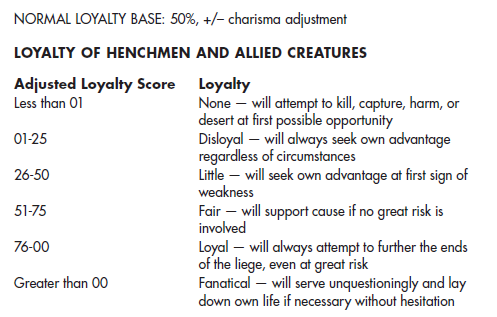
This section finishes with an entire page of modifiers to henchmen loyalty, obedience and morale. Each individual entry is interesting - I specially like the idea, for example, that while most creatures prefer to follow lieges of similar alignment, chaotic creatures make bad leaders and followers in general. However, keeping track of all these things looks like a nightmare. I prefer the much simpler 2d6 checks of B/X. Anyway, here is a good summary:


What have we learned today?
 
Once again - "lots of cool tables, but everything seems a bit unnecessarily complex, sometimes redundant". We have gems that we can use as written if you want that kind of detail, various troops for mass combat games, and two potential new classes waiting for a B/X adaptation: the commander and the sage.

Coming next... TIME! SPELLS! (prepare yourself: part IV is my favorite part of the DMG so far!)

Contains affiliate links. By purchasing stuff through affiliate links you're helping to support this blog.

Additional reading (on alignment):

Monday, June 05, 2023

AD&D weapon SPEED and ARMOR PIERCING made EASY!


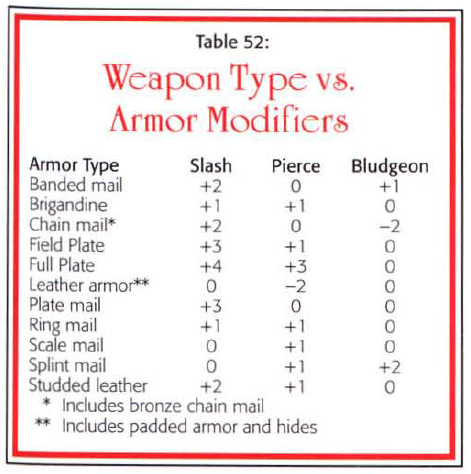
The "weapon versus armor" table (page 37) is probably one of the least used in the PHB, as we've seen. However, it contains some cool ideas. Basically, it makes weapons more distinct and more balanced. And, well, much cooler. 

Notice that the table contains not only "weapon versus armor", but also length, space required and speed factor. The first two are probably ignored as often as weapon versus armor, but are quite simple and easy to understand. Speed factor, however, is intertwined with the cryptic AD&D initiative rules. It ultimately means that you can attack first and more often with a fast weapon (the lower the speed factor, the quicker the weapon). 

Finally, certain weapons can dismount and disarm, and weapons deal differnte damge agasint large opponents. We will leave that for another time.

Could we use this information for something cool in our B/X games? Or at least try to reduce it to B/X levels of complexity? 

I think we can! 

First, take a look at the table. I added color, an "average" column for the weapon versus armor values, and repeated the speed column by its side to show something that should be more or less obvious: speed in inversely proportional to to-hit bonuses (the blue/red colors almost never match in these columns). This means heavier/slower weapons hit more often, even if they attack less often. 


Here's the same table with some outliers eliminated (fists, staves, clubs, an whatever the awl pike is) to increase contrast.


Now speed is reduced to 1-10 and to-hit bonuses are reduced to -3 to +3 (but the average for each weapon is just -1 to +2).

I wouldn't want to check a table for every attack, nor use the AD&D initiative system in my games. But what if we only had one single number per weapon, meaning both "speed" and "strength against armor"? They'd need to be inversely proportional. 

Here is my fix: When you roll a natural 20, your deal normal damage and roll again to see if your attack was a brutal hit. This is resolved as a regular attack, but with a bonus equal to your speed factor

Hit or miss, you can now make another attack ("fast hit") against the same target or an adjacent foe, IF the number on the d20 is GREATER than your speed factor, but with no bonus.

In practice, this means someone using a heavy weapon deals double damage on a natural 20 very often, regardless of armor. On the other hand, quick weapons often get another attack - which is particularly deadly if you are unarmored.

Example: Aleena gets a natural 20 using a mace (SF 6). She rolls again with a +6 bonus (which makes a huge difference against heavy armor), potentially damaging the original target even further. AND she gets a second attack if her roll is higher than 6. 

Example 2: a lowly bandit attacks a knight in plate (AC 3) with a dagger. He gets a natural 20, and can roll again (with a +2 bonus), and very likely attack again (no bonus). Still, his chances of hitting are very low. Had the target been unarmored, he would have a decent chance of doubling or tripling the original damage. 

I do not mean necessarily that I would use AD&D numbers - I should probably come up with my own and maybe even create some exceptions. But the procedure looks sound, it seems to achieve what I intended: 

- Weapons are distinct in both "speed" and "strength against armor". 
- Every weapon can potentially have its own niche. 
- A single digit is added to weapon stats. 
- Even that single digit can be safely ignored 95% of the time. 
- You can assign any number to speed factor on the run, not only because the 1-10 skill is intuitive, but also because it is fair (every number has its pros and cons).
- You can easily fit this in the Dark Fantasy Basic scheme of t/s/m/l/g weapons, by assigning SF 2/4/6/8/10 (plus one or minus one for maces, spears, etc.).
- Crits are meaningful, but not enough to be "too deadly". Doubling damage is rare if you're wearing armor, tripling it very unlikely - and memorable!

Now let's see some numbers.
 

Table 1 calculates the chances of a brutal hit (we NEED to do something cool with those cases that beat 100%, of course - they should probably cleave or carry over somehow).

Table 2 calculates the chances of a quick hit (THAC0 19 means you usually hit 20% of the time against AC 2; SF 1 means you get a second attack 95% of the time, multiply both to get 19%, etc.).

Table 3 is just the sum of both tables. It illustrates that, while slower weapons are better overall, the difference is much more significant with low AC - AND low AC affects fast weapons much more. Exactly as we wanted!

I love these tables - they remind me of FASERIP/Tagmar. But here, they are just illustrations - you do not need to look at any tables to play the game, just a single number per weapon!

So, the dagger (SF 2) has about 30% of a brutal hit against AC 2, AND a 14% chance of landing a fast hit. The chance of triple damage (assuming a new attack against the same target) is very low (I think less than 5%, but it isn`t easy to calculate, since a successful roll increases both chances). But against AC 10 the chances are 70% for a brutal hit and 52% for a fast hit.

A two-handed sword has 70% chance of a brutal hit against AC 2, plus a 8% chance of  fast hit. Against unarmored foes, a brutal hit is certain, and a fast hit happens 30% of the time.

The chance of dealing triple damage against unarmored foes is similar for both weapons.

The exact numbers are not most the important part, of course. We are here for the FUN: swinging a huge weapon that crushes your enemies even inside armor, or stabbing your unarmored foes repeatedly with a dagger.

Of course I want these to be multipurpose mechanics. You can use the same number for all kinds of things - initiative, backstabbing, maybe weapon size/length ("weapon size" sounds better than "speed factor" BTW - or maybe "leverage"?), etc. 

But this is fine tuning - for now, I'm very happy with the general idea.

In the next post about this subject, I'll try to give you a table that is ready to use with B/X...

Saturday, June 03, 2023

Weapon versus armor - from AD&D to B/X

As you might know, I'm into B/X (using my own clone, and also frequently using modules from other basic systems), but I have been reading lots of AD&D lately.

In the last few days, I've been looking at the weapon versus armor table in AD&D. 

Now, according to Delta's blog, the weapon versus armor table in AD&D contains mathematical/revision errors. It is a simple "lost in translation" mistake. I've heard some good arguments saying that there is no error (i.e., the revision was done on purpose). But I think he makes a good point. Go read it and decide for yourself.

In any case, I also think there's cool stuff to learn from both chainmail and AD&D. And this is what matters to me. 

[BTW, Delta - one of the best old school D&D bloggers out there IMO - has done all the hard work putting this stuff on a sheet. I'm only playing with the numbers, and literally adding some color. Any mistakes you find below are probably mine, however - please let me know in the comments].

In chainmail, to hit someone in plate and shield (AC 2 in AD&D) with a dagger, you'd need to roll 12 using 2d6, for example. A 2h-sword would only require 7.  I added and "average" column to compare the overall effectiveness of each weapon.

Notice that green/blue means good (chances of hitting), red means bad. The spear is a "bad" weapon against armor on average.


If you calculate the chances of hitting with 2d6, you'll find that rolling 12 happens about 3% of the time - while rolling 7 or more happens about 60% of the time. 

This means the 2h-sword is TWENTY TIMES better than the dagger against plate and shield - but if your target is unarmored, they are nearly identical! 

Likewise, the mace is about FIVE TIMES better than a regular sword against AC 2, but the sword is a bit better against unarmored foes.

Notice that all weapons deal the same damage in Chainmail.

Now, let's check the Greyhawk table. It might contain a "translation error", but this doesn't matter for our purposes. There is no perfect way to convert from Chainmail to D&D, for various reasons. What we are doing here is looking at certain tendencies and making generalizations (e.g., "maces are good at defeating heavy armor, daggers are terrible for that unless the target is prone").


These tables show that:

- Almost all weapons are good against unarmored and bad against plate and shield; i.e., armor is even more important than AC would indicate (on average, there is a 10-point spread between AC 9 and AC 2).

- On the other hand, most modifiers are positive, which means you're hitting more often against anything but plate. 

-  The biggest difference is against low ACs. In practice (because THAC0 and statistics), this means choosing the right weapon could double or triple your damage against heavy armor, but barely matters  (damage output raised by less than 20%) against unarmored foes.

- Heavy and unbalanced weapons are good against heavy armor, and just better overall.

As you can see this solves a number of issues with B/X weapons, for example. The sword stops being simply the best weapon (1d8 damage), and faces some difficulty against heavy armor. The spear is in a similar situation (long, good against charges, but bad against armor). Big weapons, such as the lance and 2H sword get a well-deserved boost. The hand axe is no longer simply cheaper and better than the mace.

In addition, it makes wearing armor more relevant. This is also a much deserved boost to plate armor, which is heavy and restrictive. Plate gives you great protection against a sword or dagger, maybe making you invulnerable (unless you're prone - see below!).  

While this is much simpler and a bit more sensible than the AD&D table, it is still a bit fiddly for my tastes. Of course to see the whole picture, we'd have to consider speed factor and space required - which is much worse. And we'd also need to consider variable weapon damage, a popular rule in B/X and basically every version of D&D.

But maybe we can extrapolate some cool ideas from here? 

Let's see... 

The easiest way of simplifying this is just giving a bonus to hit to certain weapons (from 0 to +2 ti avoid negatives). Instead of calculating it, we should judge on a case by case basis.

Or we could get more detailed.

Light, balanced weapons (dagger, hand axe, spear, short sword, club) have a hard time against heavy armor. Let's say, -1 to hit against chainmail (AC 5[14]) or better (but see "daggers and penalties", below).

[Wouldn't it be nice if these lighter weapons gave you a small bonus when backstabbing? Now, the thief can still backstab with a heavy weapon, it is just not optimal. And Chainmail also gives pointy weapons a bonus against prone targets in armor. Neat!].

Heavy/unbalanced weapons (two-handed, with the "slow" tag) are more likely to cause damage: +1 regardless of armor.

I used to ignore the "slow" tag, but maybe give it a -1 to initiative puts things back in the right place.

Everything else is unchanged. I'm not particular fond of "small bonus against medium armor" that some weapons get, and I don't quite agree with some of the conclusions (e.g., why is a 2H sword so much better than a lance against armored opponents?).

This is a radical simplification, that brings me back to an old idea of having a few weapon traits: brutal/unbalanced, fast/balanced, and everything else.

Now, I have so many small problems with D&D weapons that if I were to recreate the list (again) I'd probably start from scratch (or from 5e - at least the weights make sense). But it is fun to see that the original system makes a lot more sense once you actually take the time to understand it - which includes understanding what AD&D got wrong.

Come to think of it, rewriting the entire thing is doable. Not sure if it is worth the effort. Let me know in the comments.

---

Notes.

The 1e table
While using the 1e table fixes some B/X weapon problems, it creates issues of its own. A 2H-sword is better against AC 8 than AC 10 (i.e., the unarmored target is more protected!). Same happens occasionally for shields (i.e., having a shield HURTS YOU against a mace).

This is - assuming you're only using a few armor types. Because if you're using all the armor types available, the table becomes impractical, as "AC 5" means different things (sometimes you'll have AC 5 with a shield, sometimes without) - but should ALWAYS protect you more than AC 6, for example.

Still, it is a good place to start.


The 2e table
I feel I should mention the 2e table, which is simpler and more manageable, but still not ideal to me. 


Maybe there's some merit to the idea of separating damage types, but I think we would still have to consider weight/balance to differentiate spears from picks/warhammers, and axes from swords. Maybe add chop (axe) and thrust or impale (spear)?

Looking at this from the armor side - rather than the weapon side - also simplifies things a bit.

Daggers and penalties

I'm a bit unsure of giving any penalties at all. Daggers are already weaker than most weapons because they do 1d4 damage. And, while a dagger should indeed be ten times less effective against plate in a battlefield, players want to use daggers and look cool. 

The sword, on the other hand, gets 1d8 damage. But it is an iconic weapon that I wouldn't like nerfing.

Penalties in general are just bad - they will discourage you from picking a weapon, and could even make hitting an enemy impossible. Players will not care for them in my occasionally "forget" them.

Maybe giving a boost to weaker weapons (such as the mace) is enough.

The "armor bonus" trait

B/X ranged weapons have three ranges: short (+1 to hit), medium (0), and long (-1 to hit). OSE uses this notation: "Missile (5’–10’ / 11’–20’ / 21’–30’)"

Could we do the same with armor for some weapons? E.g. Dagger, "Armor bonus (9/7/5)", meaning +1 against AC 8 and 9, and -1 against AC 5 or better. Seems easy enough if we add it only to a few weapons, but too fiddly if applied across the board. 

I prefer one of the generalizations suggested above.

Monsters and high-level play

One problem of giving weapon bonuses against heavy armor is that powerful monsters will have good armor very often. Should high level heroes ALWAYS carry heavy weapons, since they are expected to face tough monsters?

This problem is not as big as it seems. High level PCs will hit a lot more often against heavy armor anyway, making the difference less relevant. In old school D&D, there are still powerful monsters with not-that-great AC. And finally, one important aspect of making things balanced, I think, is not only throwing powerful monsters at the PCs, but letting them eventually face hordes of minions - which is fun and genre appropriate. 

Still, if you're fighting a dragon, you'd better bring a big sword!

Critical hits

I still think Critical Hits are the best way to deal with these differences. You can just ignore all little details until you roll a natural 20, and then your mace smashes the enemy, despite being worse than the sword most of the time. And everyone loves crits!

I feel Critical Hits are on of those ideas that Gygax didn't include in AD&D because it was too fiddly or "realistic", but in reality could make the game a bit SIMPLER

But let's leave that to another post. I think I could balance all weapons using only critical hits. (We don't need to make them perfectly balance, but we should find at least ONE USE for each weapon). AND maybe I can make speed factor easy. Wouldn't this be cool?

Minimalist OSR + Manual of Arms

All these ideas are being progressively incorporated in my minimalist OSR game, which you can get for free here. All feedback is welcome!

I'm also considering adapting my Manual of Arms books to OSR rules - including weapon versus armor. Let's see how this goes.

Additional reading:

Thursday, June 01, 2023

d100 skills for B/X and AD&D

One thing that drives me crazy about old school D&D is how random skills checks are - to the point of the same character having two different methods of making the same check (e.g., B/X Halflings having 90% chance when hiding in the wild and 2-in-6 elsewhere).

Lamentations just uses 1d6 for most checks, while Dark Fantasy Basic uses only the d20. Labyrinth Lord uses the d100 for all thief skills, but other methods for other checks. 

I like the d100 - could we use that for everything?

Let's try to convert existing checks to a d100... while keeping vaguely similar chances.


Ability checks - just use 5% per point for ordinary tasks. Strength 12 means you succeed 60% of the time. Multiply the stat by a different number if the task is too hard or too easy. For example:
- 1% for the nearly impossible (e.g., bend bars, identify potions and magical items without trying them).
- 2% when the game says you have a 1-in-6 chance (should be 1.5% but let's keep it simple).
- 3% when the game says you have a 2-in-6 chance.

Saving throws - 20% plus a level bonus. You can use 5% for everyone but 3/4/5 (or 2/3/4 in B/X) for mages/others/fighters is even better. Demihumans add 20% or something.

Thief skills - 2% per ability point for everyone, but thieves also add 5% per level. 

Turn Undead - 50%, plus 10% per cleric level, minus 10% per undead HD. 

Attacking - 3/4/5 per level for mages/others/fighters (or 2/3/4), plus 1% per point of Str (melee) or Dex (ranged). Armor reduces this by 5% per point of armor (10% for leather, 20% for chain, etc.).

Open doors - use ability checks (Str). 

Reaction rolls - use ability checks (Cha) to change reaction by one step. Cha no longer affects reaction rolls

Survive Resurrection/ Raise Dead/System Shock - 20% plus 5% per point of Con.

Magic - Int/Wis check (1%), plus 5% per mage level (3% for clerics, etc.). You need at least 10% to cast 1st-level spells, 20% for second-level, etc.

But why?

There are certain things we can do with a d100 that are harder to do with a d20.

- A "35% chance" or similar is always very intuitive to anyone.

- Critical hits and fumbles when you roll doubles (11, 22, 33, etc.). If a thief fails to disarm a trap, he only gets hurt 10% of the time. Likewise for climbing and falling, etc. In combat, a critical hit can either double damage, ignore armor, give you a free attack, or something else.

- Ability scores: each point matters! I love that!

- An easy solution (1%) for very hard tasks.

- Great granularity, you can play endlessly with 1% increments. You could even add 1% per level to ALL adventuring checks that are normally unaffected by levels, as PCs should get better at not getting lost, etc.

Would I use this?

Not really - it is still too fiddly for my tastes. Unless you use a spreadsheet to calculate these things automatically. Maybe it could work with a bit more streamlining... Maybe letting PCs assign a number of points to combat, skills and magic (and HP) per level... But we already have Runequest (or Mythras) for that. 

These are fine systems, BTW. But I guess I'm sticking with the d20 (and my minimalist OSR game) for now.

Additional reading:

Monday, May 29, 2023

Knights of Dark Renown (book review)

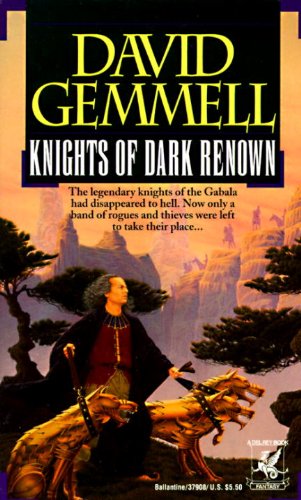
I've read Knights of Dark Renown by David Gemmell because of a recommendation from my friend Jens, after reading The Blade Itself - which we both disliked. 

This is the Amazon summary:
Once the legendary knights of the Gabala defended the nine duchies. [...] But they were gone, disappeared through a demon-haunted gateway between worlds. Only one held back [..]. Now he was the coward knight, and in torment. 
Murder and black magic beset the land. Rumors circulated that the king was enchanted, changed, that his soul was dead . . . and that a reign of terror was about to begin. Now Manannan realized he would have to face his darkest fears: he had no choice but to ride through that dreaded gate and seek out his vanished companions.
There is a lot more to the book than this, however - I won't get into it to avoid spoilers. I'll just say that this book is well worth the read. 

It succeeds in basically every criteria we usually mention here: it is good fantasy (has plenty of monsters, spells and ideas for your games), it is good dark fantasy (with tragedy, mature themes, dark humor, bloody twists, hard choices, loss, downfall, flawed heroes, cool villain monologues and shades of gray) and also good epic fantasy (with well-constructed heroism and hope).


To mention a few ideas I particularly liked:

- How the idea of "colors of magic" are treated. This is an evocative, coherent magic system. I could see it influencing Magic: The Gathering (and certainly my games). Also, it has a very interesting take on magic items, which require not only special efforts but also special materials. 
- One of the best portrayals of a bard that I've read in fantasy, mostly because he has an important role to play instead of being a comic relief.
- How the "gateways to hell" are treated, somewhat reminiscent of The Elder Scrolls IV: Oblivion. The whole "hell dimension" part is really interesting.
- Monsters that appear out of their natural habitat, creating a contrast between fantasy and realism.
- In addition to bards, the book has cool rangers/outlaws, awesome knights, paladins... and anti-paladins.

Other than that, the book is enjoyable for all the usual reasons: the characters are interesting, the plot is engaging, the setting is good. The action scenes are short and sweet, not particularly gritty or awesome. The characters are probably my favorite thing here: while there is no one as mighty and cool as Conan or Elric, everyone feels like real people, with flaws, different qualities and interests, and so on.

The pacing starts great but it gets a bit rushed by the end, similarly to The Broken Sword. In any case, the book never fails to keep you engaged. It has a cinematic quality that would do well in a TV series.

In fact, this book reminds me of The Broken Sword in several ways, although it is a bit less tragic and more heroic. And its quality is just a bit below the savage awesomeness of Poul Anderson's... which, as I've said, is one of the best appendix N I have read.

This book was published in 1989, so it couldn't make it to the Appendix N. Curiously, "Gemmell’s first U.S. editions were handled by New Infinities", owned by Gary Gygax" (source). Gygax once said "I've read one book by David Gemmell and enjoyed it." (source). 

In any case, this is certainly above-average for Appendix N books and fantasy books in general. It is also the start of a big saga, which I might be curious to read next... Let's see! 

Wednesday, May 24, 2023

All elves are half-elves

(A  brief detour from my DMG series, related to the most recent post; might be a good idea to do these from time to time).

I've heard that the next edition of D&D (6e, D&Done, or whatever) is banning "half" characters: no half-elves, half-orcs, etc. I will not discuss their motives (nor do I trust WotC enough to care about what motives they claim). This is not a big concern for me because I'm no longer playing WotC D&D. I'm playing my own games and running my own campaigns the way I like them.

However, I want to share a quick thought... or two.

Copyright WotC. Notice elf/gnome wizard, dwarf/orc warrior.

First, it's worth mentioning that the original D&D (1974) suggests that you could start the game as a low-level Balrog or dragon. On the other hand, elves and dwarves do not have infravision*, and even monsters lose it as they join the party:
In the underworld some light source or an infravision spell must be used. Torches, lanterns and magic swords will illuminate the way, but they also allow monsters to “see” the users so that monsters will never be surprised unless coming through a door. Also, torches can be blown out by a strong gust of wind. Monsters are assumed to have permanent infravision as long as they are not serving some character. 
- The Underworld & Wilderness Adventures, pg. 9. 
* They do on Supplement I and Chainmail; could be an oversight.

AD&D keeps infravision (and adds half-elves, half-orcs) but, as mentioned in a previous post, says this on "monstrous" PCs: 
The game features humankind for a reason. It is the most logical basis in an illogical game. From a design aspect it provides the sound groundwork. From a standpoint of creating the campaign milieu it provides the most readily usable assumptions. From a participation approach it is the only method, for all players are, after all is said and done, human, and it allows them the role with which most are most desirous and capable of identifying with. From all views then it is enough fantasy to assume a swords & sorcery cosmos, with impossible professions and make-believe magic. To adventure amongst the weird is fantasy enough without becoming that too!
For me, having monstrous PCs is a matter of taste and setting. But, in this matter, it is very hard to keep your cake and eat it too.

Having PCs with infravisions partly ruins the "light source mini-game", where PCs have to keep track of torches, monsters are hardly surprised, etc.

In a similar manner, having PC elves and dwarves robs these beings of some of their mystery (and weirdness). Same goes for orcs, ogres, minotaurs, and so on.

In this sense, I think all elves are "half-elves", as they are part human and part the fey elf of legend. Few people play elves as the dangerous, selfish beings of Poul Anderson or the semi-divine beings from Tolkien.

[Maybe you could have these watered down PC elves and also keep "authentic" elves and call the Sidhe or whatever. Other solution are changelings/foster children, etc. Humans raised by elves or vice-versa, so PCs can never fully grasp the mystery of elves]. 

The same pattern is observed in dragonborn (half-dragons), tielflings (half-fiend), warforged (half-machine), genasi (half-elements), centaur/werewolf/shifters/tabaxi/kenku/etc. (half-beast), aasimar/deva (half-celestial),  dhampirs/revenants (half-undead), and so on. They all stand halfway between human and something else

Even more: they are CLOSER to human than to something else, having rational thoughts, human desires and free will.

[Dwarves and Halflings are even more obvious, often being portrayed as caricatures of scots and merry Englishmen].

It might be possible to have, say, wolf PCs (actual wolves, not intelligent ones), but this is not common at all - and I think few players could pull it off. Gygax is right in saying "humans are the role with which most are [...] capable of identifying with".

So, "half elves", IMO, could be a decent compromise in a game that doesn't allow elf PCs. So, you could have some elven traits, but keep elves as a whole a bit alien and mysterious. Although I don't think I've ever heard of such a game. 

Elves became so familiar that they are now all half-elves. Orcs follow a similar trend. Once they stop being archetypal demonic (or piglike) creatures and become simply green-skinned humanoids (with an actual humanlike civilization), there is no further need for half-orcs. Or, worse, they might have NO specific civilization and customs: they can become paladins, mages, etc, exactly like humans. At this point, they ARE humans except for appearance and some vague generalizations (and even that is disappearing).

(This could be a motive for using race-as-class, BTW, if you want to keep races distinct).

In practice, I err on the side of letting my PCs choose whatever character type they want (and treat it as cosplay, playing them like humans). But I can feel that this detracts from my games (here is one example) unless I'm playing in a highly cosmopolitan setting (e.g., Ravnica). I might as well go all-human (maybe allowing "elf blood etc.") or all-weird (everything goes but nothing stands out in the crowd) in my future games, since it tends to work better in my experience.

(BTW, this is why Dark Fantasy Basic is human-only but a future version might have more races for my players, as exemplified here).

And, come to think of it, I can't recall a good fantasy book where non-human characters are treated as humans in costumes (except maybe some parts of Tolkien). The ancestry of non-humans (or "different humans") is always important, even if they go against it: think of Tanis, Drizzt, Hellboy, and even Elric, Geralt and Daenerys Targaryen.

I do understand, however, if elves and dwarves are so familiar to you that you want to allow them (and half-elves, etc.) while prohibiting tieflings, for example - as Gygax seems to suggest. D&D's elves, dwarves and especially Halflings are so human-like that allowing only these types of PCs is almost as natural as running a human-only campaign. And I can definitely see how having serpent-folk PCs ruins serpent-folk, or tieflings partly ruins fiends, for example.

Just something to keep in mind. In the end, it is your campaign; do what serves you best.

Recommended reading:

On infravision:

Monday, May 22, 2023

AD&D DMG cover to cover - Part II, pages 9-22

We are reading the original DMG - the ultimate DM book - but from a B/X and OSR point-of-view. Check the other parts of this series here

Today we will tackle:
THE GAME 9
— APPROACHES TO PLAYING ADVANCED DUNGEONS & DRAGONS 9
— DICE 9
— USE OF MINIATURE FIGURES 10
— AIDS TO PLAYING ADVANCED DUNGEONS & DRAGONS 11
CREATING THE PLAYER CHARACTER 11
— GENERATION OF ABILITY SCORES 11
— NON-PLAYER CHARACTERS 11
— THE EFFECT OF WISHES ON CHARACTER ABILITY SCORES 11
— CHARACTERISTICS FOR PLAYER CHARACTERS 11
— PLAYER CHARACTER NON-PROFESSIONAL SKILLS 12
— STARTING LEVEL OF EXPERIENCE FOR PLAYER CHARACTERS 12
CHARACTER AGE, AGING, DISEASE, AND DEATH 12
— CHARACTER AGE 12
— AGING 13
— Unnatural Aging 13
— DISEASE 13
— DEATH 15
CHARACTER ABILITIES 15
— EXPLANATION OF ABILITIES 15
CHARACTER RACES 15
— PLAYER CHARACTER RACIAL TENDENCIES 15
CHARACTER CLASSES 16
— FOLLOWERS FOR UPPER LEVEL PLAYER CHARACTERS 16
— The Paladin’s Warhorse 18
— SPYING 18
— THIEF ABILITIES 19
— THIEVES AND ASSASSINS SETTING TRAPS 20
— ASSASSINATION EXPERIENCE POINTS 20
— ASSASSINS’ USE OF POISON 20
— THE MONSTER AS A PLAYER CHARACTER 21
— LYCANTHROPY 22

The game

First, we get a small paragraph repeating what we have heard before: D&D is about fun, not "realism" or "simulation". Sounds obvious, but it is valuable advice if you are coming from wargames - as they did at the time.

Next, we get a section explaining dice. Again, this looks obvious now, but it was necessary back in 1979, since the stranger dice types (including the iconic d20) were a lot less common. One interesting things is that it teaches you what a bell curve is - I find this knowledge to be essential to DMs (and, well, to everyone) and sorely lacking in modern DMGs.

In the end of this part, we get an interesting alternative for the habitual reaction rolls, and a good conclusion on dice in general. I'll reproduce it here (as a curiosity), but TBH I won't try it in my games, since it requires special dice and a lot of rolling and thought for something that can easily be resolved with 2d6.

Unfortunately, this is apparently something common in the book: we get decent advice mixed with unrefined, convoluted, in unnecessarily complex systems. 
The author has a d6 with the following faces: SPADE, CLUB, CLUB, DIAMOND, DIAMOND, HEART. If, during an encounter, players meet a character whose reaction is uncertain, the card suit die is rolled in conjunction with 3d6. Black suits mean dislike, with the SPADE equalling hate, while red equals like, the HEART being great favor. The 3d6 give a bell-shaped probability curve of 3-18, with 9-12 being the mean spread. SPADE 18 means absolute and unchangeable hate, while HEART 18 indicates the opposite. CLUBS or DIAMONDS can be altered by discourse, rewards, etc. Thus, CLUBS 12 could possibly be altered to CLUBS 3 by offer of a tribute or favor, CLUBS 3 changed to DIAMONDS 3 by a gift, etc.

In closing this discussion, simply keep in mind that the dice are your tools. Learn to use them properly and they will serve you well.
The sections on miniatures and playing aids (sheets, etc.)  are not especially relevant or useful nowadays, since most of it has gone digital.

Creating the PCs

As AD&D is an ongoing game of fantasy adventuring, it is important to allow
participants to generate a viable character of the race and profession which he
or she desires. While it is possible to generate some fairly playable characters
by rolling 3d6, there is often an extended period of attempts at finding a
suitable one due to quirks of the dice. Furthermore, these rather marginal
characters tend to have short life expectancy — which tends to discourage new
players, as does having to make do with some character of a race and/or class
which he or she really can’t or won’t identify with. Character generation, then,
is a serious matter, and it is recommended that the following systems be used.
Four alternatives are offered for player characters: [...]

Coming from a BX/OSR view, this is strange advice, as many are used to roll 3d6 in order and play with what they get.  In practice, however, I agree with Gygax - why not let players get the class/race they want? Most players will create the same kind of PCs over and over again (in my experience), but they are having fun, so be it. 

So, instead of the usual 3d6 in order, we get FOUR different methods of generating PCs, the most famous being "roll4d6, drop lowest. That's a lot of redundancy and needless dice rolling, and generates very high ability scores. I might choose a less benevolent method for my own games, however: maybe assign 14, 12, 11, 10, 9, 7, or roll 3d6 seven times and assign to taste. Even better, just roll 3d20.

NPCs, wishes, Characteristics for PCs

NPCs have their own methods of generating ability scores. I find this unnecessary. Wishes can augment ability scores, but after 16 they only improve by one decimal point per wish. Okay. PCs shouldn't have (random) NPC characteristics (e.g., personality - the table is actually on page 100) forced upon them, as they should play the PCs as they see fit. Except for weight and height somehow.  Okay.

Player Character non-professional skills

Now, we get something useful. PCs are defined by their class "virtually to the exclusion of all other activities", but might have some past experience determined randomly. This is nice as it replaces many skills and backgrounds in modern games. It can be ported directly to B/X, and a similar system is used in modern games such as Shadow of the Demon Lord and my own Dark Fantasy Basic (both with a bit more specific advice on how to use these backgrounds mechanically). Just roll 1d100 and check the table below:

When secondary skills are used, it is up to the DM to create and/or adjudicate situations in which these skills are used or useful to the player character. As a general rule, having a skill will give the character the ability to determine the general worth and soundness of an item, the ability to find food, make small repairs, or actually construct (crude) items. For example, an individual with armorer skill could tell the quality of normal armor, repair chain links, or perhaps fashion certain weapons.

Starting level of experience for player characters

Some advice on dealing with PCs of different levels, and also players of different levels of experience. All very vague and nothing particularly useful except for the advice of running separate high level and low level campaigns, so that new players can have a taste of high level if they want.

CHARACTER AGE, AGING, DISEASE, AND DEATH

This section has several detailed tables on starting age, aging, disease, death and resurrection. As such, they can be used in B/X as written. While I'm not particularly interested in checking monthly to see if the PCs suffer from parasites or mild ear disease, I can see the point if you're running a particularly extended and realistic campaign. But fun trumps realism, remember? Which is why we don't get realistic combat or even critical hits (IIRC). Instead, we have urinary system infection.

A sword to the head without a helmet is in the rules, but this won't cost you an eye or ear. Disease might. I'm not even sure there are rules for PCs that have lost an eye or part of their hearing. Guess we will see later on (let me know in the comments, or remind me to edit this post in a few months!). In short, these rules are interesting, but half-baked at best.

CHARACTER ABILITIES, RACES

An explanation on what abilities (Strength, Dexterity, etc.) mean and how they function, followed by a section explaining dwarves, elves, etc. Mildly useful if you still want to understand the difference between Wisdom and Intelligence ("while the intelligent character will know that smoking is harmful to him, he may well lack the wisdom to stop"). The race descriptions are pretty standard.

CHARACTER CLASSES

Frist, we get lots of random tables for followers the PCs can get when they reach high levels. These are organized as troops, presumably for domain management and mass battles. Rangers get special creatures, including, potentially, a copper dragon or storm giant. The paladin's special warhorse is also described here.

Then we have rules for spying. Especially for NPC spies (assassins). No idea why this is in the PC section, but it is useful to gather information.

Thief skills are next. Back Stabbing does not function against creatures with no discernible backs. Opening locks, finding traps, disarming traps take 1-4 rounds each. Useful information. Slippery walls can be added to make climbing harder for the thief. "Slightly slippery is the norm for some reason, which DOUBLES the chance of failure. Sounds like a bad choice and a needles nerf on the thief.

OTOH, we learn that thieves and assassins can set traps. Assassins also learn to concoct poisons, and this section contains a poison table that is very useful for B/X games, as B/X does not contain a similar tool.

THE MONSTER AS A PLAYER CHARACTER is included in character CLASSES for some reason. Here, the author insists in the “humanocentric” tone of AD&D, discouraging PCs that want to de dragons, demons, devils, etc. This is contrary to OD&Ds suggestion that you could start the game as a low-level Balrog or dragon (and seems to contradict the advice we've read a few pages ago that players should be able to pick race, class, and personality as desired). I think each method has its own pros and cons, which deserve a post of its own (this one!). Suffice to say, this is general advice and could be useful for any RPG. I'll highlight this bit (emphasis mine):
The game features humankind for a reason. It is the most logical basis in an illogical game. From a design aspect it provides the sound groundwork. From a standpoint of creating the campaign milieu it provides the most readily usable assumptions. From a participation approach it is the only method, for all players are, after all is said and done, human, and it allows them the role with which most are most desirous and capable of identifying with. From all views then it is enough fantasy to assume a swords & sorcery cosmos, with impossible professions and make-believe magic. To adventure amongst the weird is fantasy enough without becoming that too!
Next, we get advice discouraging PCs to become lycanthropes, very much in the same vein, but more detailed. Apparently, these are allowed, with lots of downsides. Nothing particularly useful for my games here. Well, enough for today.

What have we learned today?
 
Lots of cool tables, but everything seems a bit unnecessarily complex, sometimes redundant. Some philosophical essays that are worth a read, and at least two subsystems that are easy and fun to use in B/X games: secondary skills and poisons. The spying section is equally useful, since B/X does not have an assassin class but does have spies you can hire, with no rules except for some very vague guidelines.


Contains affiliate links. By purchasing stuff through affiliate links you're helping to support this blog.